
Buyer Guide
Ready-Stock vs Custom-Made Hijabs for New Brands
Direct answer
Ready stock vs custom hijabs is a choice between two sourcing models, not a contest with one universal winner. Ready-stock hijabs can help a new brand launch faster and test demand with fewer development steps. Custom-made production can provide greater control over fabric, color, dimensions, branding and packaging. The better route depends on launch speed, budget, MOQ, differentiation, inventory risk and long-term product strategy. New buyers should compare the complete specification and landed cost, approve samples in either model and document how successful products will be reordered.
What Are Ready-Stock Hijabs?
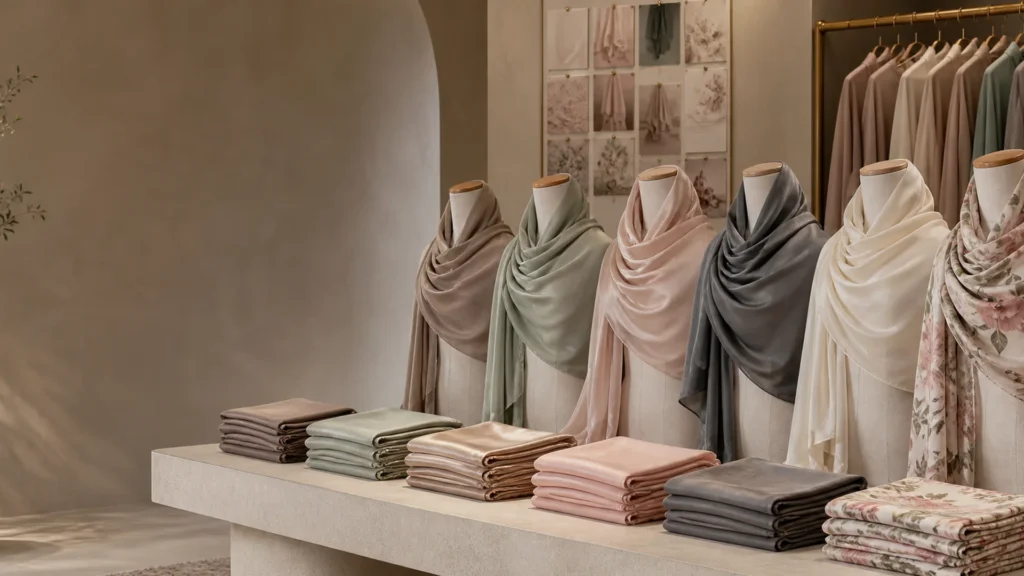
Ready-stock hijabs are products that have already been produced or are available within an existing supply programme. Buyers usually select from current styles, colors and specifications rather than developing every feature from the beginning.
This model may reduce development steps and shorten the route from selection to launch. It does not mean that every supplier offers the same order quantity, color availability, branding or packaging. “Ready stock” should also not be interpreted as a permanent guarantee that the same item will always remain available.
The trade-off is control. A buyer may be able to choose among available options, but the underlying fabric, dimensions or finish may already be fixed. Ask for the current specification, actual availability, sample and reorder terms before building a launch plan around a catalogue item.
What Are Custom-Made Hijabs?
Custom-made hijabs are developed against a buyer’s approved brief rather than selected only from an existing finished specification. Depending on the project and supplier capability, the brief may address fabric, dimensions, colors, printing, logo, labels, packaging, product specifications and sample approval.
Not every custom project needs every option. A brand may keep an established fabric but add a label, or may develop a more distinctive product with several controlled variables. More customization usually creates more decisions, dependencies and approval points.
The guide to private label hijab manufacturing explains how a brief moves through specifications, samples, revisions, bulk production and packaging. This article focuses instead on deciding whether that development route is appropriate in the first place.
Ready Stock vs Custom Hijabs: Quick Comparison
Ready stock generally prioritises speed and lower development complexity; custom production generally prioritises product control and differentiation. Actual terms still depend on the supplier, product and project.
| Factor | Ready stock | Custom made | Buyer consideration |
|---|---|---|---|
| Speed | Product development may already be complete | Requires brief, sampling and approval | How fixed is the launch date? |
| MOQ | May offer a lower entry point for existing items | Varies with fabric, color, print, labels and packaging | Compare quantity by SKU and color |
| Development | Fewer specification decisions | More decisions and revision stages | Does the team have time to manage approvals? |
| Customization | Usually limited to available specifications | Can provide more control where supported | Which features truly create customer value? |
| Differentiation | Similar items may be sold by other retailers | Can create signature product details | Can merchandising alone distinguish the offer? |
| Fabric and color | Choose from current options | May specify and physically approve targets | How important are material and signature shades? |
| Dimensions | Finished specification already exists | May be adjusted where supported | Does the market need a particular format? |
| Labels and packaging | May be limited or added later | Can be integrated during development | What is essential for launch? |
| Sampling | Confirms the actual offered product | Develops and approves the intended product | What exactly does the sample approve? |
| Cost structure | May avoid some development and setup costs | May add sampling, artwork and custom setup | Compare total landed cost, not only unit price |
| Inventory risk | Useful for focused tests, but too many SKUs still create risk | Better brand fit can coexist with high first-order risk | How much untested stock can the business carry? |
| Reorder | Depends on continuing availability | Can use approved records for repeat production | Neither model guarantees permanent availability or zero variation |
| Scalability | Can validate channels and categories quickly | Can create controlled core products | What is the route from test to repeat range? |

Which Option Is Faster to Launch?
Ready stock is generally faster because product development may already be complete. The buyer can focus on selection, sample review, order confirmation and delivery planning rather than creating a new specification.
Custom-made production normally adds specification, sample, revision and approval stages. The schedule depends on material availability, the number of custom variables, the speed of buyer feedback and the supplier’s proposed workflow. This article does not set a NoorSilk lead time for either route.
Work backwards from the required launch date. Include photography, content creation, freight, customs where applicable, receiving and launch preparation—not only the time before goods leave the supplier.
How Does MOQ Differ Between Ready Stock and Custom Production?
Ready stock may have a lower purchasing entry point because the product already exists, while custom MOQ can change with fabric, colors, printing, labels, packaging and setup. Neither statement is universal: suppliers can set different minimums for different products.
Compare MOQ at three levels: total order, product or fabric family, and each color/SKU. A total quantity that looks manageable can become risky when divided among too many slow-moving variants.
Use the dedicated guide to understand hijab MOQ. Ask the supplier to calculate the minimum against the exact brief instead of assuming that “in stock” means no MOQ or that every custom detail shares one minimum.
Which Option Has Lower Inventory Risk?
Ready stock may reduce early development commitment, making it useful for a small market test or limited collection. However, buying too many existing styles, colors or sizes can create the same inventory problem as an oversized custom launch.
Custom production can fit a defined brand more closely, but an untested assortment or large first run may put more cash into slow stock. Greater differentiation does not eliminate demand uncertainty.
Limit the first range to clear product roles and measurable hypotheses. The guide to planning a focused hijab test collection shows how to divide a small illustrative range and use sales evidence before expanding.
Is Ready Stock Always Cheaper?
No. Ready stock may remove certain development, sampling or setup costs, but it is not automatically cheaper at every quantity or specification. Custom quotes may include sample work, artwork, custom color, labels, packaging or smaller production runs; they may also describe a materially different product.
Compare fabric, dimensions, finish, included packaging, inspection basis, freight basis and expected quantity before comparing unit prices. A low unit price can be a poor decision if the product does not fit the customer or cannot be reordered as planned.
The article on wholesale hijab pricing and unit cost explains how product specifications, MOQ, customization and delivery terms change a quotation.
Where Does Custom Production Help Brand Differentiation?
Custom production can give a brand more control over fabric, dimensions, signature colors, printed artwork, labels and packaging where the project supports those choices. This can create product details that are harder to reproduce through catalogue selection alone.
Ready-stock products may be identical or similar to products sold by other retailers. A brand can still differentiate them through photography, styling, curation, customer service, content, bundles and presentation. Custom manufacturing is not the only way to build a brand; it becomes valuable when specific product control is central to the proposition.
Identify the few differences customers can recognise and value. Do not customize every feature simply because it is possible.
How Does Fabric Control Differ?
Ready-stock buyers normally choose among fabrics and specifications that already exist. Custom-made buyers may be able to define composition, weight, texture, opacity, drape and finish more precisely, subject to feasibility and supplier capability.
Material choice affects comfort, styling, photography, care and price position. If the fabric direction is not settled, first compare hijab fabrics. Then approve the selected material physically rather than relying on a fibre name or photograph.

How Does Color Control Differ?
Ready stock normally offers a choice from colors currently available. Custom development may use target shades, Pantone references, physical samples and approval records where relevant to the material and process.
A color name or screen image is not a complete production standard. If signature colors matter, the guide to Pantone color matching for hijabs explains physical approval, lighting, tolerance and reorder records without promising a mathematically exact match across materials or batches.
What Changes With Dimensions and Product Specifications?
A ready-stock item already has a finished specification. A custom project may allow adjustments to dimensions, construction or edge finish where supported, but every additional change expands the development and approval workload.
Record finished length and width, fabric, color, edge, label and packaging in both sourcing models. For ready stock, the document confirms what is being purchased. For custom made, it also controls what is being developed and repeated.
How Do Private Labels, Hang Tags and Packaging Differ?
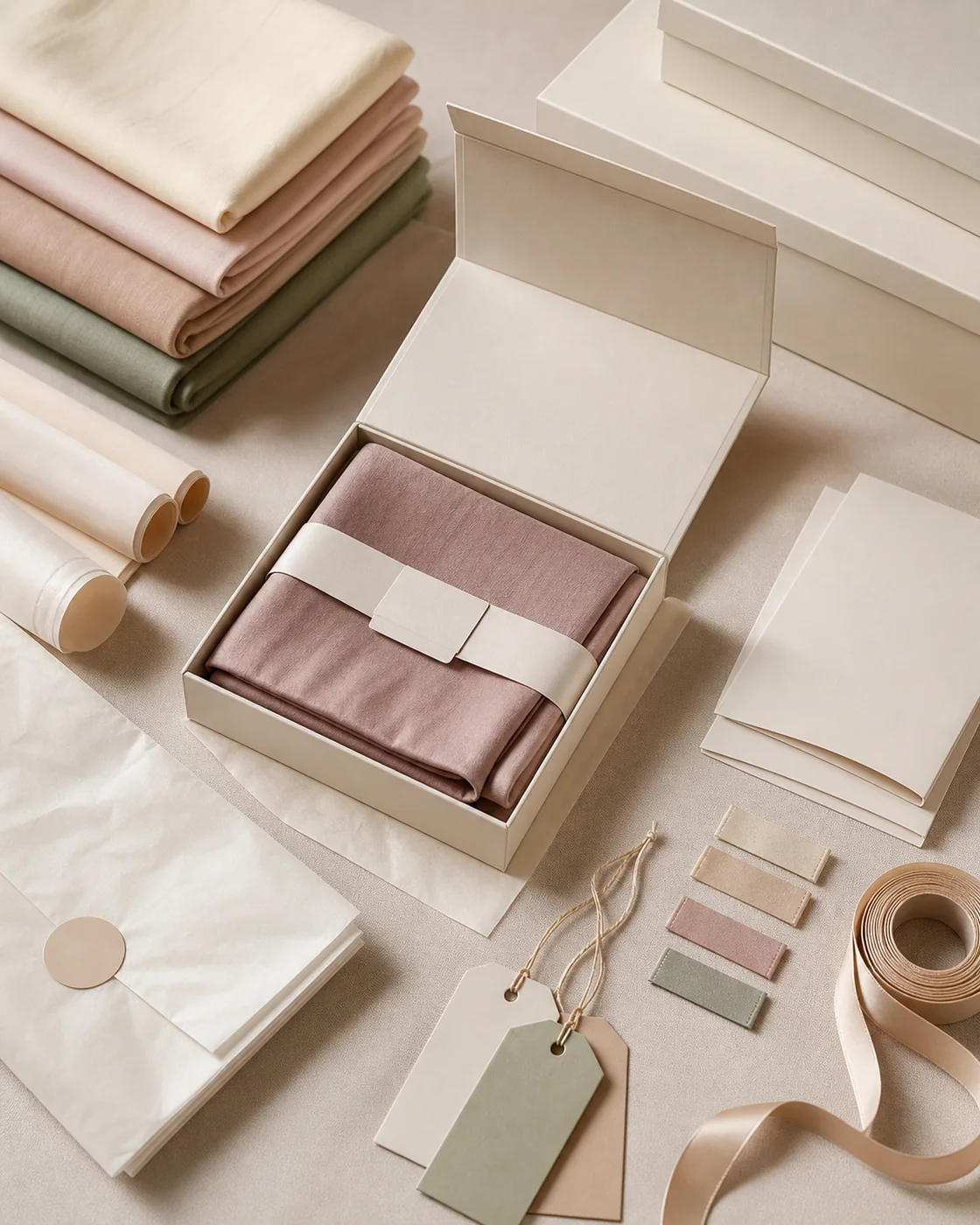
Ready stock may permit limited branding such as an added label or outer package, depending on the supplier and item. Custom production may integrate labels, tags and packaging earlier in product development. Neither model automatically includes every branding method.
Decide which elements are essential for the first customer experience. Heavy investment in elaborate packaging before demand is validated can consume cash that might be needed for product testing, photography or reorders. Confirm material, dimensions, artwork, placement, language and approval for each component.
When Is Ready Stock a Good Choice for a New Hijab Brand?
Ready stock can be useful when the main goal is to validate demand, launch faster, test colors, compare retail channels, learn customer preferences or control early development spending. It works best when existing products already fit the required quality and market position.
Define what the test must teach: preferred fabric, selling price, color response, conversion by channel or reorder demand. If the long-term goal is a highly differentiated range, decide in advance what sales evidence would justify moving winning categories into custom development.
When Is Custom-Made Production a Better Choice?
Custom made may be more appropriate when the brand has a defined product concept and needs a specific fabric, signature color, distinctive dimensions, branded labels, tailored packaging or original printed design. It can also help create repeatable core products around an approved specification.
It is not automatically the right first step for every new brand. The buyer needs enough clarity, budget, time and decision capacity to manage samples and revisions, and enough evidence that the differentiated product serves a real customer need.
Can a Brand Start With Ready Stock and Move to Custom Production Later?
Yes. A staged sourcing strategy can reduce early uncertainty while creating a path toward differentiated products.
- Stage 1 — Test: launch a focused selection of ready-stock or otherwise low-complexity products.
- Stage 2 — Learn: identify the fabrics, colors, price points and channels that perform.
- Stage 3 — Define: convert evidence into a product brief and prioritise meaningful improvements.
- Stage 4 — Develop: sample custom versions and approve specifications, branding and packaging.
- Stage 5 — Scale: build repeatable core products and plan reorders from documented references.
This is a framework, not a fixed requirement. A brand with a proven concept may begin custom; another may continue using carefully selected wholesale products.
What Is a Hybrid Ready-Stock and Custom-Made Strategy?
A hybrid strategy uses both sourcing models in one assortment. Ready stock can fill basic, fast-moving or seasonal gaps, while custom products form the signature core of the brand.
This can preserve flexibility, reduce development risk and keep the assortment fresh. It also increases operational complexity: product codes, specifications, packaging, margins and reorder rules must distinguish stock products from custom ones.
Give every SKU a role. Avoid using ready stock and custom production for near-identical items unless the buyer can explain why both are needed.
How Does Sampling Differ?
A ready-stock sample verifies the actual offered product: fabric, color, dimensions, finish, sewing and included packaging. It should represent the item and lot being considered as closely as the supplier can confirm.
A custom sample also functions as a development and approval tool. It may bring together specifications, color, labels, artwork and packaging, depending on project scope. Comments should be tied to a sample code and revision rather than communicated as disconnected messages.
Sampling is necessary in both models. Ready stock does not make fabric, opacity, handfeel or consistency visible through a catalogue image.
How Do Reorders Differ?
A ready-stock reorder depends on whether the supplier still holds or continues the same item, fabric and colors. Confirm whether the reference is permanent, seasonal or subject to replacement.
Custom reorders can refer back to an approved sample, fabric record, color code, specification sheet and artwork version. Those records make repetition more systematic, but they do not remove material-lot variation, color-batch variation or availability risk.
For both routes, store the exact SKU, supplier reference, sample, order history and any approved changes. Ask how substitutions will be communicated before they occur.
What Quality-Control Differences Matter?
Ready-stock buyers should focus on the consistency and condition of the actual available goods. Compare fabric, shade, dimensions, edges, sewing, defects and packing across representative pieces where appropriate.
Custom buyers must also control the relationship between approved pre-production references, bulk output and final specification. More custom variables create more opportunities for misunderstanding unless ownership and acceptance are documented.
This article does not claim a specific NoorSilk inspection method. Buyers should ask each supplier how samples and bulk goods are compared and what evidence is available for the exact project.
How Should Buyers Compare a Ready-Stock Quote With a Custom Quote?
Compare like with like and include the full cost to receive a saleable product. Unit price alone cannot show whether two offers describe the same fabric, dimensions, branding or delivery basis.
| Factor | Ready-stock quote | Custom quote | What to compare |
|---|---|---|---|
| Fabric | Existing reference and composition | Proposed approved specification | Weight, handfeel, opacity, drape and finish |
| Dimensions | Current finished size | Requested finished size and tolerance | Use the same measurement basis |
| MOQ | Total, SKU and color requirements | Minimums affected by custom variables | Sellable quantity by variant |
| Colors | Available shades | Development and approval route | Number of colors and reorder reference |
| Branding | What can be added to existing goods | Labels, artwork and placement in the brief | Included items and setup |
| Packaging | Standard pack and optional additions | Custom format and approval | Materials, units per pack and artwork |
| Sample | Confirms available item | Develops and approves the new item | Purpose, revision and cost |
| Development | Usually limited | Specification, revision and setup work | Which charges are one-time or repeating? |
| Unit and landed cost | Quoted product plus delivery-related costs | Product, setup and delivery-related costs | Same Incoterm, currency and destination |
| Reorder | Availability and reference continuity | Records, feasible repeat production and changes | Risk, lead planning and substitution policy |
Common Mistakes New Brands Make
- Choosing ready stock only because it seems faster: the product may not fit the target customer.
- Choosing custom production too early: the concept may lack demand evidence.
- Launching too many custom SKUs: quantity fragments across untested variants.
- Assuming ready stock means no MOQ: suppliers can still set order requirements.
- Assuming custom means premium quality: quality depends on specification, execution and control.
- Ignoring product specifications: names and photos are not reproducible standards.
- Skipping ready-stock samples: existing goods still require physical review.
- Overspending on packaging: presentation is funded before product demand is known.
- Comparing prices without specifications: the offers may not be equivalent.
- Having no transition plan: test products never become controlled core products.
Decision Framework: Ready Stock or Custom Made?
Use the business priority to choose a route, then verify that the actual supplier offer supports it.
| Priority | Route to consider | Decision gate |
|---|---|---|
| Fast launch | Ready stock | Are suitable goods actually available and sampled? |
| Low development complexity | Ready stock or simplified branding | Do existing specifications fit the market? |
| Market testing | Focused stock selection or simplified custom test | Can the assortment produce useful sales evidence? |
| Signature fabric, color or dimensions | Custom made | Is the difference valuable enough to justify development? |
| Original printed design | Custom made | Are artwork, print proof and approvals ready? |
| Strong product differentiation | Custom or hybrid | Which features will customers recognise? |
| Flexible assortment | Hybrid | Can the brand manage two supply routes clearly? |
| Repeatable long-term core | Custom specification may become useful | Are sample and reorder records controlled? |
What Should a Buyer Ask Before Choosing?
| Ready-stock questions | Custom-made questions |
|---|---|
| Is the item currently available? | What information is required for the brief? |
| What are its exact specifications? | Which customization is feasible? |
| Which colors and quantities are available? | How is MOQ calculated for product, color and options? |
| Can the same reference be reordered? | What sample and revision process applies? |
| Can branding be added, and at which stage? | How are fabric and colors approved? |
| What packaging is included? | How are specifications, artwork and changes documented? |
| Will substitutions require approval? | What references are retained for reorders? |
Ready-Stock vs Custom-Made Hijab Buyer Checklist
- Define the launch goal and what must be learned.
- Describe the target customer and sales channel.
- Set the available product, development and inventory budget.
- Work backwards from the desired launch date.
- Separate essential customization from optional ideas.
- Confirm fabric, handfeel, opacity and drape needs.
- Confirm stock or custom color requirements.
- Confirm finished dimensions and edges.
- Define labels, artwork and branding.
- Define standard or custom packaging.
- Confirm MOQ by order, product, color and option.
- Confirm what each sample will approve.
- Compare equivalent unit costs.
- Compare landed cost on the same delivery basis.
- Estimate inventory risk by SKU.
- Plan how successful items will be reordered.
- Choose ready stock, custom or a hybrid route.
- Document the approved specifications before ordering.
Choose the Sourcing Route That Matches the Launch
A new brand seeking existing products and a faster route to market can explore NoorSilk’s wholesale hijab sourcing page. A buyer who needs controlled fabrics, colors, dimensions, labels, printing or packaging can review the OEM and private label hijab manufacturing route.
If the range is still being defined, begin with the product-sourcing checklist for a new hijab brand. The goal is not to choose the most complex model; it is to choose the least risky model that can deliver the intended customer value and a credible path to replenishment.
Choose the right inquiry path
Need ready-stock options or a custom hijab project?
Share your market, launch date, product types, quantity, fabric, colors, branding and packaging priorities.
Request a Wholesale or Custom QuoteDiscuss the Sourcing Route on WhatsApp