
Buyer Guide
How to Create a Wholesale Hijab Line Sheet
Direct answer: A wholesale hijab line sheet is a concise B2B sales document that helps retailers, boutiques and distributors review a collection and place an order. Give each sellable product a clear image, name, style code or SKU, fabric, available colors and sizes, dimensions, wholesale price and currency, plus the applicable order minimum, availability, lead time and ordering route. Add suggested retail price, pack size or barcode only when they are relevant and verified. A good line sheet is easy to scan, current, and consistent across all variants; it is not a substitute for a factory specification or an inspirational lookbook.
Use it to answer six buyer questions without another email: What is available? Which exact variant? At what wholesale price? Under what order requirements? When can it be supplied? How do I order? If any answer is unknown, verify it before distributing the sheet instead of filling the gap with an optimistic claim.
What Is a Wholesale Hijab Line Sheet?
A line sheet is a compact, buyer-facing product and terms reference for selling a hijab range to trade customers. It can be a PDF, spreadsheet or online B2B view. The format matters less than whether a buyer can identify a specific item, evaluate the offer and submit the correct quantity under clear conditions.
The document should support a purchase decision rather than tell the entire brand story. It may be used by boutique owners, retail buying teams, distributors, showrooms, sales representatives and B2B marketplace teams. A large distributor may need structured item data and barcodes; a small boutique may start with a simple, accurate PDF. Neither should have to guess which color or size a price belongs to.
Line Sheet vs Catalog vs Lookbook: What Is the Difference?
The distinction is practical rather than a universal naming rule. A line sheet is order-focused; a catalog presents a broader range; a lookbook creates visual interest and styling context. Some B2B platforms call their digital line sheets “catalogs,” so judge the document by its fields and buyer use, not its filename.
| Document | Main job | Typical content | Buyer action |
|---|---|---|---|
| Wholesale line sheet | Help a trade buyer select and order exact products | Images, product codes, variants, prices, availability and terms | Choose quantities and place an order or request confirmation |
| Product catalog | Present the breadth and positioning of a range | Collections, categories, product stories and selected details | Explore products, then request a current line sheet or quote |
| Lookbook | Show styling, mood or campaign direction | Editorial photography and short copy | Become interested in the collection |
A brand can use all three. The buyer-facing line sheet still needs current commercial data even if a catalog or lookbook already has attractive pictures.
Is a Line Sheet the Same as a Product Specification Sheet or RFQ?
No. A product specification sheet tells a factory what to make and how the approved product is defined. A line sheet tells a retailer what finished or offerable product can be bought and under which commercial conditions. An RFQ travels in the opposite direction: a buyer asks a supplier to price a defined requirement.
| Document | Sent by / to | Decision it supports | Details that belong there |
|---|---|---|---|
| Product specification | Brand or buyer → manufacturer | What must be produced? | Fabric construction, approved color, stitching, edge finish, measurements and references |
| Supplier RFQ | Purchasing buyer → prospective supplier | Can the supplier quote this scope? | Requested product, quantity, customization, delivery and quote basis |
| Wholesale line sheet | Selling brand → retail buyer | Which products and variants should I buy? | Item identity, image, wholesale price, order requirements and availability |
Use the hijab product specification guide for production detail and the wholesale quote-request guide for sourcing. Neither is a replacement for this sales document.
What Should the Collection Header Tell a Buyer?
The top of the sheet should identify the offer before the buyer reaches the product grid. Show the brand and collection, season or delivery window where relevant, document version, price effective date, currency, wholesale contact and the route for placing an order. A short terms summary can prevent a buyer from reading a price without knowing the applicable order requirement.
| Header field | Why it matters |
|---|---|
| Brand and collection | Names the range being offered |
| Season or delivery window | Separates seasonal, carryover and current offers |
| Version and effective date | Shows which price/availability edition is current |
| Currency and market | Prevents symbol or market-specific terms from being misread |
| Order contact or form | Gives the buyer an immediate next step |
For international selling, a bare currency symbol is insufficient: write the currency code, such as USD, EUR or GBP, and state whether tax, shipping or duties are included only according to the actual offer. If markets have different prices, terms or tax presentation, prepare controlled market versions rather than forcing one sheet to serve every buyer.
What Belongs in Each Hijab Product Block?
Each block should let a buyer recognize a sellable variant and match it to a price. Start with product name, style or product code, and SKU where the variant needs separate ordering. A product code may name the general style, while SKUs distinguish colors, sizes or packaging variants. A barcode or GTIN is a separate identifier when a retailer requires one; do not use the three labels interchangeably.
| Product-block field | Buyer-facing guidance | Include when |
|---|---|---|
| Product image | One clear main image; consistent crop and truthful color | Always if visual identification matters |
| Product name / style code | Stable, unambiguous name and code | Every style |
| SKU and color name/code | Exact sellable variant; show available options | Separate colors, sizes or other variants exist |
| Fabric / brief composition | Modal, chiffon, jersey, cotton, silk or other accurate material description | Relevant to buyer choice; keep it concise |
| Size / finished dimensions | Use a consistent unit and clearly label shape or size | Always when fit, coverage or merchandising depends on it |
| Wholesale price and currency | Price of the defined SKU/unit and valid market | A current wholesale offer exists |
| Suggested retail price | RRP/MSRP distinguished from wholesale | The brand chooses to provide one and it is appropriate |
| MOQ, opening minimum or pack | State the correct basis: order, style, color, value or pack | Such a requirement actually applies |
| Availability / lead time | Current stock, preorder, made-to-order or other verified status | Every offer needs a realistic fulfillment path |
| Barcode / GTIN | Retail scan identifier, not a substitute for SKU | A buyer or channel needs it |
“Black hijab” alone is not an orderable identifier. Keep product codes stable and show the buyer enough color information to choose without relying on a photograph. A color name can be paired with an internal color code if that improves accuracy. Do not use this article as a full SKU-coding manual; a separate SKU-system guide can address that workflow later.
How Should Images, Fabric, Colors and Dimensions Be Shown?
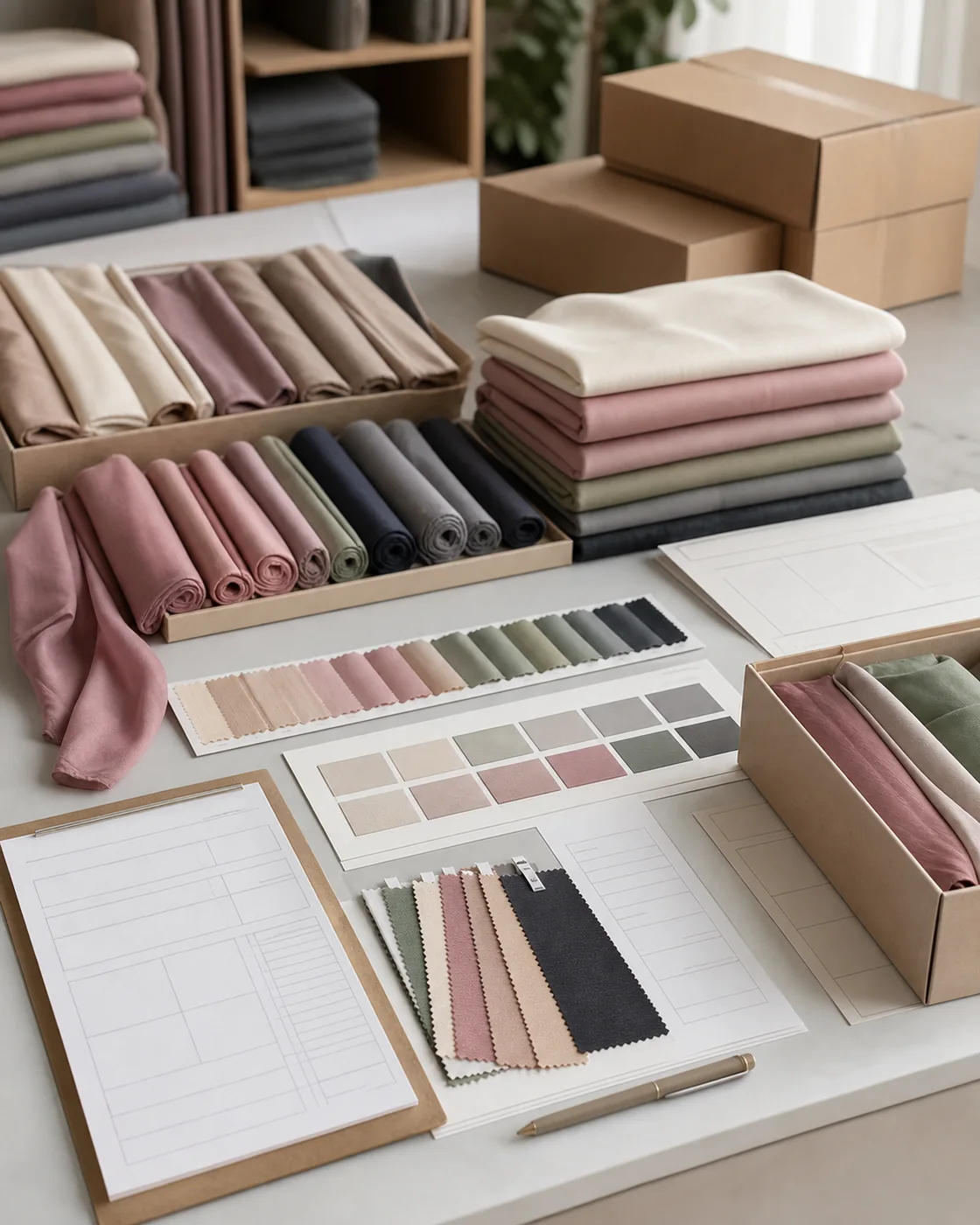
Use images for identification, not only editorial mood. Keep similar crops and lighting, show the product rather than only a styled scene, and add a texture detail or color swatch when it helps. Photos can vary across screens, so pair them with an approved color name and code where useful. Do not imply that a digital swatch guarantees the exact physical shade.
Describe fabric plainly, and add composition when it changes buying or labeling decisions. “Silk” and “satin” are not equivalent descriptions: silk names a fibre category while satin describes a weave or surface effect. Keep a line sheet concise; a technical fibre, opacity or edge-finish breakdown belongs in supporting product information, not every product row.
Show whether the hijab has one standard size or multiple sellable sizes, with finished dimensions and a consistent unit. The hijab size and dimensions guide explains how buyers choose the size; the line sheet only needs to show what is offered. Mark a style “core”, “seasonal”, “new” or “carryover” only when the label reflects the actual collection plan. The core-versus-seasonal color guide discusses their different merchandising roles.
Which Prices and Order Requirements Must Be Clear?
Wholesale price should be explicit for an actual offer. It is the price the retailer pays under the stated conditions; it is not the manufacturer’s production cost, the brand’s landed cost or the eventual consumer selling price. A suggested retail price (MSRP/RRP) may help buyers evaluate positioning, but is optional and must be labeled separately. Do not present a suggestion as a mandatory selling price.
Order requirements also need a precise basis. An opening-order minimum, reorder minimum, MOQ per style or color, minimum order value, case pack and color pack are different conditions. Include only those that genuinely apply. A hijab range does not necessarily require a fixed case pack. If a pack applies, explain what is inside and which variants can be mixed.
| Commercial field | What the sheet should clarify | Avoid |
|---|---|---|
| Wholesale price | Currency, selling unit, market and effective date | Unlabeled dollar sign or old price |
| Suggested retail price | Optional suggested value, separate from wholesale | Confusing it with the trade price |
| Opening / reorder requirement | Whether it is units, value, style or color | Using “MOQ” without scope |
| Pack or case size | Pieces and variant mix if applicable | Assuming every product has a case pack |
| Payment and cancellation | Current written policy or a link to it | Terms not actually offered |
| Shipping basis | What is included; quote separately if appropriate | Ambiguous delivered-price claims |
For cross-border orders, mention a shipping or Incoterm basis only if it is genuinely offered and defined. There is no need to turn the sheet into a shipping manual. If lead time differs between ready stock and made-to-order pieces, show the relevant category and confirm the current window. The production lead-time guide explains the planning variables; a sales sheet should state the current commercial promise, not a generic timeline.
How Do Ready Stock and Made-to-Order Sheets Differ?
A ready-stock sheet should make current availability and realistic dispatch information easy to find. A made-to-order sheet should make the order scope, minimums, customization boundaries and confirmed lead-time basis clear. Do not mark an item “in stock,” “ready to ship” or “ships in X days” without checking live inventory or a valid supply commitment.
| Offer type | Most important fields | Buyer question | Accuracy risk |
|---|---|---|---|
| Ready stock | SKU, available quantity or status, wholesale price, dispatch window, reorder route | Can I order this now? | Stale stock status |
| Preorder | Booking cut-off if used, expected availability, order commitment | When will the item be available? | Unqualified delivery promise |
| Made to order | Order minimum, variant options, approved scope, lead-time basis | What can be made for my order? | Presenting an unconfirmed option as standard stock |
Can the Same Line Sheet Sell a Collection and Private-Label Manufacturing?
Not without a clear distinction. A wholesale collection line sheet lists a brand’s existing sellable styles and prices. A private-label capability sheet usually presents fabric and customization options, sampling route and the information needed for a project-specific quote. It should not invent fixed private-label SKUs, prices, minimums or stock levels just to resemble a ready-stock line sheet.
| Offer | Document focus | Buyer next step |
|---|---|---|
| Existing wholesale collection | Orderable styles, variants, current prices and availability | Select SKUs and quantities |
| Private-label development | Capabilities, choices and scope to confirm | Submit requirements for a tailored quote |
If you need an opening-order plan before building the retail offer, the first wholesale hijab order quantity guide addresses SKU depth, budget and inventory risk. The line sheet then communicates the resulting offer to the retailer; it does not itself decide manufacturing quantity.
Which Layout and File Format Make Ordering Easier?
Choose a row table for many variants and quick comparison, or product cards for fewer styles that need visual space. A grid can work if a buyer can still read SKU, price and variants without zooming. There is no universal number of products per page: image scale, field density, print size and buyer readability matter more than fitting the maximum possible items.
| Format | Strength | Limitation | Good use |
|---|---|---|---|
| Controlled layout, easy to present or print | Old copies circulate; data not automatically live | Curated collection pitch with version/date | |
| Spreadsheet | Sortable SKUs and quantity entry | Less visual polish; accidental edits possible | Large assortment or attached order form |
| Online B2B sheet / portal | Can connect product data and ordering | Needs access, maintenance and data control | Repeat buyer workflows with live information |
A line sheet and order form can be one file or two connected files. The line sheet explains the offer; the order form captures quantities and purchase details. Whichever setup you choose, make it easy to transfer the exact SKU, color, size and quantity. Add a current order email, form link or portal route; a QR code is useful only if it leads to a maintained destination.
How Should Prices, Markets and Languages Be Versioned?
Put a document version, update date, price effective date and currency in a visible position. When price, stock, product status, color, MOQ or terms change, issue an updated version and mark the previous one superseded. A date without a version is better than nothing, but may not identify which of two circulating PDFs is current.
For different markets, use controlled versions where currency, tax display, shipping or terms differ. For multiple language versions of the same market offer, keep product codes, SKUs, dimensions, price, currency, order rules, availability, lead time and document version aligned. Localize headings, descriptions and ordering instructions; change commercial facts only when the market-specific offer actually differs.
Do not turn a line sheet into a stock ledger that is already out of date when sent. Use a status date or live link, and ask for confirmation when availability is volatile. Archive replaced copies so buyers do not order from an old price sheet.
What Mistakes Make a Wholesale Line Sheet Hard to Use?
The most damaging mistakes prevent a buyer from identifying the exact item or the real offer. Decorative layout cannot repair missing codes or outdated terms.
| Mistake | Why it slows or distorts the order | Better action |
|---|---|---|
| No stable SKU or color name | Buyer and seller may select different variants | Show a consistent product/variant identifier |
| Unclear currency or mixed price labels | Wholesale, retail and supplier cost may be confused | Label currency and price type |
| Outdated price or no effective date | Old terms keep circulating | Version and archive each edition |
| Missing availability or lead time | Buyer cannot plan a launch | State verified status and realistic route |
| Unclear minimum or pack | Order quantities may be invalid | Specify basis and pack contents, if applicable |
| Inconsistent product photos | Variants are hard to compare | Use consistent images and color labels |
| Too much story, too little commercial data | Key buying answers are buried | Move long narrative to catalog or lookbook |
| No order method or contact | Buyer must chase the next step | Provide current route and contact |
Wholesale Hijab Line Sheet Checklist
Before sending the document, check that each item is accurate for the offered market and date. Optional fields are marked accordingly; do not fill them with invented defaults.
- Brand and collection are named; season or delivery window is shown if relevant.
- Version, update date, price effective date and currency are visible.
- Each product has a clear, consistent image, name and product/style code.
- Each sellable variant has the appropriate SKU, color name and code if used.
- Fabric description and finished size or dimensions are concise and correct.
- Wholesale price is clear; suggested retail price is separate if provided.
- Opening requirement, MOQ or pack size states its true basis if applicable.
- Availability and lead-time information is verified and dated where necessary.
- Barcode/GTIN is present only if required and confirmed.
- Payment, shipping, cancellation and returns refer to current written terms.
- Order method and contact work; linked form or portal matches the same offer.
Copyable Wholesale Hijab Line Sheet Template
This is a blank structure for a brand’s own confirmed data, not a NoorSilk price list or policy. Keep one row per orderable SKU or a product card with a clearly attached variant table.
| Header | Enter the current confirmed value |
|---|---|
| Brand / collection / season | Brand and offer identity |
| Document version / updated / price effective | Version and dates |
| Market / currency | Market scope and ISO currency code |
| Wholesale contact / order route | Current email, form or portal |
| Product row / card field | Enter the current confirmed value |
|---|---|
| Image; product name; style code; SKU | Exact sellable item and variant |
| Fabric; color name/code; finished size | Brief product identification |
| Wholesale price; RRP/MSRP if used; currency | Correct price type and market |
| MOQ / opening requirement; pack if used | Applicable unit or value basis |
| Availability; lead time; barcode if used | Verified supply and retail data |
| Notes | Only information needed to order correctly |
| Wholesale terms / order block | Enter the current confirmed value |
|---|---|
| Opening order / reorder minimum | Real policy or “inquire” where no fixed offer exists |
| Payment / shipping / price validity | Current written terms and market basis |
| Returns / cancellation, if applicable | Current policy or a link to it |
| Order submission | Quantity entry, form, portal or sales contact |
The finished document should make one action obvious: choose the exact SKU and quantity, then send an order under the current terms or request a quote where the offer is not fixed.
Explore a Wholesale Hijab Range or Discuss Private Label
If you sell to retailers, use the checklist to turn your approved products into an orderable collection. If you are sourcing a new private-label range, share your target fabrics, product mix, colors, quantities and branding needs so a project-specific scope can be discussed; no fixed price, MOQ or stock status is implied.
Explore wholesale hijab options · Discuss private-label production · Request a quote