Buyer Guide
Hijab MOQ Explained: A Practical Guide for Brands and Wholesale Buyers
Hijab MOQ is the minimum quantity a supplier will accept for an order, but the number may apply to the complete order, one product, one color or one custom component. NoorSilk accepts projects starting from 20 pieces. The exact minimum depends on the hijab type, fabric, color plan, labels, printing and packaging, so buyers should confirm the breakdown before comparing quotations.
The short answer
A 20-piece starting MOQ is a planning point, not a promise that every option can be mixed
Begin with one proven product, a focused color plan and only the branding elements you need. Ask whether the minimum applies to the total order or to each style, color, print and packaging design. This gives you a realistic landed quantity before you approve samples or pay a deposit.
1. What does MOQ mean in hijab manufacturing?
MOQ stands for minimum order quantity. It is the smallest quantity a supplier can accept under a particular product and production setup. It is not automatically the smallest quantity of all products combined. That distinction matters because a quotation that says “MOQ 20” can mean different things at different suppliers.
Five ways an MOQ may be defined
- Per order: the minimum number of finished pieces across the complete order.
- Per product or style: modal, chiffon and jersey products may be treated as separate production runs.
- Per color: each shade may need a minimum quantity, especially when fabric is dyed or sourced specifically.
- Per print or artwork: every pattern can require separate preparation and approval.
- Per component: woven labels, boxes, printed bags or inserts may have minimums set by their own suppliers.
Always ask the manufacturer to state the unit clearly. Do not calculate your budget from the headline MOQ until you know how many products, colors and custom components it covers.
2. Why is hijab MOQ rarely just one number?
A finished hijab may look simple, but the order combines fabric, cutting, edge finishing, thread, labels, quality checks and packing. Many of these steps have preparation costs that are similar whether the run contains 20 pieces or 200 pieces. The supplier must also work with fabric mills, printers and packaging vendors that have their own minimums.
For ready or previously developed products, the supplier may already hold suitable fabric and standard packaging, making a smaller order practical. A custom-dyed fabric, exclusive print or rigid retail box usually requires a larger commitment because material and setup cannot always be purchased for only a few finished pieces.
3. How NoorSilk’s 20-piece starting MOQ works
NoorSilk accepts hijab projects starting from 20 pieces. This is intended to help boutiques, new brands and established buyers test a product or prepare a focused collection without beginning with an unnecessarily large inventory commitment.
The 20-piece figure is a starting MOQ, not a universal rule for every combination. The confirmed minimum depends on the product, available fabric, number of colors, dimensions, edge finish, labels, printing and packaging. For example, an order using an available plain fabric and standard packing may be easier to arrange at a low quantity than an order requiring a new print, custom-dyed shade and individually printed box.
Browse the hijab product catalog to choose a starting product, or review the Hijab Fabric Guide before preparing your brief.
4. How MOQ changes by order type
| Order route | How the minimum usually works | Best use |
|---|---|---|
| Ready or developed styles | Based on available products, fabrics and colors; usually the simplest low-quantity route | Testing demand and boutique restocks |
| Private label | Finished product minimum plus any separate label, tag or packaging requirement | Launching under your own brand |
| Custom colors | Depends on fabric availability, color matching and dyeing requirements | Building a controlled brand palette |
| Custom printing | May apply per artwork because each print needs files, setup and approval | Exclusive seasonal or signature products |
| Full OEM development | Calculated from fabric, dimensions, construction, colors, trims and packaging together | Creating a distinct repeatable collection |
If your priority is a low first-order quantity, begin with the simplest route that still supports your positioning. You can add more custom elements after the product and color demand are clearer. See the difference between wholesale hijab supply and OEM and private label manufacturing.
5. What can increase the hijab MOQ?
- Too many fabrics: modal, chiffon, jersey and cotton may come from different material programs.
- Too many colors: each shade can divide the production run and create separate sourcing or dyeing work.
- Exclusive color matching: a custom shade may require a lab dip, dye lot or fabric minimum.
- Custom printing: artwork preparation, strike-offs and print setup can apply to each design.
- Special dimensions or construction: new measurements, shapes or edge finishes require a separate specification.
- Woven labels and trims: the component vendor may make more labels than the finished hijab order needs.
- Retail packaging: printed bags, cards and boxes often have independent minimums.
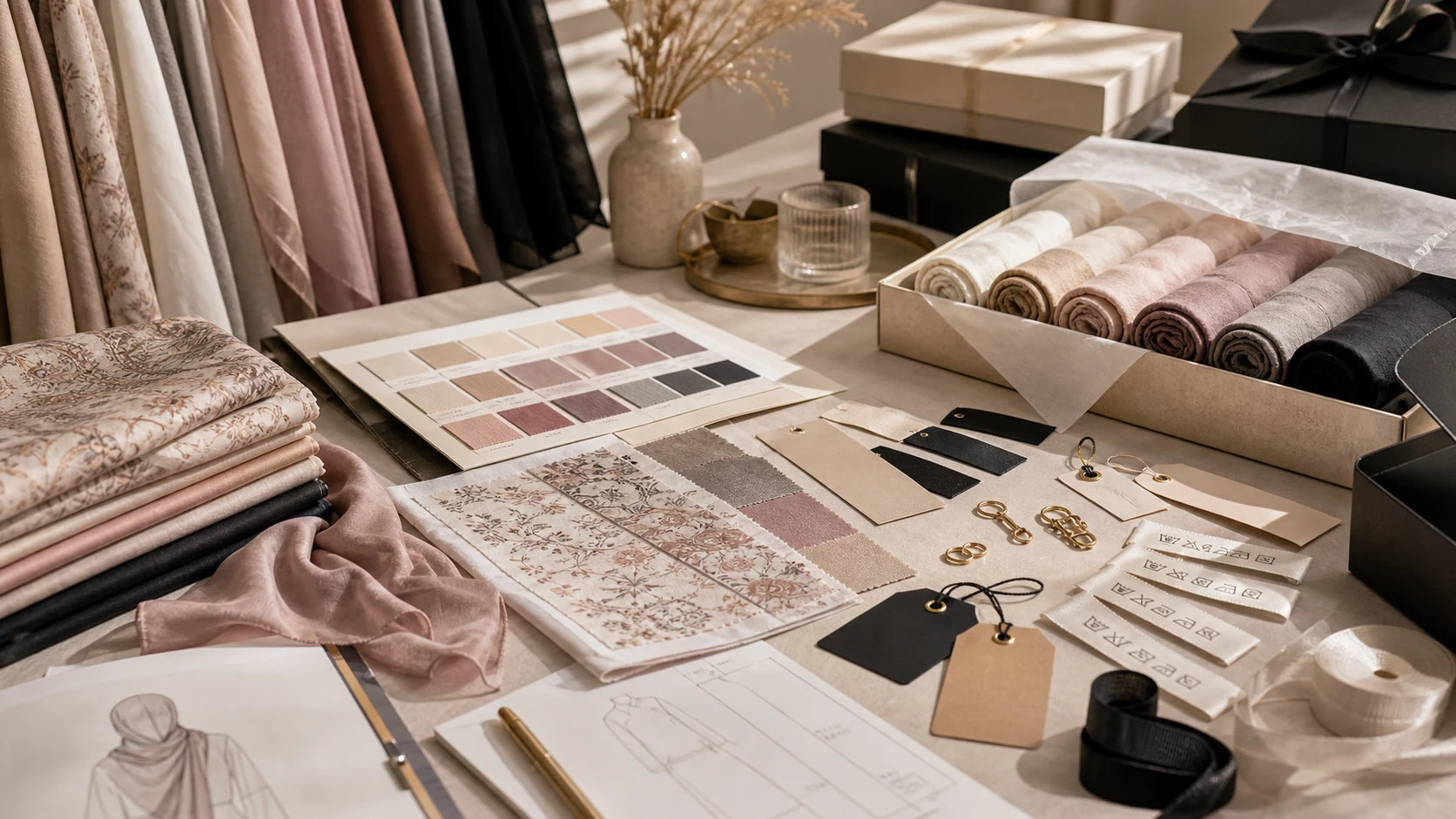
Some components can be purchased in a larger quantity and stored for later reorders, but this must be agreed in advance. Confirm ownership, storage period, remaining quantity and what happens if artwork changes.
6. How to plan a practical 20-piece test order
A test order should answer a commercial question. It is not useful to divide a small quantity across so many variations that no product receives a fair market test. Start with your clearest customer profile, wearing occasion and price position.
Example planning method
One product, one fabric, a focused color story
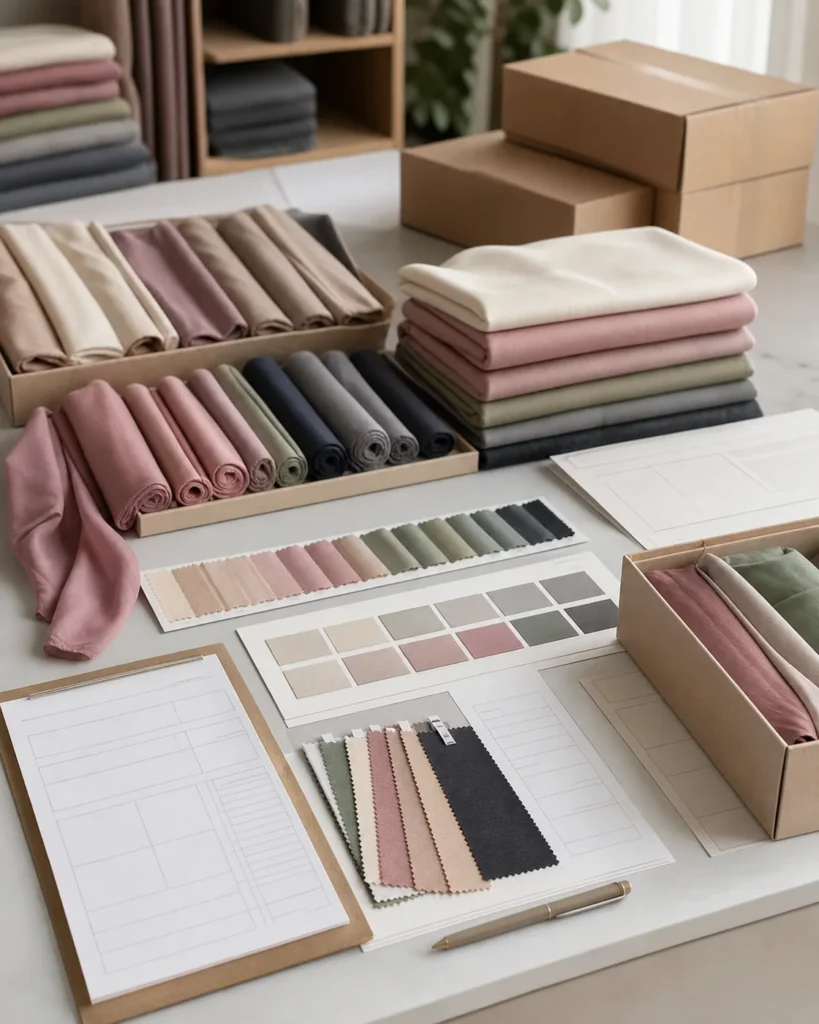
A boutique might test one plain modal hijab in a small group of commercially relevant colors, subject to the confirmed per-color requirement. Keep the dimensions, edge finish and packaging consistent. The sales result then tells you more about color demand without mixing several product variables into the same test.
Use these steps
- Choose one priority customer and use case, such as everyday workwear or occasion dressing.
- Select one core product from the modal, chiffon, jersey or cotton range.
- Choose a limited palette based on actual customer demand, not only personal preference.
- Keep branding simple: one approved label and practical packaging.
- Record the product code, fabric, dimensions, colors and quantities on the quotation.
- Use sales and customer feedback to plan the reorder rather than expanding every option at once.
7. How MOQ affects unit price, cash flow and inventory risk
A low MOQ can reduce the amount of cash tied up in untested stock, but the unit price may be higher because setup, sourcing and handling costs are spread over fewer pieces. A larger order can improve the unit price, yet the saving is not useful if slow-selling colors remain in storage.
Compare the complete commercial picture: product cost, custom labels, packaging, sample charges, payment fees, freight, import costs and local delivery. This is your landed cost. A low factory price does not automatically produce a healthy margin if the order creates excess inventory or expensive shipping.
Ask for quantity tiers
- Price and permitted color breakdown at the starting MOQ
- Price at the next practical production tier
- Which customization becomes available at the higher tier
- Whether repeat orders can use approved fabric, color and packaging records
Use these figures to compare the cash required now with the likely sell-through period. For more planning help, read the Wholesale Hijab Guide.
8. Samples, production timing and reorders
MOQ should be confirmed together with the sample and production process. A sample lets you approve the fabric, shade, dimensions, edge finish, label position and packaging before the bulk order begins. Keep the approved sample and written specification as the production reference.
NoorSilk’s typical sampling time is 2-3 days after the material and product brief are confirmed. Standard production is typically completed within seven working days after payment and final approval. Custom fabric, printing, packaging, higher quantities or peak-season capacity may require a different schedule, which should be confirmed on the quotation.
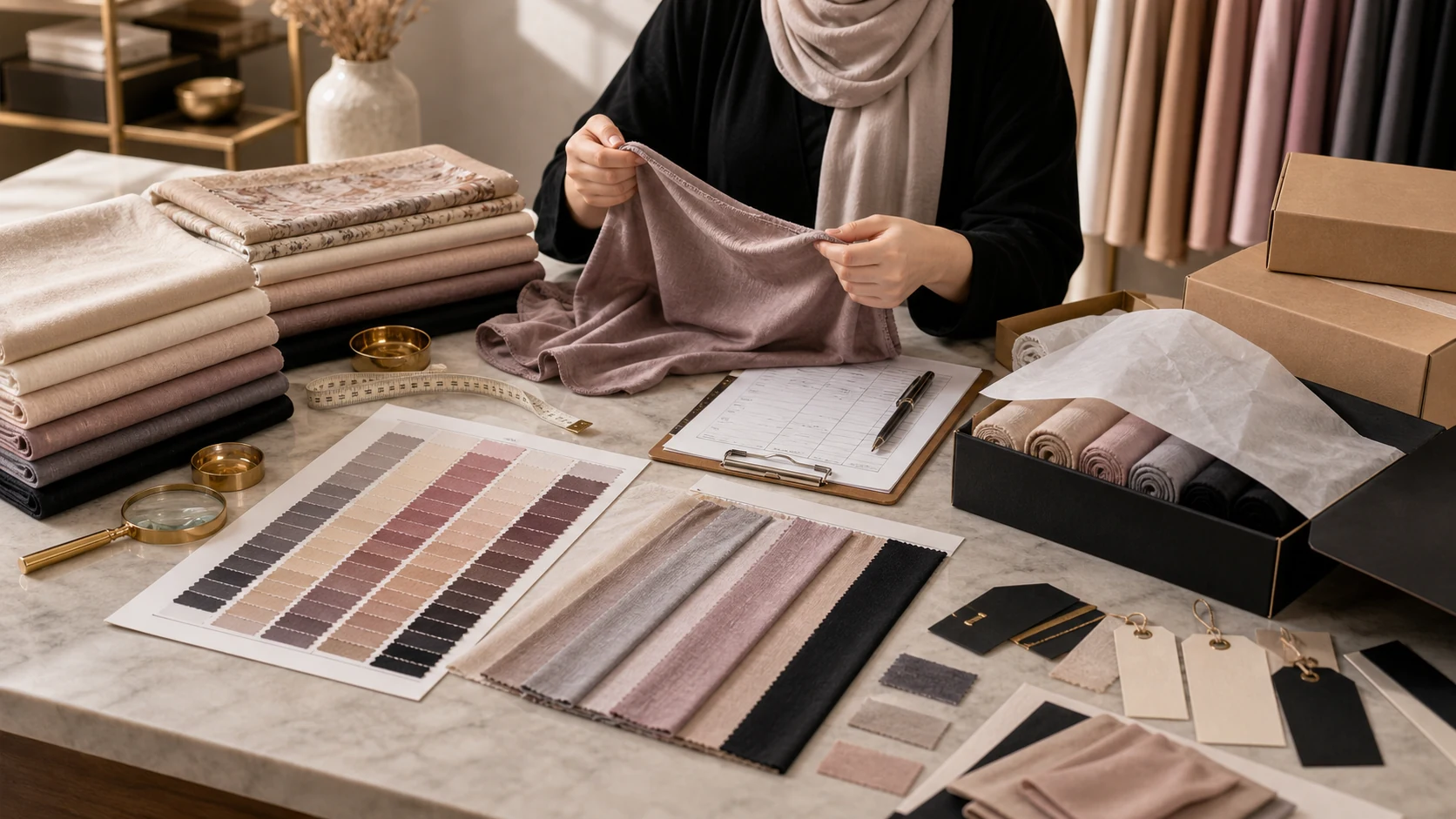
For reorders, ask whether the exact fabric and color reference remains available. Different material lots can show small shade or hand-feel variation. A reliable supplier should explain what can be repeated and when a new approval is needed.
9. What to include in a hijab MOQ request
A message that only asks “What is your MOQ?” cannot produce a precise answer. Send enough information for the supplier to identify the product and every custom component.
- Target hijab product or reference code
- Preferred fabric and any composition requirement
- Finished dimensions and shape
- Total expected quantity
- Number of colors and proposed quantity per color
- Plain, custom-dyed or printed design
- Label, hangtag, barcode and packaging requirements
- Destination country and target delivery date
- Whether the order is a test, launch or reorder
- Reference images or artwork files when available
Ask the supplier to reply with the MOQ basis, unit price, sample terms, production time, packaging quantity, payment terms and freight basis. This gives you a quotation that can be compared with another supplier on the same scope. The Hijab Manufacturer Buyer Checklist covers the wider supplier review process.
10. Common MOQ mistakes to avoid
- Assuming the minimum is for the whole order: it may apply to every style or color.
- Adding too many first-order SKUs: each variation divides your stock and makes demand harder to measure.
- Ignoring packaging minimums: custom boxes or labels may exceed the finished product quantity.
- Comparing quotations with different specifications: a lower MOQ may reflect a different fabric or finish.
- Choosing quantity only for a cheaper unit price: unsold inventory can cost more than the saving.
- Skipping the sample: low quantity does not remove the need to approve product quality.
- Forgetting the reorder plan: confirm whether the same material, color and components can be repeated.
Frequently asked questions
What is NoorSilk’s minimum order quantity for hijabs?
NoorSilk accepts projects starting from 20 pieces. The confirmed MOQ depends on the product, fabric, number of colors and customization such as printing, labels or packaging.
Can I mix colors within a 20-piece order?
It may be possible for selected products and available fabrics, but it is not automatic. Send the proposed color breakdown so NoorSilk can confirm any per-color requirement before quoting.
Is hijab MOQ calculated per style or per color?
It can be calculated per order, product, color, print or custom component. Ask the supplier to state the MOQ basis and approved quantity breakdown in writing.
Does private labeling change the MOQ?
It can. The finished hijab may qualify for a low MOQ while woven labels, printed cards, bags or boxes have separate supplier minimums. Request a separate quantity for each component.
Can I order a sample before bulk production?
Yes. A sample should be used to approve fabric, color, dimensions, finishing, branding and packaging. NoorSilk’s typical sampling time is 2-3 days after the material and brief are confirmed.
How can a new hijab brand keep its first order manageable?
Start with one priority product, a focused color plan and simple branding. Test actual demand, document customer feedback and add more styles or custom elements when planning the reorder.
{“@context”:”https://schema.org”,”@type”:”FAQPage”,”mainEntity”:[{“@type”:”Question”,”name”:”What is NoorSilk’s minimum order quantity for hijabs?”,”acceptedAnswer”:{“@type”:”Answer”,”text”:”NoorSilk accepts projects starting from 20 pieces. The confirmed MOQ depends on the product, fabric, number of colors and customization.”}},{“@type”:”Question”,”name”:”Can I mix colors within a 20-piece order?”,”acceptedAnswer”:{“@type”:”Answer”,”text”:”It may be possible for selected products and available fabrics, but the proposed color breakdown must be confirmed before quoting.”}},{“@type”:”Question”,”name”:”Is hijab MOQ calculated per style or per color?”,”acceptedAnswer”:{“@type”:”Answer”,”text”:”MOQ can apply per order, product, color, print or custom component. The supplier should state the basis in writing.”}},{“@type”:”Question”,”name”:”Does private labeling change the MOQ?”,”acceptedAnswer”:{“@type”:”Answer”,”text”:”It can. Labels, cards, bags and boxes may have separate minimum quantities from the finished hijab.”}},{“@type”:”Question”,”name”:”Can I order a sample before bulk production?”,”acceptedAnswer”:{“@type”:”Answer”,”text”:”Yes. Use a sample to approve fabric, color, dimensions, finishing, branding and packaging before bulk production.”}},{“@type”:”Question”,”name”:”How can a new hijab brand keep its first order manageable?”,”acceptedAnswer”:{“@type”:”Answer”,”text”:”Start with one priority product, a focused color plan and simple branding, then use sales feedback to plan the reorder.”}}]}
Plan a manageable first order
Ask NoorSilk to confirm your MOQ breakdown
Share the product, fabric, colors, quantity, labels, packaging and destination market. NoorSilk will review the scope, explain which options can be combined and confirm the sample and production plan.