Buyer Guide
How to Plan a 50-Piece Hijab Test Collection
Direct answer
A small hijab test collection can help a new brand validate product-market fit before committing to a larger inventory order. A 50-piece hijab test order can be used as a planning example to evaluate fabric demand, color preference, sell-through, customer feedback, packaging, pricing and reorder decisions. It is not an ideal quantity for every brand: the feasible order size depends on supplier MOQ, customization, budget and market, and a 50-piece plan only produces useful evidence when the SKU count remains controlled.
This guide uses 50 pieces as an illustrative inventory-planning framework, not as NoorSilk’s MOQ, a promise that a supplier will accept the quantity or a recommendation that every buyer should order exactly 50 pieces. Confirm the actual minimums and commercial requirements for the selected products and supplier.
Why Use a Small Hijab Test Collection?
A small test collection limits inventory exposure while helping a brand learn which product, fabric, color, price and presentation customers actually respond to. It can make comparison easier because the range is deliberately focused.
- Test fabric preference and wearing feedback.
- Compare color demand before expanding a palette.
- Observe whether the retail price converts.
- Create product photography and test listing clarity.
- Review packaging during real fulfillment.
- Collect early feedback, returns and repeat requests.
- Use sales velocity to inform a reorder.
Small batches also have limitations. Unit cost may be higher, some custom processes or packaging may not be practical, color flexibility may be limited, and setup or freight is spread across fewer units. The goal is not automatically the lowest unit price; it is useful learning with controlled inventory exposure.
Is 50 Pieces Enough to Test a Hijab Collection?
Fifty pieces can be enough for a controlled market test if the assortment remains narrow and the brand has a realistic way to reach potential buyers. It is rarely enough to evaluate many fabrics, styles and colors independently.
Dividing 50 pieces across ten styles and five colors would create a highly diluted assortment and little evidence per SKU. A plan using one or two relevant fabric categories, a limited number of product codes and a focused palette can make each result easier to interpret. This does not create one correct allocation; the split must follow the test objective.
Start With One Clear Test Objective
A test order should answer one primary question. Trying to test fabric, price, packaging, five product categories and many colors simultaneously makes it difficult to know why one SKU performed better.
| Test objective | Keep relatively fixed | Change deliberately |
|---|---|---|
| Fabric demand | Color roles, dimensions, price position and presentation | One or two fabric directions |
| Color demand | Fabric, dimensions, finish and price | A focused set of color roles |
| Product category | Comparable positioning and selling conditions | Selected hijab categories |
| Retail price | Product and presentation where possible | Planned price or offer structure |
| Packaging | Product, audience and price | Packaging format or presentation |
| Channel demand | Product and price | Boutique, online, pop-up or audience segment |
Write the primary question and the decision it will inform. For example: “Which of these color roles merits a deeper reorder?” is more actionable than “Will customers like my brand?”
Choose the Right Number of Fabrics
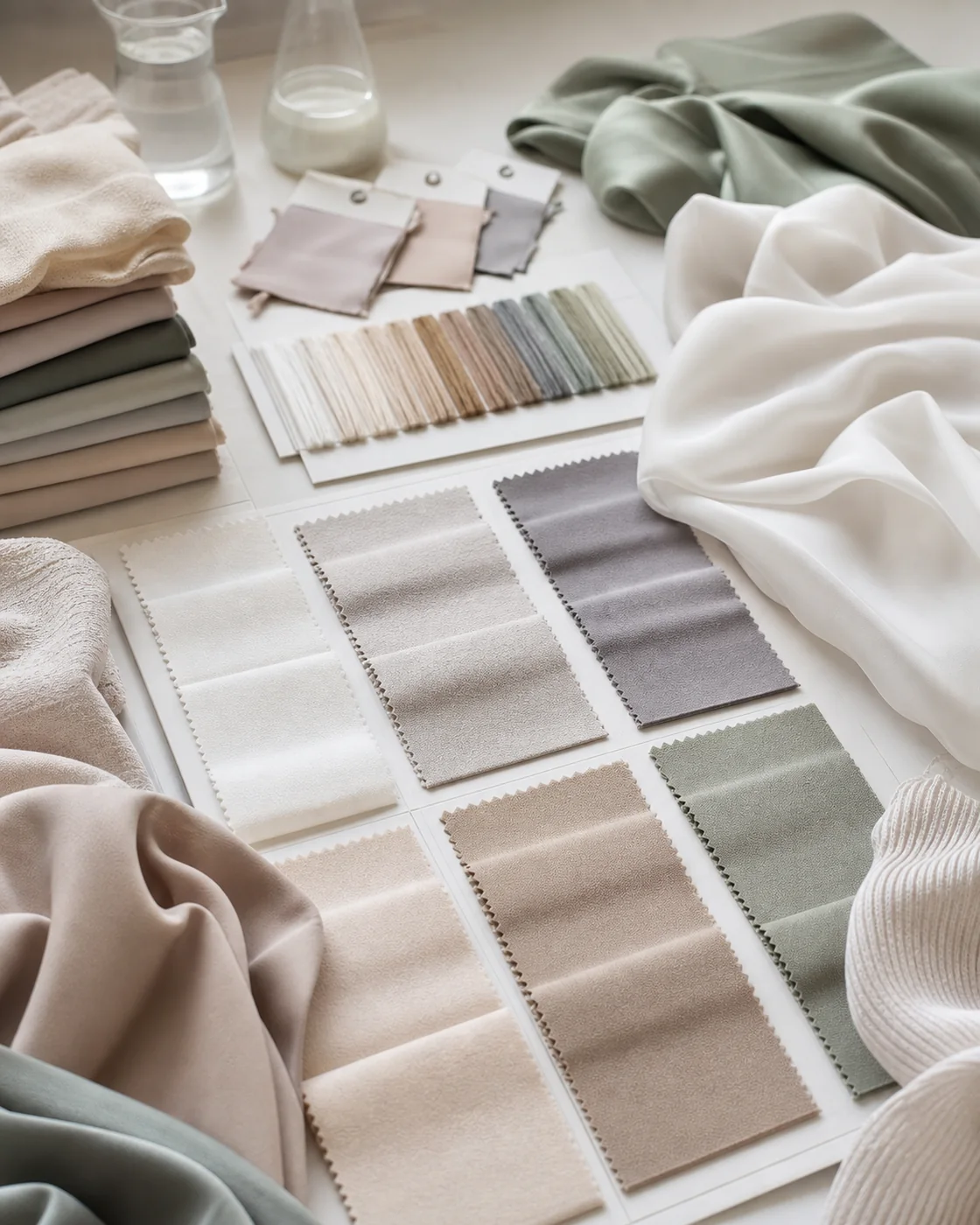
A test containing modal, chiffon, jersey, cotton and silk can spread a small quantity across too many customer propositions. Start with the one or two fabric categories most relevant to the target customer and climate, unless comparing categories is the explicit objective.
Use the guide to compare hijab fabrics. If modal or chiffon is shortlisted, review the detailed discussions of modal weight, opacity and drape and types of chiffon fabric. Select and approve the actual sample rather than relying on a fabric name.
How Many Colors Should You Test?
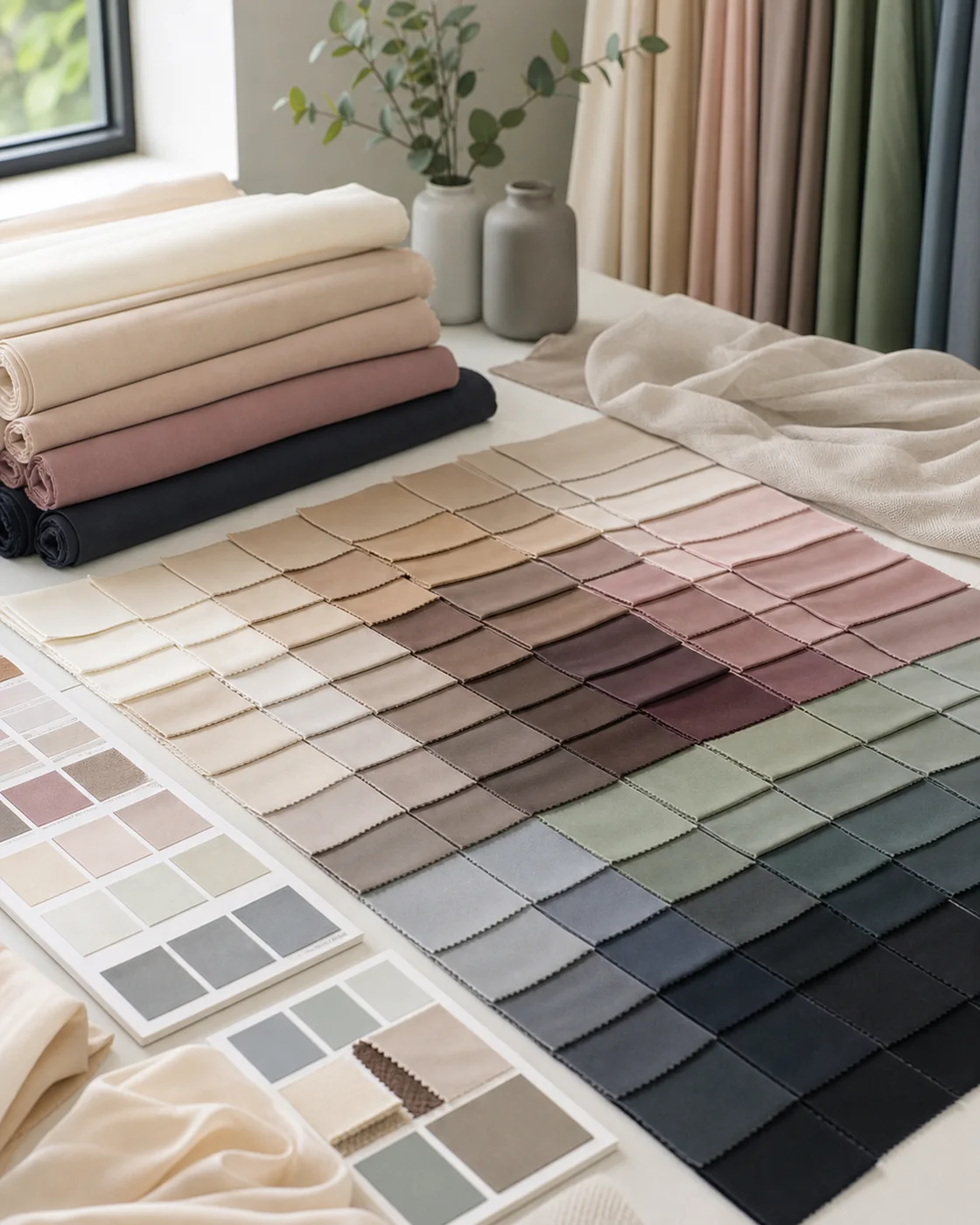
Test enough colors to compare meaningful roles without leaving too few units in each SKU. There is no universal number. Every additional color adds inventory, photography, listing, packaging and reorder complexity.
Classify the palette before naming individual shades:
- Core colors: intended to support the ongoing range.
- Neutral colors: versatile shades selected for the target audience.
- Seasonal colors: shades linked to a planned launch period.
- Accent or experimental colors: smaller hypotheses that need evidence.
Do not assume that a specific color is always the best seller. Use audience data, prior sales, preorders, customer conversations or a documented market hypothesis. Keep color naming and photography consistent so customers understand what they are choosing.
How to Divide 50 Pieces Across SKUs
Divide the pieces according to what needs to be learned. The following frameworks are illustrative only and do not represent supplier MOQ or fixed purchasing advice.
| Scenario | Illustrative structure | Best suited to testing | Trade-off |
|---|---|---|---|
| A: one fabric, equal colors | 1 fabric × 5 colors × 10 pieces | Color comparison within one product | Assumes equal starting confidence |
| B: two fabric directions | 2 fabrics × 3 colors each with an uneven split totaling 50 | Fabric demand with a small shared palette | Fewer observations per fabric/color combination |
| C: core plus experiments | 1 core fabric, 4 core colors and 2 test colors with uneven quantities totaling 50 | Protecting depth in the core while testing accents | Color results cannot be compared by raw sales alone |
Ensure every row in the order has a distinct SKU and planned quantity. When allocation is uneven, compare rates and selling conditions rather than only units sold.
Use Uneven Quantity Allocation When Appropriate
Colors do not need equal quantities when the brand has a reason to distinguish core, secondary and experimental roles. An uneven split can preserve stock depth in higher-confidence hypotheses while limiting exposure to new shades.
Base that confidence on evidence such as an existing audience, prior sales, preorders, waiting lists, customer interviews or structured polls. Likes and poll responses show interest, not guaranteed purchases. Record the hypothesis before launch so the allocation is not rationalized after the results appear.
How Fabric Choice Changes a Test Order
Fabric changes cost, opacity, photography, climate suitability, styling, target customer and possible reorder behavior. A lightweight sheer product may need styling explanation or layered photography; a stretch product may require recovery and dimension checks; a premium material changes care and price expectations.
Keep these differences visible in product descriptions and feedback questions. If two fabrics have different prices and audiences, do not treat their sales totals as a pure fabric comparison.
Should a Test Collection Include Custom Branding?
Include full branding when brand presentation is part of the hypothesis; use a simpler agreed presentation when the first objective is mainly product demand. The right choice depends on supplier feasibility, setup requirements, budget and what the test must prove.
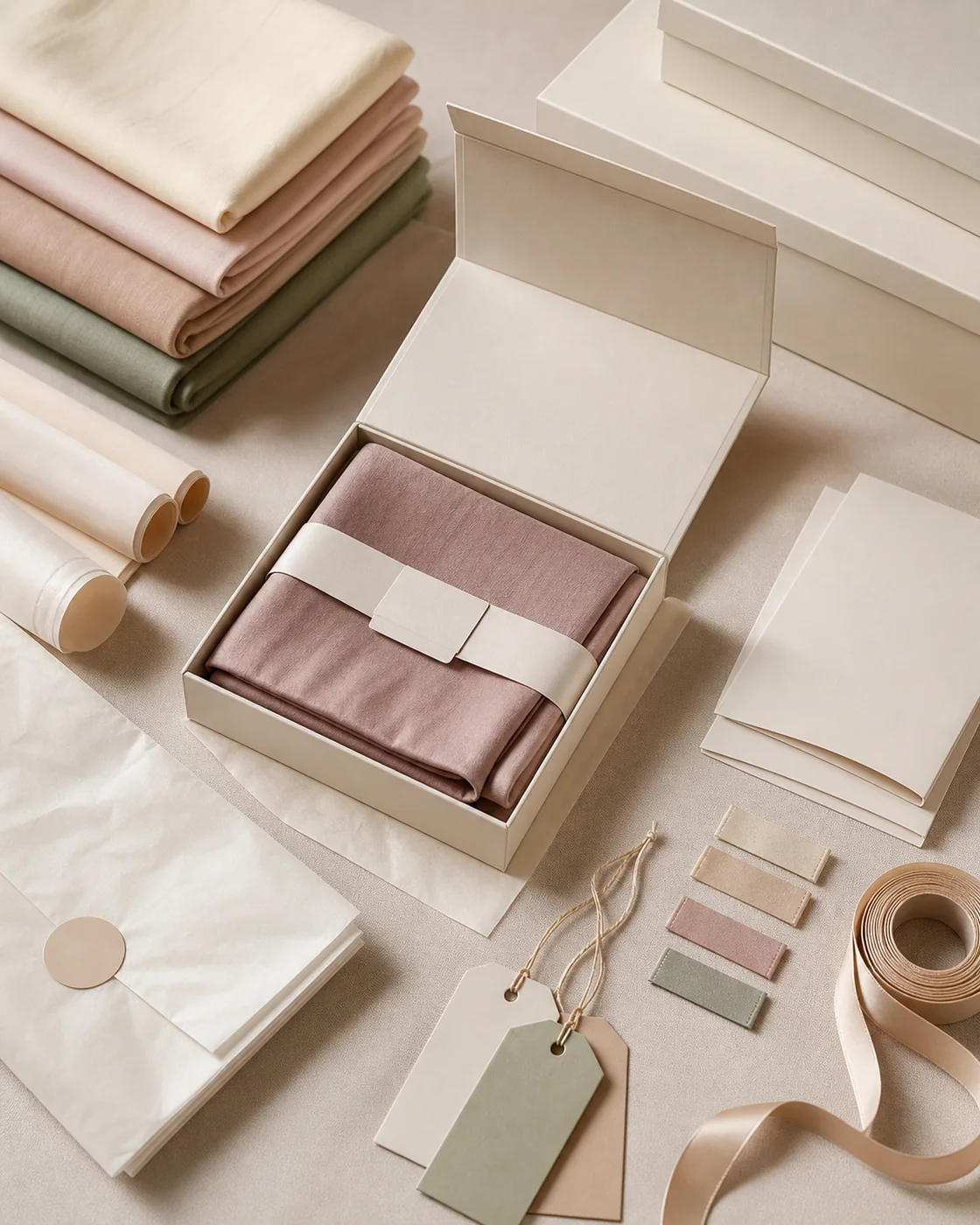
Possible elements include woven or printed labels, care labels, hang tags, pouches, logo applications and retail packaging. Confirm which options are available and sample them before ordering. A minimal presentation may reduce complexity but cannot test the complete branded experience; full packaging can produce better presentation evidence but increases setup and inventory risk.
Should You Test Custom Printed Hijabs in the First Collection?
Printed hijabs add artwork, print color, pattern scale, sample approval, method and setup variables. They can make a first test more complex, yet they may be essential if original prints are the brand’s main proposition.
Limit patterns and control the base fabric, repeat, scale, colors, border and version. Approve a physical printed result rather than a screen mockup. Use the production guide to prepare artwork for custom printed hijabs.
How MOQ Affects a 50-Piece Test Collection
Supplier MOQ determines whether a 50-piece framework is feasible. Minimums may apply to the entire order, a style, color, fabric, custom process or packaging component, and rules differ between suppliers and products.
Ask how mixing works before finalizing the SKU plan. If the proposed structure is not feasible, adjust the quantity, reduce variables, change the customization or reconsider the test format. The separate guide to understanding hijab MOQ explains why minimums exist; this article uses MOQ only as a constraint on assortment design.
How Pricing Changes on Small Test Orders
A small batch may carry a higher unit cost because packaging, labels, printing, development, handling or freight is spread over fewer pieces. Sampling and setup can also sit outside the product unit price.
The business purpose of a test order is not necessarily the lowest unit cost. It is to buy useful market evidence with less inventory exposure. Estimate retail price, gross margin and total landed or delivered cost before ordering, and use the guide to understand wholesale hijab pricing.
Build a Simple Test Collection Budget
A complete budget includes the product and the work required to present, sell and deliver it. Do not spend the entire available amount on inventory and then discover that photography, freight or marketing is unfunded.
| Budget item | Why it matters | What to confirm |
|---|---|---|
| Product | Core inventory investment | Unit scope, quantities and SKU split |
| Sampling | Confirms specifications before the test batch | Sample, revisions and delivery |
| Branding | Creates the identity being tested | Labels, tags, logo and setup |
| Packaging | Affects presentation and fulfillment | Retail, protective and shipping formats |
| Freight | Changes delivered cost and launch timing | Shipping scope, destination and documents |
| Duties and taxes | May apply by destination | Buyer/importer responsibilities |
| Photography and website | Customers need accurate product presentation | Content, listings and color consistency |
| Marketing | Insufficient reach weakens the test | Audience and launch channel |
| Contingency | Protects against reasonable unplanned costs | Budget reserve defined by the buyer |
Plan Product Codes Before Ordering
Even a 50-piece collection needs product codes. Build a simple system linking product, fabric, color and size where applicable. The full combination becomes the SKU used in the order, inventory, product listing, sales report and reorder.
| Field | Illustrative format | Use |
|---|---|---|
| Product code | A stable style identifier | Separates product constructions |
| Fabric code | A short material identifier | Connects product and approved fabric |
| Color code | A unique internal shade code | Prevents similar color names from merging |
| Size code | Only where multiple sizes exist | Tracks size-specific stock |
| SKU | Product + fabric + color + size as applicable | Links buying, sales and replenishment |
Codes should be unique and stable, not dependent on a temporary marketing name. Preserve the supplier reference alongside the internal SKU when they differ.
Prepare the Product Specification Before the Test Order
A small order still needs a written specification. Confirm fabric and composition, dimensions, color, finish, label, packaging and print details where applicable. A test batch should validate market response to a defined product, not combine product-development uncertainty with inventory testing.
The private label hijab manufacturing process explains how the brief, specification, revisions and approvals connect to production. The Day 1 brand sourcing checklist is for wider launch planning.
Approve Samples Before Ordering the Test Collection
A sample validates the product specification; a test collection validates market response. They are not the same. Ordering 50 unapproved pieces turns a product-development issue into an inventory problem.
Approve the relevant fabric, hand feel, dimensions, opacity, drape, color, stitching, edges, logo, labels, print and packaging first. Keep the final sample and written approval reference for comparison with the test batch.
How to Launch the Test Collection
Use a launch format that can generate observable buying behavior: a limited online release, soft launch to an existing audience, documented preorder, boutique test, pop-up or controlled social-commerce offer. The aim is not to build a complete marketing strategy inside the sourcing plan; it is to expose the products to the intended customer under understandable conditions.
Keep product information, imagery, availability and price consistent. Record the launch date, channel, audience size where available, promotion and any stock restrictions so results can be interpreted later.
What Data Should a New Hijab Brand Track?
Track units and customer signals by SKU, not only total revenue. A simple sheet should show what was available, what sold, how quickly, what came back and why.
| Field | What it reveals | Buyer action |
|---|---|---|
| SKU | Exact fabric/color/size combination | Keep every transaction attributable |
| Units received | Actual available inventory | Reconcile shortages or non-sellable pieces |
| Units sold | Demand converted into purchases | Compare within the same time period |
| Sell-through rate | Share of available units sold | Use units sold ÷ units available × 100% |
| Time to sell | Sales velocity | Compare launch and post-launch periods |
| Returns | Fit, color, quality or expectation issues | Record reason by SKU |
| Customer feedback | Comments on fabric, color, size and packaging | Separate repeated signals from isolated opinions |
| Reorder requests | Demand after a stockout | Record verified customer interest |
| Margin | Commercial contribution | Do not reorder on sales rate alone |
Sell-through is a general inventory measure, not proof of product-market fit by itself. Use consistent available-unit definitions and note whether returns are subtracted.
Do Not Judge a Product Only by Total Sales
Low sales can reflect a product problem, unsuitable color, price resistance, insufficient traffic, inaccurate photography, seasonality or audience mismatch. High sales can also reflect a discount, stronger placement or a smaller starting quantity.
Before discontinuing a SKU, ask whether customers saw it, understood it and could buy it under comparable conditions. Compare sell-through, margin, return reasons, feedback and traffic. Avoid treating social likes as purchases or raw unit sales as a fair comparison when starting inventory differs.
How to Decide What to Reorder
Classify each SKU as reorder, watch or rethink/discontinue using several signals rather than personal preference.
| Decision | Possible evidence | Next check |
|---|---|---|
| Reorder | Strong sell-through, acceptable margin, positive feedback and repeat demand | Supplier consistency, current stock and reorder timing |
| Watch | Mixed sales, limited traffic or insufficient time | Improve evidence before expanding quantity |
| Rethink or discontinue | Repeated product/price issues, returns or weak demand under adequate exposure | Change color, price, presentation or product before another order |
Save the reasoning with the SKU records. A future reorder plan should combine demand, lead-time planning and inventory position rather than repeating the original split automatically.
When Should You Expand the Collection?
Expand after evidence shows repeatability, reorder demand, workable margin, supplier consistency and acceptable inventory turnover. One fast-selling SKU is useful evidence, but it does not justify immediately multiplying the range into dozens of colors and products.
Add one layer of complexity at a time: more colors, a second fabric, another style or printed designs. State what each addition is intended to learn or contribute to the assortment.
Common Mistakes in a Small Hijab Test Order
- Testing too many fabrics or product categories.
- Adding too many colors and diluting every SKU.
- Skipping product samples because the order is small.
- Using extensive custom packaging before deciding whether presentation is part of the test.
- Ignoring unit economics and delivered cost.
- Not assigning stable product and color codes.
- Failing to track starting stock, sell-through and returns.
- Reordering from personal preference rather than evidence.
- Treating likes, polls or compliments as confirmed demand.
- Comparing sales without accounting for traffic, price, promotion and stock depth.
- Allocating too much inventory to experimental colors.
- Changing several variables and attributing the result to only one.
Example 50-Piece Hijab Test Collection Framework
Illustrative example only: this table teaches allocation logic. It is not a NoorSilk order, MOQ, availability statement or recommended universal split.
| Fabric role | Color role | Illustrative SKU | Quantity | Test objective |
|---|---|---|---|---|
| Core fabric | Core neutral A | CORE-A | 12 | Higher-confidence baseline |
| Core fabric | Core neutral B | CORE-B | 10 | Compare two core shades |
| Core fabric | Secondary color | CORE-C | 8 | Measure broader palette interest |
| Core fabric | Seasonal color | CORE-D | 7 | Test launch-period relevance |
| Core fabric | Experimental color A | CORE-E | 5 | Limit exposure to a new hypothesis |
| Core fabric | Experimental color B | CORE-F | 4 | Compare another accent direction |
| Second fabric | Shared core neutral | TEST-A | 4 | Early fabric signal only |
| Total | 50 | Planning example | ||
This uneven structure gives more depth to higher-confidence colors and only an early signal for the second fabric. It cannot support a strong fabric comparison because that SKU starts with fewer pieces. Another brand could use a different structure for a different question.
50-Piece Hijab Test Collection Checklist
- Define the primary test objective.
- Define the target customer and channel.
- Choose one or two relevant fabric categories.
- Limit the number of product SKUs.
- Select core color roles.
- Select controlled test colors.
- Define quantity per SKU.
- Confirm supplier MOQ and mixing rules.
- Prepare written product specifications.
- Approve physical samples.
- Confirm branding scope.
- Confirm retail and shipping packaging.
- Check unit economics and total budget.
- Create product, fabric, color and SKU codes.
- Launch under documented conditions.
- Track stock and sell-through by SKU.
- Collect returns and customer feedback.
- Identify winners using several metrics.
- Plan evidence-based reorders.
- Document lessons before expanding.
Turn the Test Plan Into a Supplier Inquiry
Once the objective, fabric, colors, SKU structure, quantity, branding and packaging are defined, the brand can send an effective supplier inquiry. Include the specification, allocation table, target market, sampling needs and which decisions remain open.
Review NoorSilk’s wholesale hijab service for catalog and bulk sourcing, or the OEM and private label service when the project requires custom product and brand development. Actual MOQ and feasibility must be confirmed against the chosen product and brief.
Define the test before requesting stock
Ready to discuss a focused hijab test collection?
Share the test objective, market, fabric, colors, SKU allocation, quantity, branding and packaging so the appropriate wholesale or private-label route can be reviewed.