Buyer Guide
100% Cotton vs Cotton Blend Hijabs: What Wholesale Buyers Should Know
Direct answer
100% cotton and cotton-blend hijabs can both work well, but they do not behave identically. Wholesale buyers should compare breathability, softness, drape, shrinkage, wrinkle recovery, dimensional stability, stretch, durability and care on the finished fabric—not judge quality from cotton percentage alone. A higher cotton content may support a natural-fibre story and a familiar dry handfeel, while a suitable blend may adjust fluidity, recovery, care or durability. Construction, weight and finishing can matter as much as composition, so the final decision should be based on a written specification and physical sample.
What Does “100% Cotton Hijab” Mean?
A 100% cotton hijab is one whose declared fibre composition is cotton rather than a mixture of cotton and another fibre. That statement identifies the fibre content; it does not define the complete fabric or guarantee one particular feel, thickness or performance.
Two fabrics carrying the same 100% cotton declaration may use different fibre qualities, yarn counts, twist, woven or knitted constructions, densities, weights and finishes. One may be a light cotton voile with a crisp, airy character; another may be a denser, softly washed fabric with more body. Even the edge finish and final dimensions influence how the scarf wears.
For sourcing, treat composition as one specification field. Ask for construction, fabric weight where applicable, finished dimensions, surface finish, care direction and a representative sample before deciding whether the material fits the intended collection.
What Is a Cotton-Blend Hijab?
A cotton-blend hijab uses cotton together with one or more other fibres. Depending on the product, examples in the wider textile market can include cotton with viscose, polyester, elastane or modal. These examples explain possible blend logic; they do not state that NoorSilk supplies every combination.
A blend may be engineered to adjust drape, stretch, shape retention, wrinkle behaviour, softness, durability, care or cost. The result depends on the exact fibres and percentages as well as yarn, construction and finish. The words “cotton blend” alone are therefore incomplete.
Ask the supplier to declare every fibre percentage. A 95/5 cotton-elastane knit, for example, solves a different product brief from a woven cotton-viscose fabric. Buyers should never assume that all cotton blends stretch, resist wrinkles or feel the same.
100% Cotton vs Cotton Blend Hijabs: Quick Comparison
There is no automatic winner. The table describes common possibilities, not guarantees; the finished construction and sample remain the deciding evidence.
| Characteristic | 100% cotton | Cotton blend | What the buyer should consider |
|---|---|---|---|
| Breathability | Can provide comfortable airflow and moisture absorption | May be light and breathable depending on the second fibre and construction | Compare weight, density, finish and use conditions |
| Softness | May feel soft, dry, crisp, brushed or washed | Can modify softness and surface character | Approve the actual handfeel |
| Drape | Can range from structured to fluid | May increase fluidity or body depending on blend | Review full-size drape, not fibre names |
| Wrinkling | May show creasing in some constructions | Some blends can improve wrinkle recovery | Test after folding, wear simulation and care |
| Shrinkage | May respond to moisture, washing and heat | Some blends can improve dimensional stability | Confirm finished dimensions and care behaviour |
| Recovery | Depends strongly on knit/weave and finish | May be adjusted by fibre and construction | Separate recovery from initial stretch |
| Durability | Depends on fibre, yarn, construction, abrasion and care | May be engineered for particular wear needs | Do not infer durability from one fibre alone |
| Stretch | Woven cotton may have little stretch; cotton knit behaves differently | Some blends stretch, while others do not | Record direction and amount qualitatively or by an agreed test |
| Care | May need more attention to creasing, heat or shrinkage | May offer easier-care performance depending on blend and finish | Validate washing, drying and ironing instructions |
| Printing | Can be suitable with the correct preparation and print process | Suitability depends on fibre mix, surface and process | Approve a physical print on target fabric |
| Climate | Can suit warm-weather and natural-fibre ranges | A lightweight blend may also suit warm conditions | Evaluate weight, airflow, moisture and layering |
| Price positioning | May support a cotton-focused or natural-fibre story | Can support performance-led or value-led positioning | Compare total product performance, not composition as a price shortcut |
How Do 100% Cotton and Cotton Blends Compare for Breathability and Comfort?
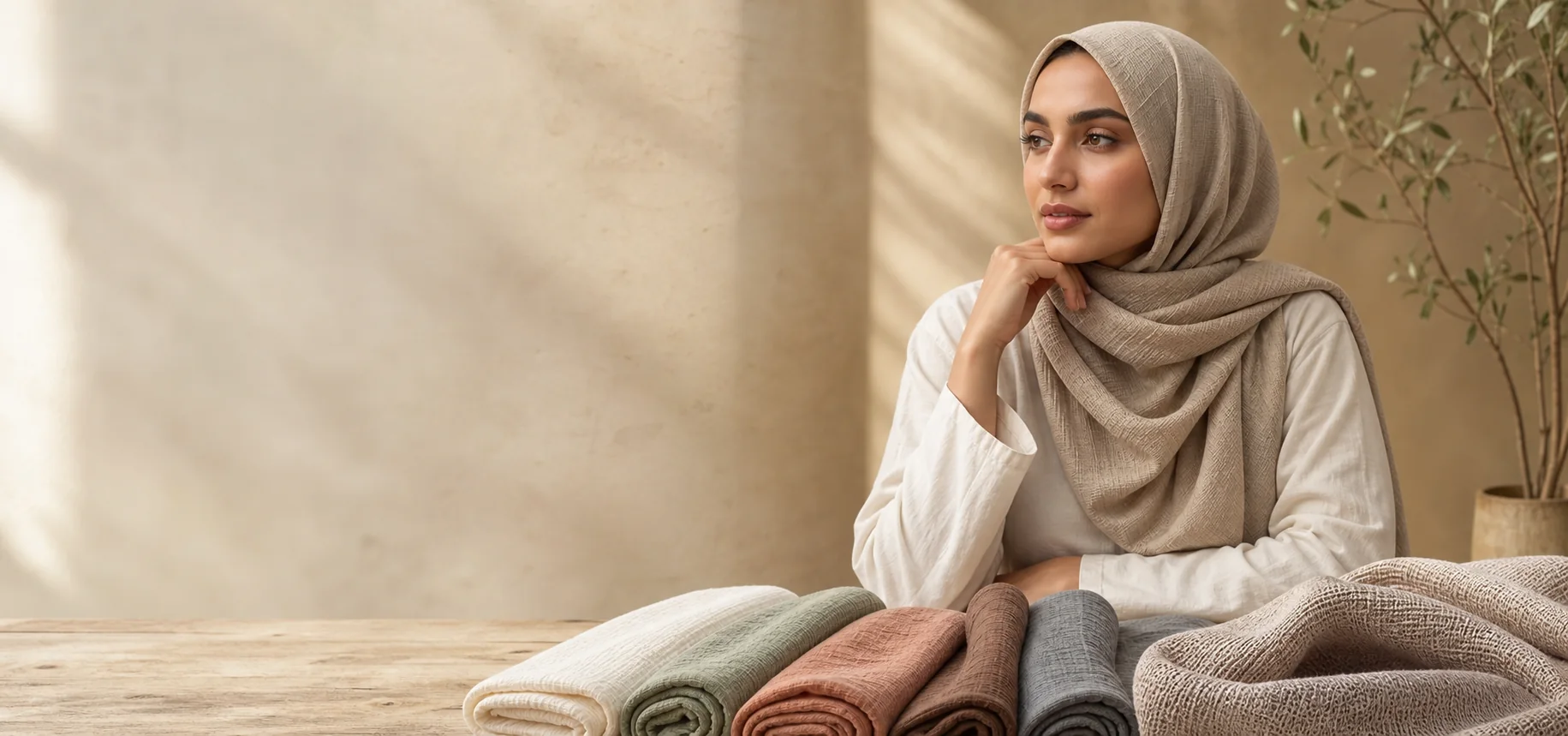
Both can be comfortable, and a cotton blend is not automatically less breathable. Cotton is valued for moisture absorption and can support comfort, but the experienced airflow and warmth also depend on fabric weight, density, construction, finishing, climate and the number of layers worn.
A light, open cotton construction may feel airy, while a dense or heavily finished cotton fabric may feel warmer. A light blend with an open construction may perform differently from a compact blend of the same fibre percentages. Moisture absorption, moisture movement and drying behaviour are also related but not identical properties.
For a warm or humid target market, compare full-size samples during realistic wear and layering conditions. Record the fabric weight and construction so that a later reorder does not replace the approved comfort profile with a materially different base.
How Do Drape and Structure Differ?
100% cotton may provide a natural dry hand, crispness or structure in some constructions, while some cotton blends can add fluidity, softness, stretch or shape retention. Neither outcome follows from composition alone.
Drape is influenced by weight, yarn, weave or knit, thickness, finish, dimensions and edge treatment. A scarf that looks fluid as a small swatch may behave differently at finished size. A structured product can support neat folds and volume; a fluid product can follow the face and shoulders more closely. The better choice depends on the styling promise of the range.
Review the sample unfolded, folded, draped and tied in the intended way. Ask whether its structure and movement remain acceptable after the proposed care cycle.
Which Wrinkles Less: 100% Cotton or a Cotton Blend?
Some cotton blends may recover from creasing better than some 100% cotton fabrics, but “cotton blend” does not mean wrinkle-free. Fibre ratio, yarn, fabric construction and finishing determine the visible result.
Cotton fibre has relatively low resilience compared with some alternatives, so certain cotton products can retain folds. Finishing and mechanical construction may alter that behaviour. A blend selected for recovery may make an everyday or travel style easier to maintain, while a deliberate natural crease can suit another product story.
Fold the sample consistently, leave it for a defined comparison period, open it and observe both immediate and later recovery. Repeat after care if the product is intended to be washable. Use the same method for competing fabrics rather than relying on supplier adjectives.
Do Cotton Hijabs Shrink?
They can. Cotton fabrics may respond dimensionally to moisture, washing, drying and heat, but there is no single shrinkage percentage that applies to every cotton hijab. Yarn, construction, wet processing, finishing, sewing and care all matter.
Some cotton blends can improve dimensional stability, but a blend is not an automatic guarantee. CottonWorks’ technical guidance on shrinkage notes that specifications must account for fibre, yarn, construction, wet processing, finishing, manufacturing and laundering variables.
Measure the finished sample before and after the agreed care method. Check length, width, shape, edge behaviour and twisting, not only a fabric swatch. Record approved finished dimensions, allowed project-specific variation and the care instruction used for evaluation. Do not approve dimensions first and discuss shrinkage only after bulk production.
How Do Stretch and Recovery Differ?
Stretch describes how much or in which direction a fabric extends; recovery describes how well it returns toward its original dimensions after the force is removed. A material may stretch but recover poorly, producing growth, curling or distortion.
100% cotton fibre itself does not automatically create substantial stretch, but knitted cotton and mechanically elastic constructions may extend. A cotton blend containing an elastic fibre may be designed for additional stretch, while many other cotton blends are not stretch fabrics at all.
Compare widthwise and lengthwise behaviour, relaxed dimensions and recovery after repeated handling. If stretch comfort is central to the brief, the guide to jersey hijab stretch, weight and recovery provides a dedicated evaluation framework.
Does 100% Cotton Provide Better Opacity?
Not necessarily. Opacity depends on weight, density, yarn, construction, colour, stretch, finish, background and layering. A 100% cotton label does not guarantee coverage, and a cotton blend is not automatically sheer.
Dark and light colours can behave differently on the same base. Stretching a knitted fabric can open the structure and change coverage. A lightweight voile may be intentionally airy, while a denser fabric may provide more coverage but affect drape and warmth.
Review the intended colour in one layer, multiple layers and the actual styling context. Do not impose one universal GSM threshold as a substitute for a physical opacity check.
How Do Surface Texture and Handfeel Vary?
Cotton can be smooth, crisp, brushed, textured, dry, soft-washed or finished in many other ways. A cotton blend changes again according to the partner fibre, yarn and treatment. Composition on a label cannot predict handfeel by itself.
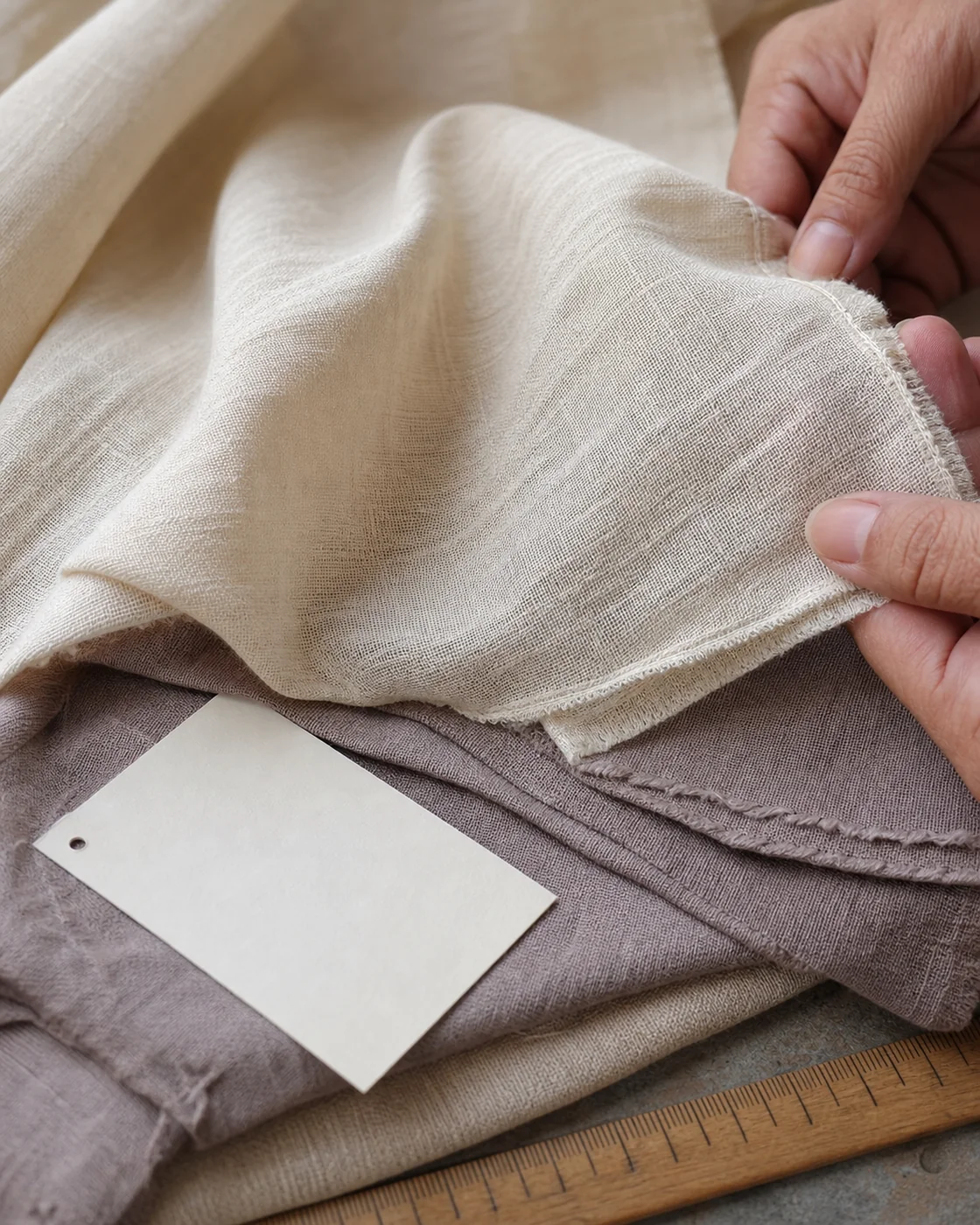
Handle a clean sample with dry hands and compare it with a stable reference. Assess face and reverse, surface friction, softness, cool or warm touch, edge feel and any change after care. For e-commerce, ensure that product descriptions and close-up photography reflect the approved surface rather than implying that every cotton product has the same texture.
Which Fabric Is Better for Durability and Everyday Use?
Neither composition wins automatically. Durability depends on fibre quality, yarn strength, twist, construction, finishing, abrasion, seam and edge quality, washing and the actual blend.
A suitable blend may be developed to improve a particular wear property, but “contains polyester” or another fibre is not proof that the finished hijab is more durable. Likewise, 100% cotton can perform well when its yarn, construction and finish fit the intended use.
Define the use case first: daily essential, premium natural-fibre line, travel style, occasion product or high-frequency uniform program. Then compare representative samples for surface wear, seam integrity, dimensional change and appearance after the relevant care cycle.
| Performance question | Why composition alone cannot answer it | Useful approval evidence |
|---|---|---|
| Will it feel breathable? | Weight, density, finish and layering change the wearing experience | Full-size sample reviewed for the target climate |
| Will it drape as intended? | Yarn, construction, dimensions and edge finish influence movement | Finished sample styled in the intended way |
| Will it retain its dimensions? | Processing, finishing and care affect shrinkage and shape | Before-and-after measurements using the agreed care method |
| Will it recover from folds or stretch? | Resilience and recovery vary with fibre, knit/weave and finish | Side-by-side handling comparison with recorded observations |
| Will the surface remain acceptable? | Fibre length, yarn, friction and finishing influence fuzz and pilling | Relevant wear or test method applied to the exact fabric |
| Will colour and print meet the brief? | Composition, base shade, surface and process alter appearance | Physical colour or print approval on the target fabric |
Can Cotton and Cotton Blends Pill?
Both can show pilling, fuzzing or surface wear. The tendency depends on fibre length and strength, yarn structure, fabric construction, finishing and friction—not simply on whether a label says cotton or blend.
Loose fibres can work toward the surface during rubbing. Whether they form and retain pills depends partly on how fibres break or remain attached. A softly brushed surface may also show fuzz without representing the same mechanism as severe pilling. Cotton Incorporated’s fibre-property reference also demonstrates why length, fineness, uniformity and strength are separate quality variables rather than one generic “cotton quality” score.
Inspect likely friction zones and compare samples using an agreed method when surface durability is commercially important. Avoid publishing a pilling grade unless the product has been tested by a defined method and the result belongs to that exact approved fabric.
Which Is Better for Hot and Humid Climates?
There is no single best option. A suitable warm-climate hijab balances weight, airflow, moisture behaviour, density, drape, opacity and layering. Some 100% cotton constructions fit a natural, breathable product position; a lightweight cotton blend may also work well.
Do not equate cotton percentage with thermal comfort. A dense, heavy cotton can feel warmer than a light, open blend. A very sheer fabric may require more layers, changing the actual wearing experience. Humid markets also make drying behaviour and care convenience relevant.
Evaluate the complete product for the target climate and sales channel. If possible, compare more than one construction in the same finished dimensions and similar colours.
Which Is Better for Cooler Markets?
Either can work. Higher weight, denser construction, greater coverage or a more structured surface may support a cool-weather collection, but fibre composition remains only one variable.
A buyer may prefer more body, layering potential or a warmer hand for an autumn range. That does not mean every heavy cotton is suitable or every blend is light. Compare warmth perception, drape, opacity and comfort together and position the product according to evidence from the finished sample.
100% Cotton vs Cotton Blend for Printed Hijabs
Neither is universally best for printing. Print performance depends on fibre composition, pretreatment, print method, colorant or ink, surface, absorbency, base colour, finishing and the required design.
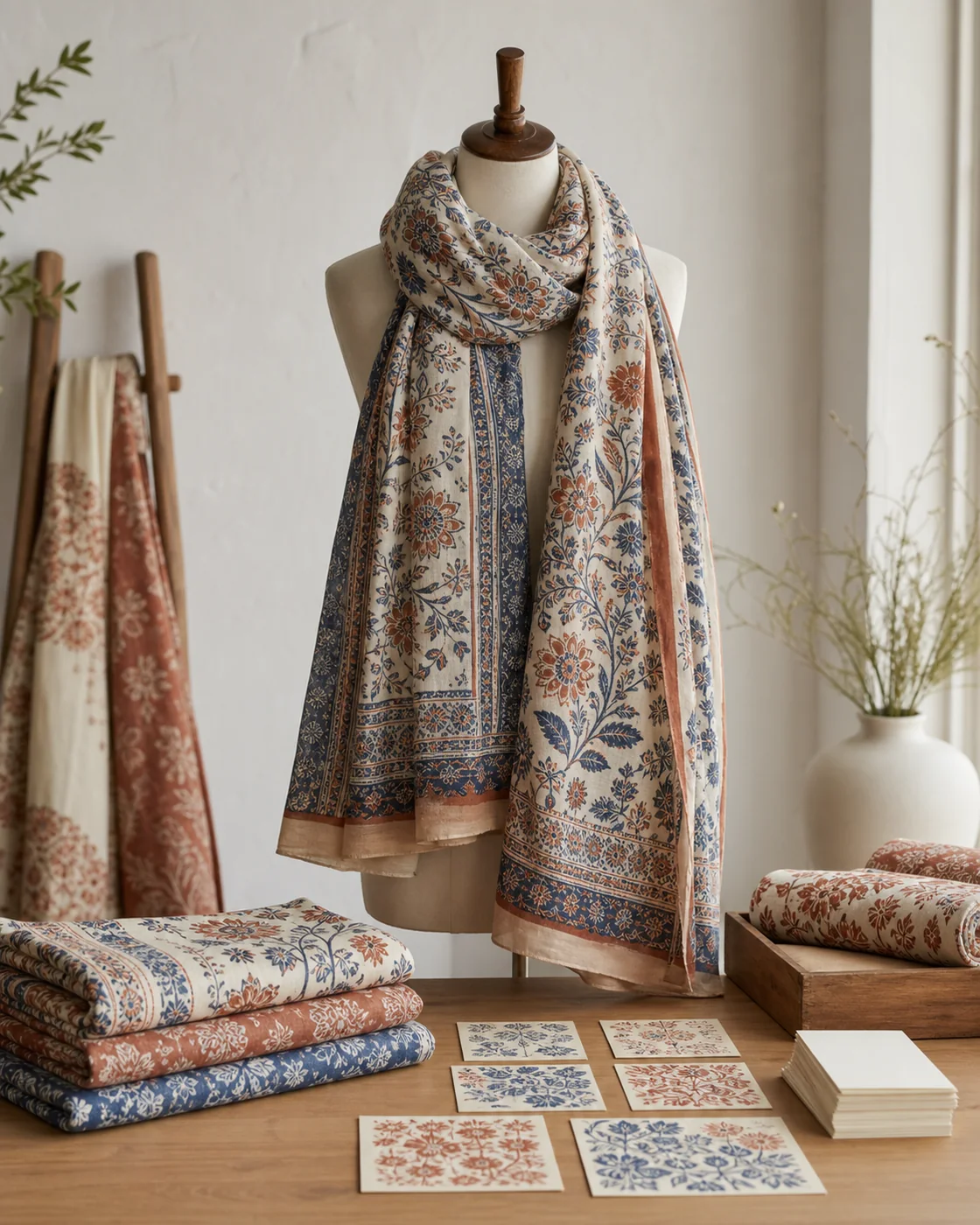
A colour that works on one cotton base may change on a blend. Fine details, saturation, handfeel and reverse-side appearance may also differ. Approve the artwork on the intended fabric through the physical proof stage proposed for that process.
Use the guide on preparing custom printed hijab artwork to control file format, repeat, scale, colour references, edges and sample approval.
How Does Color Development Differ on Cotton and Cotton Blends?
The same Pantone target can appear different on different compositions and constructions. Fibre response, base colour, texture, sheen, opacity, dye or print method and finishing all affect hue, depth and saturation.
Do not transfer a colour approval from one cotton base to another without review. Confirm the shade on the final target fabric, and retain the approved physical sample with its exact composition and construction. The guide to Pantone color matching for hijabs explains screens, lab dips, strike-offs, lighting, tolerance and reorder records.
How Does Fabric Weight Change Cotton Hijab Performance?
Fabric weight can influence opacity, structure, drape, warmth, airflow and durability, but there is no universal “best GSM” for a cotton hijab. Two fabrics at a similar GSM can still behave differently because construction, yarn, thickness and finish differ.
A lighter fabric may feel airy but require opacity or layering checks. A heavier one may offer more body or coverage yet change drape and climate suitability. Record GSM when it is part of the agreed specification, then evaluate it with the full product rather than as a stand-alone quality score.
How Do Care Requirements Affect Product Positioning?
Care affects whether a product fits an everyday, premium, travel or convenience-led collection. Washing, drying, ironing, crease recovery and dimensional change influence both customer expectations and return risk.
A natural-fibre story may support one price position, while easier-care performance may support another. Neither should be claimed without confirming the approved product. Establish the proposed washing, drying and ironing direction, evaluate sample behaviour and ensure care information reflects the actual composition and finish.
Requirements for fibre and care labelling depend on the country of sale and the responsible business. Buyers should verify current local rules rather than copying one market’s label into every destination.
What Should Wholesale Buyers Check in a Cotton Hijab Sample?
A sample should answer whether the complete product—not only the fibre label—fits the intended customer, climate, styling and price position.
| Sample checkpoint | What to review | How to record it |
|---|---|---|
| Composition | Every fibre and percentage | Supplier declaration linked to sample ID |
| Weight and construction | GSM if applicable, weave/knit, density and thickness | Approved material reference |
| Handfeel and airflow | Softness, friction, breathability and moisture feel | Defined comparison comments |
| Drape and opacity | Flat, folded, styled, one layer and multiple layers | Photos plus physical approval |
| Wrinkle, stretch and recovery | Creasing and return after handling | Repeatable method and observations |
| Dimensional stability | Length, width, shape and edge after agreed care | Before/after measurements |
| Colour and surface | Target shade, uniformity, texture, fuzz and pilling tendency | Colour/sample reference and comments |
| Making quality | Edge finish, stitching and finished dimensions | Specification and acceptance notes |
| Care and packaging | Instructions, fold presentation and protection | Approved label and pack reference |
How Should Buyers Compare Two Cotton Fabrics Properly?
Compare more than the composition line. “100% cotton” versus “70/30 blend” is not a controlled comparison if the weight, dimensions, finish, construction, colour or product type also differ substantially.
Keep as many conditions similar as practical, then isolate the variables that matter. If exact matching is impossible, document every difference so the result is not attributed to composition alone.
| Worksheet field | Fabric A | Fabric B | Buyer decision |
|---|---|---|---|
| Composition and blend ratio | Record | Record | Does the fibre story fit the range? |
| Construction and finish | Record | Record | Are these truly comparable bases? |
| Weight, thickness and dimensions | Measure | Measure | Which supports desired opacity and drape? |
| Handfeel and breathability | Observe | Observe | Which fits target climate and customer? |
| Wrinkle, stretch and recovery | Test consistently | Test consistently | Which supports styling and care promise? |
| Care and dimensional change | Evaluate | Evaluate | Which risk is acceptable? |
| Colour and printing | Approve physically | Approve physically | Which reproduces the collection direction? |
| Commercial fit | Quote/specification | Quote/specification | Which provides the stronger total product proposition? |
How Should Cotton Fabric Requirements Be Written in a Specification Sheet?
The specification should convert a general request for “cotton hijabs” into an identifiable product that can be sampled, approved and reordered.
| Specification field | What to record |
|---|---|
| Product code | Unique SKU and revision |
| Fabric name | Commercial or internal material reference |
| Fibre composition | All fibres and exact blend percentages |
| Weight | GSM or other agreed basis where applicable |
| Construction | Woven/knit and defined construction reference if specified |
| Finished dimensions | Length, width and project-specific tolerance |
| Colour | Name, code and approved physical reference |
| Opacity and drape | Expected appearance and approved sample |
| Stretch and recovery | Direction and requirement where relevant |
| Surface finish | Smooth, crisp, brushed, textured, washed or approved direction |
| Edge finish | Hem, stitching or other approved treatment |
| Care | Confirmed washing, drying and ironing direction |
| Labels and packaging | Content, placement and approved presentation |
| Approved sample | Sample code, date, approver and storage reference |
The article on private label hijab manufacturing shows how a product brief and specification move through samples, approvals, production, quality review and packaging.
Common Mistakes When Sourcing Cotton Hijabs
- Assuming 100% cotton is automatically better: the product still depends on construction, weight and finish.
- Comparing composition without weight: the bases may not be equivalent.
- Ignoring shrinkage: approved dimensions may change after care.
- Ignoring wrinkle behaviour: the product may not fit its convenience promise.
- Ignoring drape: a good swatch may not style well at full size.
- Not checking finished dimensions: fabric width is not the finished scarf size.
- Buying from photographs: images cannot prove handfeel, opacity or recovery.
- Not recording blend percentages: “cotton blend” is too vague for reorders.
- Ignoring care requirements: customer expectations and product behaviour become misaligned.
- Skipping samples: composition cannot demonstrate the complete product.
- Losing approved specifications: later production has no controlled reference.
- Approving colour only on screen: the target fabric can change the result.
When Should a Brand Choose 100% Cotton?
Choose it when the finished sample supports the product brief and the brand prioritises a natural-fibre position, a particular cotton handfeel, moisture absorption, breathability or a cotton-focused story. The decision remains conditional on construction, weight, care, climate and customer expectations.
100% cotton may be appropriate for natural everyday essentials, crisp voile directions or collections where declared fibre content is central. It is not automatically the right answer if the product requires stronger wrinkle recovery, specific stretch, very fluid drape or another performance target that the sampled cotton construction does not meet.
When Might a Cotton Blend Be the Better Choice?
A blend may be preferable when the approved construction better delivers the required wrinkle recovery, drape, stretch, durability, ease of care, dimensional stability or commercial position. The exact benefit must be linked to the declared fibres, percentages and finished sample.
Do not choose a blend merely because it is assumed to be cheaper or “more technical.” Compare its comfort, surface, colour, care and long-term appearance against the 100% cotton option. The better commercial product is the one that meets the target customer and specification with acceptable sourcing risk.
| Brand priority | Direction to investigate | Decision gate |
|---|---|---|
| Natural-fibre-led story | Start with suitable 100% cotton constructions | Does the approved sample also meet drape, opacity and care needs? |
| Wrinkle recovery or travel convenience | Compare cotton with performance-oriented blends and finishes | Is the improvement visible after a consistent fold and care review? |
| Stretch styling | Compare knit constructions and relevant declared blends | Are both stretch and recovery acceptable at finished size? |
| Warm-climate everyday range | Compare lightweight cotton and cotton-blend constructions | Does the final product balance airflow, moisture, opacity and layering? |
| Printed seasonal range | Compare bases compatible with the intended print route | Does the physical proof deliver colour, detail and handfeel? |
| Repeat core programme | Prioritise a clearly specified and reproducible construction | Are composition, dimensions, colour and approval records controlled? |
Cotton Hijab Buyer Checklist
- Confirm every fibre in the composition.
- Confirm the exact blend percentage.
- Confirm woven or knitted construction.
- Record fabric weight where applicable.
- Evaluate softness and surface feel.
- Review full-size drape.
- Check opacity in the intended colour and layers.
- Check wrinkle behaviour and recovery.
- Evaluate dimensional stability using the agreed care method.
- Assess stretch where relevant.
- Assess recovery separately from stretch.
- Inspect pilling, fuzzing and surface wear tendency.
- Confirm finished dimensions and edges.
- Approve colour on the final target fabric.
- Confirm care information.
- Approve the complete final sample.
- Record specifications and the sample reference before bulk production.
From Fabric Decision to a Cotton Hijab Project
Once composition, blend ratio, construction, weight, dimensions, colour, finish and care direction are clear, the buyer can move from education to product selection, sampling or quotation. Send a comparison sheet and specification rather than asking only for the “best cotton.”
The cotton hijab manufacturing and wholesale page is the commercial route for cotton-focused projects, while the cotton hijab product collection helps buyers review available product directions. A new brand can also connect this decision to the guide on planning a first hijab range.
The practical question is not whether 100% cotton is universally better. It is which approved cotton or cotton-blend construction provides the right comfort, appearance, care and commercial fit for a defined market.
Turn the comparison into a product brief
Ready to review cotton hijab options for your collection?
Share the target market, composition direction, fabric weight, dimensions, colours, quantity, labels and packaging needs.
Request a Cotton Hijab Sample or QuoteDiscuss Cotton Fabric Requirements on WhatsApp