Buyer Guide
Best Hijab Fabrics for Hot and Humid Climates
The best hijab fabric for hot weather is not one universal material. Wholesale buyers should compare the exact construction, weight, opacity, airflow, moisture behaviour, grip, drape and required layering of each sample. Lightweight modal, suitable cotton constructions and chiffon can all support warm-climate collections, while lighter jersey may suit buyers who value secure styling. Silk or satin may serve more occasion-led needs. In high humidity, the finished wearing system matters as much as the fabric name: a sheer scarf that requires an undercap or several layers may feel less comfortable than a slightly more substantial single-layer option.
Direct answer
Choose by construction, coverage and styling—not fibre name alone
Shortlist fabrics that deliver the required coverage with the least practical bulk, then compare airflow, moisture handling, grip, dry and damp hand feel, drape, color and care on physical samples. No single fabric wins every hot or humid market.
What Makes a Hijab Fabric Suitable for Hot and Humid Weather?
A suitable fabric balances airflow, low practical bulk, adequate opacity, manageable moisture, stable dimensions and the grip needed for the intended styling method. These factors must work together.
“Lightweight” is useful only when it describes a finished product that still meets the coverage and handling brief. A very open or sheer construction may require an undercap, extra folds or more securing hardware. Those additions change heat, airflow and convenience. A denser fabric may feel warmer, yet it may also provide single-layer coverage and reduce total bulk.
For a commercial collection, suitability also includes wash behaviour, color consistency, edge finish, packing recovery and repeatability. Evaluate the scarf as sold and worn rather than judging a loose swatch by touch alone.
Breathability vs Fabric Weight
Breathability and fabric weight are related but not interchangeable. Air movement also depends on yarn, knit or weave structure, density, finish, stretch and how closely the scarf is wrapped.
Do not approve a fabric solely because its GSM is lower. Two fabrics with a similar weight can have different openness, surface feel, opacity and drape. Likewise, a light fabric folded twice may create more practical bulk than a more opaque fabric worn once.
| Buyer question | Why weight alone cannot answer it | What to test |
|---|---|---|
| Will it feel airy? | Construction and styling affect air movement. | Wear the finished scarf using the intended wrap. |
| Will it cover in one layer? | Opacity changes with density, color and stretch. | Check light and dark samples against backlight. |
| Will it feel bulky? | Dimensions, folds, undercap and edge build add bulk. | Compare the complete styling system. |
| Will it remain stable? | Very light constructions can shift, distort or snag. | Handle, wash and remeasure the sample. |
Moisture Handling in Humid Climates
In humidity, buyers should evaluate how a fabric feels, shows moisture and dries after realistic wear—not rely on a broad “moisture-wicking” description.
Absorption, spreading and drying are different behaviours. A fabric may take up moisture yet feel damp for longer; another may absorb less but show marks or cling. Finishes, blends, fabric density, color and airflow alter the result. Claims such as “quick-dry” or “moisture-wicking” should be supported by the evidence required for the destination market and by a test method appropriate to the product.
For screening, compare equal-size finished samples after the same exposure and note damp feel, cling, visible marking, odor retention, drying time under the same conditions and appearance after drying. Use this as a comparative development record, not as a laboratory performance claim.
Opacity Still Matters in Lightweight Hijabs
A hot-weather hijab still needs the coverage promised to the buyer. Opacity depends on construction, color, stretch, lighting, dimensions and the number of layers—not just weight.
Test each shortlisted quality flat, draped and styled. Review it against contrasting backgrounds and strong backlight, then repeat the check in the lightest planned colors. For stretch fabrics, inspect opacity under the amount of tension expected during wear. Record whether the approved use assumes one layer, two layers or an undercap.
The guide to modal hijab weight, opacity and drape explains why GSM must be considered with construction, color and finishing.
Modal Hijabs in Hot and Humid Climates
Modal can suit hot-weather everyday collections when the selected construction is light enough for the intended wrap, sufficiently opaque and comfortable after moisture exposure.
Buyers often shortlist modal for its soft hand feel and fluid drape, but “modal” does not define a single fabric. Fibre blend, yarn, construction, weight and finish can change grip, wrinkling, transparency and drying behaviour. A fluid fabric may feel comfortable in loose styling yet require more adjustment or an undercap if the surface is very smooth or the color is pale.
Check one- and two-layer opacity, damp hand feel, edge behaviour, creasing, wash stability and whether the intended dimensions create excessive folds. Compare NoorSilk’s modal hijab collection only as a starting point; approve the actual sample and written specification.
Cotton Hijabs in Hot and Humid Climates
Cotton can support breathable, matte and casual hot-weather ranges, but its performance varies widely by weave, blend, density and finish.
Cotton voile, gauze-like constructions, denser woven cotton and cotton blends are not equivalent products. An open construction may improve air movement but reduce coverage, while a denser quality may feel more structured. Cotton can take up moisture, yet the buyer should still check damp feel, drying, creasing, shrinkage and color appearance after washing.
Use the same care method across samples and measure before and after. If a blend is selected to improve drape or crease recovery, describe its confirmed composition accurately. Review the detailed comparison of 100% cotton and cotton-blend hijabs and the cotton hijab collection.
Chiffon Hijabs in Hot and Humid Climates
Chiffon can create a light, polished scarf with low visual bulk, but transparency, slippage and layering determine whether it performs well in heat.
Matte, crinkle, textured, smooth and printed chiffon can behave differently. A sheer chiffon worn with an undercap and multiple folds may not provide the same practical comfort as its low fabric weight suggests. A textured finish may improve grip, while a smooth finish may need pins or magnets.
Inspect opacity, face grip, edge finish, snag risk, damp cling, print or color appearance and recovery from packing. The guide to types of chiffon hijab fabric and NoorSilk’s chiffon hijab collection provide additional sourcing context.
Jersey Hijabs in Hot and Humid Climates
Jersey may work when secure, low-adjustment styling is the priority, provided the exact knit is not too heavy or heat-retaining for the target use.
Its stretch and natural grip can reduce pins and help deliver coverage, but jersey qualities vary in thickness, density, recovery and surface. A lighter jersey may be practical for travel or active everyday styling; a heavier or dense knit may feel warm in summer. Stretch can also reduce opacity.
Test recovery, opacity under tension, surface friction, pilling risk, edge curl, drying behaviour and sustained wear. See jersey hijab stretch, weight and recovery before reviewing the jersey hijab collection.
Silk and Satin Hijabs in Warm Climates
Silk and satin products should be evaluated for their exact fibre, weave, surface, opacity and styling requirements; neither term alone proves hot-weather suitability.
Silk describes a fibre, while satin describes a weave or smooth lustrous surface that can be made with different fibres. A fine silk construction may feel light, but care, transparency and price position matter. A smooth satin surface can slip and may be selected primarily for occasion presentation rather than all-day humidity.
Assess the scarf in the complete outfit and fastening method. Check perspiration marking, water spotting, colorfastness, snagging, care, grip and whether an undercap is expected. Use the article on silk versus satin hijabs to separate fibre and construction before browsing NoorSilk’s silk hijab collection.
Quick Comparison: Hijab Fabrics for Hot and Humid Markets
The table is a shortlisting tool, not a universal ranking. Exact composition, construction, weight, finish, color, dimensions and styling can reverse a general tendency.
| Fabric direction | Breathability | Weight potential | Opacity consideration | Grip | Drape | Care point | Possible positioning |
|---|---|---|---|---|---|---|---|
| Modal | Varies with construction and finish | Can be developed in lighter directions | Check pale colors and layers | Moderate or lower on smooth finishes | Often soft and fluid | Review creasing, damp cling and wash stability | Soft everyday range |
| 100% cotton | Depends on weave openness and density | Ranges from airy to structured | Open weaves need checking | Often moderate by texture | Soft to structured | Review drying, shrinkage and creasing | Matte casual or natural-look range |
| Cotton blend | Depends on fibres and construction | Can be light or substantial | Confirm density, color and blend | Varies by surface | May be more fluid than some pure cottons | Confirm composition and care performance | Easy-care or blended everyday range |
| Chiffon | Cannot be inferred from the name alone | Often low visual bulk | Frequently requires careful review | Low to moderate by texture | Light and polished | Review snagging, edges and layering | Polished everyday or occasion range |
| Jersey | Varies with knit density and composition | Light to heavy constructions exist | Check while stretched | Often relatively high | Close and flexible | Review recovery, pilling and drying | Secure, easy-wear range |
| Silk construction | Depends on weave, weight and finish | Fine lightweight options exist | Check color and construction | Often lower on smooth surfaces | Fluid to softly structured | Review marking, snagging and care | Premium or occasion capsule |
| Satin-style fabric | Depends on fibre and construction | Varies widely | Check backlighting and folds | Often low on smooth faces | Fluid with visible sheen | Review water marks, snagging and care | Dress or occasion capsule |
For a broader category overview, use NoorSilk’s modal, chiffon, jersey and cotton hijab comparison.
Which Hijab Fabric Feels Coolest?
No fabric name guarantees the coolest result. The coolest-feeling option is the approved sample that provides the required coverage with workable airflow, low practical bulk and minimal unnecessary layering.
Initial touch can mislead. A smooth surface may feel cool for a moment without remaining comfortable in sustained wear. Compare samples for a fixed period using the same undercap, wrap, environment and activity. Ask testers to record heat, dampness, cling, pressure, slippage and adjustment rather than give only a general “comfortable” score.
Which Fabric Is Best for High Humidity?
The best choice for high humidity is the one that manages moisture and coverage acceptably in the intended wrap while remaining stable, non-clinging and practical to dry and care for.
Modal, cotton, chiffon and lighter jersey can each qualify under the right specification. Eliminate samples that become uncomfortably clingy, show moisture too readily, require excessive layering or lose shape. If a performance claim will appear in marketing, obtain appropriate supporting evidence rather than converting an internal wear comparison into a scientific claim.
Which Fabrics Need an Undercap?
Undercap need depends on opacity, grip, styling, color and wearer preference. Chiffon and smooth or pale lightweight fabrics are more likely to need one; grippy opaque jersey may need less securing.
| Sample condition | Possible implication | Buyer check |
|---|---|---|
| Sheer in one layer | Undercap or additional fold may be required. | Reassess total heat and bulk. |
| Smooth and slippery | Cap, magnets or pins may improve security. | Test the intended securing method. |
| Opaque with natural grip | May support simpler styling. | Confirm opacity during movement or stretch. |
| Light color or open weave | Coverage may differ from the dark approval sample. | Approve the palest production color separately. |
Fabric Grip and Slippage
Grip affects comfort because a slipping hijab requires more adjustment, tighter wrapping or additional hardware. Surface texture, construction, finish and undercap pairing all matter.
Jersey often offers natural grip; textured chiffon or cotton may also hold effectively. Smooth chiffon, satin or some fluid modal qualities may move more. These are tendencies, not guarantees. Test head movement, walking, sitting and normal adjustment, then inspect whether securing points damage or distort the fabric.
How Fabric Color Affects Hot-Weather Collections
Color affects more than visual merchandising: it can change perceived transparency, visible moisture, lining contrast and the appearance of the fabric structure.
Build the palette only after reviewing the chosen base fabric. Very dark, saturated, pale and neutral colors can behave differently in light and against skin or undercaps. Approve colors on the actual fabric and finish, not from a screen. If custom matching is involved, follow a controlled color process and physical sample approval.
The guide to Pantone color matching for custom hijab production explains how to move from a target code to a controlled physical approval without treating the code as a guarantee of identical appearance.
Light Colors and Opacity Risk
Light colors often reveal openness, shadows and undercap contrast more readily than dark colors. Therefore, the palest planned shade should be part of sample approval.
Do not solve every opacity issue by automatically increasing weight; that can change drape and comfort. Compare construction, yarn, finish, color, dimensions and intended fold. If the product is intentionally translucent, describe styling requirements clearly and avoid presenting it as single-layer opaque.
Drape vs Airflow
Fluid drape and airflow can coexist, but one does not prove the other. Drape reflects how fabric falls; airflow reflects how readily air can move through and around the styled scarf.
A fluid scarf can lie close to the head and neck, while a slightly structured fabric may hold small air spaces. Dimensions and wrapping change both behaviours. Compare loose, close and multi-layer styling if the target customer uses more than one method. Approve the look and comfort together.
Everyday vs Occasion Collections
Everyday hot-weather products usually prioritize sustained comfort, easy care, reliable grip and repeatable coverage; occasion products may give more weight to sheen, movement, print and formal presentation.
| Collection role | Priorities | Possible directions to sample | Trade-offs to review |
|---|---|---|---|
| Everyday core | Low-adjustment wear, coverage, care | Light modal, suitable cotton, lighter jersey | Creasing, recovery, damp feel |
| Work or polished daily | Clean drape with manageable bulk | Modal or matte/textured chiffon | Grip, undercap and opacity |
| Occasion capsule | Movement, sheen, print or decorative finish | Chiffon, silk construction or satin surface | Slippage, care and perspiration marking |
| Travel or active daily | Security, recovery, easy packing | Lighter jersey or stable easy-care constructions | Heat retention and drying |
Choosing Fabric for Tropical Markets
For tropical markets such as Singapore, Malaysia or Indonesia, shortlist fabrics for persistent warmth and humidity, then validate them for local styling, indoor cooling, rain exposure and care conditions.
This is a climate-planning example, not a statement about what all consumers in those countries prefer. Test quick changes between outdoor humidity and air-conditioned interiors. Review damp cling, drying after light rain or perspiration, color transfer when wet, packing recovery and whether the scarf remains comfortable with the locally intended undercap and wrap.
Choosing Fabric for Gulf Summer Conditions
For Gulf summer use, compare outdoor heat with highly air-conditioned indoor settings and the intended level of sun exposure, coverage and formal presentation.
A light product may be useful outdoors, while sufficient coverage and a stable drape still matter for work, retail and occasion settings. This does not imply one preference across Gulf markets. Segment samples by use case—daily commute, office, travel, event or outdoor activity—and confirm each destination country’s labeling and consumer requirements separately.
| Market application | Conditions to model | Sample focus | Commercial implication |
|---|---|---|---|
| Tropical everyday | Persistent warmth, humidity, rain and cooled interiors | Damp cling, drying, grip, opacity and care | Build around repeatable everyday comfort, not a country-wide preference claim. |
| Tropical occasion | Humidity plus formal presentation | Layering, sheen, slippage, marks and edges | Separate visual effect from sustained-wear performance. |
| Gulf daily or work | Outdoor heat and strong indoor cooling | Coverage, practical bulk, drape and transition comfort | Define the specific country and use case before sampling. |
| Gulf occasion | Formal indoor use with possible outdoor transitions | Surface, opacity, secure styling and care | Treat premium positioning and climate suitability as separate decisions. |
How to Build a Hot-Weather Hijab Collection
Build the range around two or three clear wearing jobs rather than ordering every fabric in every color. A focused collection creates cleaner sample learning and inventory control.
- Define the climates and use cases: humidity, outdoor exposure, indoor cooling, everyday or occasion.
- Choose the core promise: airy fluid styling, matte casual comfort, secure no-pin wear or polished occasion drape.
- Shortlist constructions: request identifiable fabric references, not category names alone.
- Set coverage rules: one layer, two layers or undercap; include the palest color.
- Standardize sample tests: wear, moisture, wash, dimensions, color and packing.
- Assign each fabric a role: avoid duplicate SKUs that solve the same customer need.
- Approve specifications: connect each SKU to a physical sample and written sheet.
- Plan color depth: balance light shades, mid-tones and darks only after opacity review.
What Wholesale Buyers Should Check in Samples
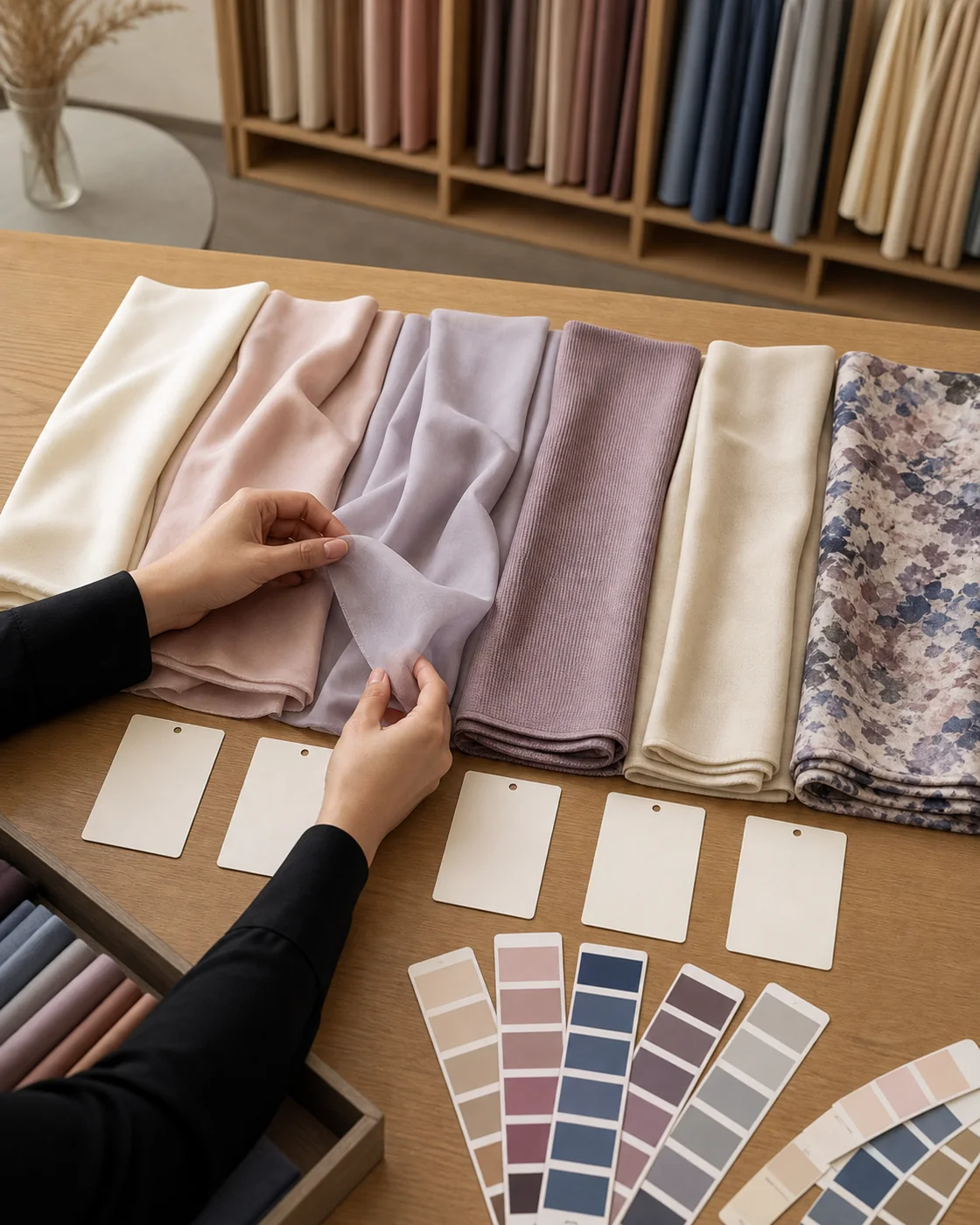
A hot-weather sample review should measure the complete product before and after realistic wear and care. Record the result so the approved reference can control bulk production.
- Confirmed fibre composition or supplier material reference
- Fabric construction and weight where relevant
- Finished length, width, shape and edge finish
- One- and two-layer opacity in the lightest and darkest colors
- Opacity under stretch where applicable
- Drape, airflow, grip, slippage and required securing method
- Dry hand feel, damp hand feel, cling and visible moisture
- Drying and appearance after drying under the same comparison conditions
- Creasing and recovery after wear and packing
- Shrinkage and dimensional stability after the agreed care test
- Colorfastness, shade and wet-transfer concerns
- Pilling, snagging, edge curl or surface change
- Label comfort and packaging recovery
- Sample code, color code, date and revision
A Simple Real-World Sample Evaluation
Use a controlled side-by-side wear and care comparison to narrow the shortlist. It does not replace laboratory testing or substantiate public performance claims.
- Condition and label every sample; photograph its initial appearance.
- Measure finished dimensions and record the styling setup.
- Check opacity flat, draped and styled in consistent light.
- Wear each sample for the same period with the same undercap and wrap.
- Record heat, damp feel, cling, slippage, pressure and adjustment at fixed intervals.
- Expose comparison samples to the same controlled moisture scenario and drying environment.
- Wash according to the proposed care instruction; dry consistently.
- Remeasure and inspect shade, hand feel, surface, edges and shape.
- Score each result against the product brief, not personal preference alone.
- Retain the selected sample as the approved reference.
How to Write Climate Requirements Into a Product Specification
Write measurable product requirements and an approved-use scenario instead of asking for a “summer fabric.” The specification should identify what is being supplied and how approval will be judged.
| Specification field | What to record | Approval evidence |
|---|---|---|
| Market and use | Target countries, season, everyday/occasion, indoor/outdoor context | Approved product brief |
| Material | Composition, supplier reference, construction and finish | Labeled fabric swatch |
| Weight | Agreed GSM and test method if specified | Measured sample; no universal “best” value |
| Dimensions | Finished length, width, shape and tolerances | Measured finished sample |
| Coverage | Expected layers, undercap assumption, stretch condition and colors checked | Styled opacity review |
| Handling | Drape, grip, stretch, recovery and edge behaviour | Approved wear sample |
| Moisture/care | Required evaluation, care direction and acceptance criteria where agreed | Comparison or qualified test report |
| Color | Color code plus physical approval on the production fabric | Approved shade reference |
| Quality control | Inspection points, methods and agreed tolerances | QC checklist and master sample |
Do not insert a fixed GSM, shrinkage limit, drying time or tolerance unless buyer and manufacturer have agreed it for the actual product and test method.
Common Mistakes When Sourcing Hijabs for Hot Weather
- Assuming the lightest GSM is automatically coolest.
- Selecting by fibre name without defining construction or blend.
- Testing a swatch instead of a finished, styled hijab.
- Ignoring the undercap and number of layers.
- Approving opacity only in a dark color.
- Equating absorbency with fast drying.
- Making “quick-dry” or “moisture-wicking” claims without suitable evidence.
- Ignoring damp cling, visible moisture or water spotting.
- Choosing smooth drape without testing grip and adjustment.
- Using one sample to represent every color.
- Skipping wash, shrinkage and dimensional review.
- Failing to define daily, travel, active or occasion use.
- Applying one cultural preference across an entire region.
- Ordering too many overlapping fabric families and SKUs.
- Not retaining the approved sample and specification for reorders.
Best Hijab Fabric by Buyer Priority
There is no single winner; the best shortlist changes with the buyer’s primary requirement and acceptable trade-offs.
| If the priority is… | Start by sampling… | Do not approve until… |
|---|---|---|
| Soft, fluid everyday styling | Lightweight modal and suitable blends | Opacity, grip, damp feel and creasing are accepted. |
| Matte, natural-look casual wear | Cotton voile or another suitable cotton construction | Drying, shrinkage, creasing and coverage are accepted. |
| Polished movement with low visual bulk | Matte, textured or other appropriate chiffon | Layering, slippage, snagging and edge finish are accepted. |
| Secure, low-adjustment styling | Lighter jersey with suitable recovery | Heat, opacity under stretch, pilling and drying are accepted. |
| Premium occasion presentation | Specific silk constructions or satin-surface options | Care, grip, marking, opacity and price position are accepted. |
| Broad warm-climate capsule | One everyday core plus one occasion or secure-style complement | Each fabric has a distinct role and passes the same sample process. |
Hot and Humid Climate Hijab Buyer Checklist
- Define the target countries and use cases.
- Separate climate assumptions from consumer-preference research.
- State everyday, work, travel, active or occasion positioning.
- Request exact composition, construction, finish and sample reference.
- Record weight only as part of the full specification.
- Confirm finished dimensions and edge construction.
- Test airflow and bulk in the intended wrap.
- Check opacity in one and two layers.
- Include the palest planned color.
- Check stretch opacity where relevant.
- Test grip, slippage and the intended fastening method.
- Evaluate the real undercap or no-undercap system.
- Compare dry and damp hand feel.
- Review cling, visible moisture and drying under equal conditions.
- Complete the agreed wash and dimensional checks.
- Inspect color, surface and edges after care.
- Assess pilling, snagging, creasing and recovery.
- Verify labels, composition wording and care directions.
- Assign every fabric a clear collection role.
- Approve a coded physical sample and written specification.
- Retain the approval set for production and reorders.
Frequently Asked Questions
What is the best hijab fabric for hot weather?
There is no universal winner. Start with lightweight modal, a suitable cotton construction, chiffon or lighter jersey, then choose the sample that balances airflow, opacity, practical bulk, grip and care in the intended styling system.
What is the best hijab fabric for humid climates?
The best option is the sample that remains comfortable when damp, does not cling excessively, dries acceptably under the intended care conditions and provides coverage without unnecessary layers. Compare equal finished samples rather than fibre names.
Is cotton good for hot weather?
It can be. Cotton performance depends on weave, density, finish and whether it is pure cotton or a blend. Buyers should check airflow, damp feel, drying, shrinkage, creasing and opacity.
Is modal good for humid weather?
Some modal constructions can work well for soft, fluid everyday styling, but modal is not one fixed specification. Check weight, construction, finish, damp cling, opacity, grip and required layering.
Is chiffon breathable?
The word “chiffon” does not guarantee breathability. Fibre, construction, density and finish affect airflow, while transparency may add an undercap or layers. Test the complete styled product.
Is jersey too hot for summer?
Not necessarily. Jersey ranges from lighter to heavier knits. A lighter construction may offer secure styling, while a dense or heavy quality may retain more heat. Check weight, density, stretch, recovery and sustained wear.
Which hijab fabric dries fastest?
No category is always fastest. Fibre content, construction, finish, weight, absorbed moisture, airflow and care conditions all change drying. Compare samples under the same method or use an appropriate test when making a performance claim.
Which hijab fabric is least slippery?
Jersey, textured fabrics and some cotton constructions often provide more grip than smooth chiffon or satin-like surfaces, but finish can change the result. Test the intended undercap and fastening method.
Does lower GSM always mean cooler?
No. Lower GSM does not describe weave openness, density, opacity, surface, dimensions or required layering. Evaluate GSM with the complete construction and wearing system.
Which fabric is best for tropical climates?
Light modal, suitable cotton, chiffon and lighter jersey can all be candidates. Use the target market’s actual climate and styling brief, then compare damp feel, drying, cling, grip, opacity and care on finished samples.
Build a Climate-Specific Sample Brief
The most useful enquiry describes the market climate, use case, preferred fabric directions, required coverage, styling method, dimensions, colors, quantity, label and packaging needs. NoorSilk can then review relevant product references and confirm what must be sampled for the actual brief.
Browse NoorSilk’s hijab fabric guide to compare available fabric directions, or prepare a project through the private-label hijab manufacturing process.
Compare the product, not only the fabric name
Ready to request hot-weather hijab samples?
Share your target climate and market, use case, preferred fabrics, colors, dimensions, styling method, quantity and customization. Sample options, feasibility, MOQ, pricing and timing can then be confirmed for the actual specification.