
Buyer Guide
Jersey Hijab Fabric: Stretch, Weight and Recovery
Direct answer
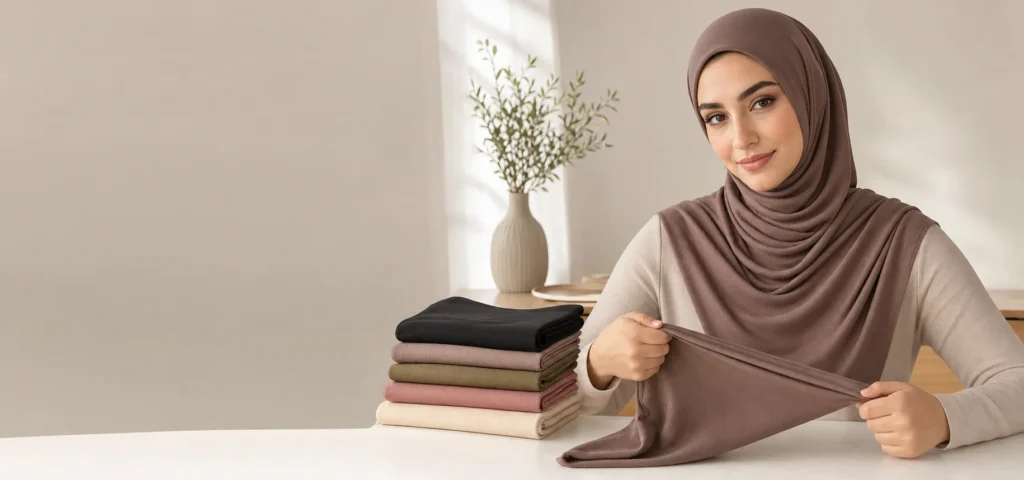
Jersey hijab quality cannot be judged by softness alone. Wholesale buyers should evaluate stretch, recovery, fabric weight, fibre composition, opacity, drape, surface texture and dimensional stability on the finished sample. A jersey that stretches readily but recovers poorly may grow, distort or lose shape over time. A heavier jersey may provide more body and coverage, but it can also feel warmer or bulkier. The right balance depends on product positioning, climate, styling behavior and the approved specification—not on one fabric name or GSM figure.
What Is Jersey Hijab Fabric?
Jersey hijab fabric is a knitted textile used to make stretchable scarves with flexible drape and a relatively easy-to-style feel. “Jersey” identifies a construction family rather than one fixed fibre, weight, stretch level or quality grade. Cotton, viscose or rayon, polyester and blends may all be made into jersey constructions, and some versions may include an elastic fibre.
That distinction matters commercially. Two suppliers can both offer “premium jersey” while presenting different compositions, knit densities, weights, surface finishes and recovery. Those differences can change opacity under tension, warmth, face framing, edge behavior, pilling tendency and how closely a repeat order matches an approved sample.
Use the term jersey as the beginning of the product brief. Then define the observable and measurable characteristics that matter to the intended customer. Buyers still deciding between material families can first compare hijab fabrics.
What Makes Jersey Different from Woven Hijab Fabrics?
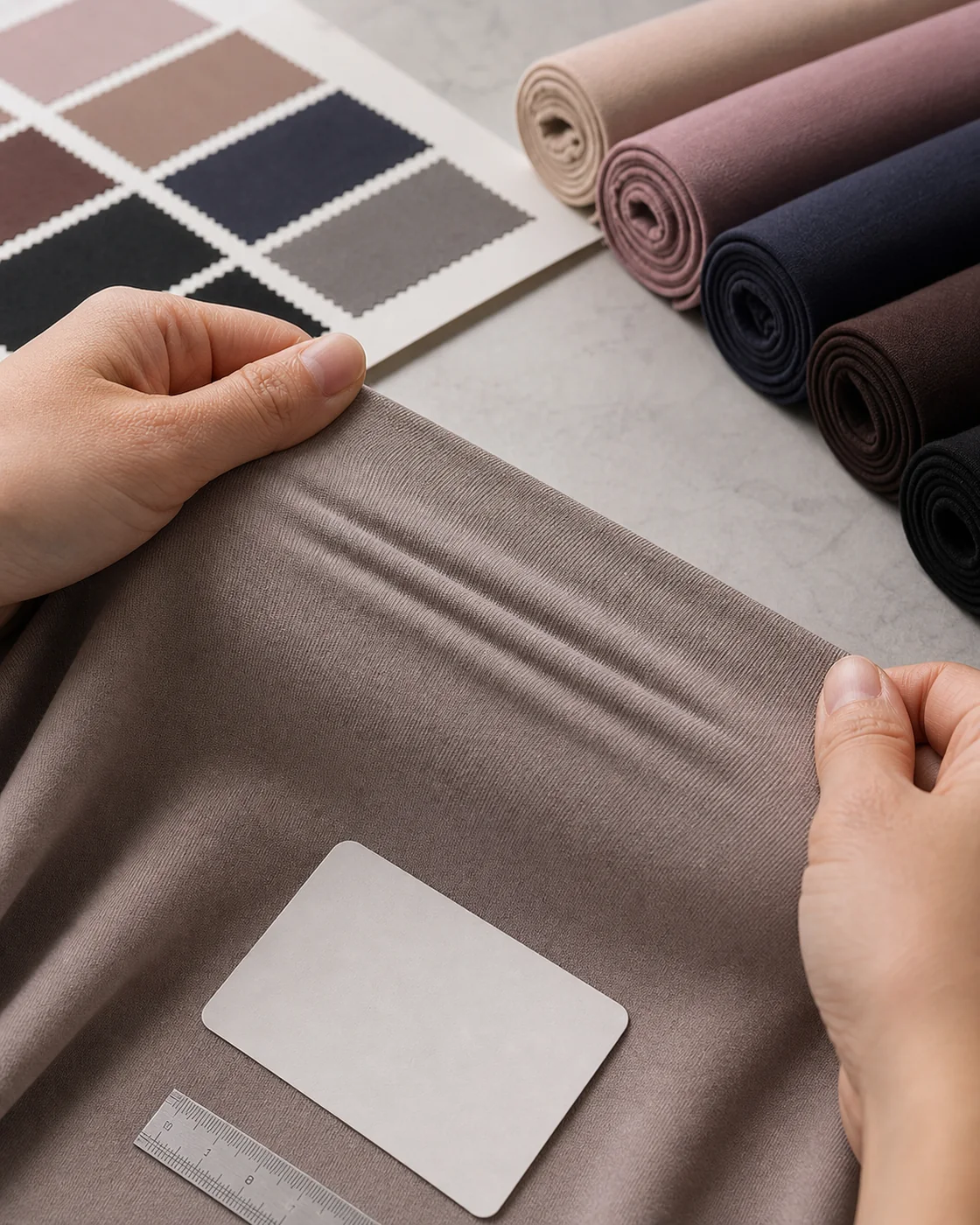
Jersey is formed from intermeshing loops, while woven fabrics are formed by intersecting yarn systems. The looped construction generally gives jersey more inherent flexibility and stretch than stable woven hijab fabrics such as many chiffon products. This changes both the wearing experience and the buyer’s sampling priorities.
| Buyer consideration | Jersey knit direction | Stable woven direction |
|---|---|---|
| Stretch | Often stretches through knit structure; direction and amount vary | Usually more dimensionally stable unless construction or elastic fibre adds stretch |
| Flexibility | Can conform readily during wrapping | May hold a cleaner or more defined fold |
| Drape | Can range from fluid to substantial depending on weight and construction | Can range from airy to structured depending on weave and finish |
| Edges | May curl, stretch or wave if cut and stitched without the right method | May fray and often needs an appropriate rolled or stitched finish |
| Sampling priority | Stretch, recovery, opacity under tension, surface wear and dimensional stability | Transparency, weave stability, snagging, grip, drape and edge finish |
These are directions, not universal rules. A dense, heavy jersey and a light jersey will not behave alike; neither will every chiffon or modal construction. Approve the complete finished hijab rather than applying one assumption to an entire fabric category.
What Does Stretch Mean in a Jersey Hijab?
Stretch describes how far and in which direction a fabric extends under force. More stretch is not automatically better. The appropriate amount must support comfortable styling without creating uncontrolled movement, excessive thinning, wavy edges or difficulty maintaining finished dimensions.
A buyer may encounter several descriptions:
- One-way stretch: greater extension in one principal fabric direction.
- Two-way stretch: commonly used commercially for stretch across two directions, although supplier terminology should be clarified.
- Mechanical stretch: extension created mainly by yarn and knit geometry rather than added elastic fibre.
- Elastic-fibre-assisted stretch: stretch influenced by elastane, spandex or another elastic component where used.
Ask which direction corresponds to the finished length and width. If a numerical stretch requirement is necessary, agree on the test method, specimen direction, load or extension, conditioning and reporting method. A percentage without those conditions is not a comparable specification.
Why Does Recovery Matter as Much as Stretch?
Recovery is the ability of a stretched fabric to return toward its original dimensions and shape after the force is removed. Stretch tells the buyer how the fabric extends; recovery helps explain what happens afterward. A jersey can feel pleasantly elastic at first yet retain unwanted growth after repeated wrapping or tension.
Poor recovery may appear as bagging, loose edges, distorted corners, uneven width or a scarf that no longer presents consistently. Better recovery supports fit, styling repeatability, shape retention and a more consistent appearance across normal use. It does not mean the product must feel tight or rigid; it means extension and return are balanced for the intended design.
| Observation | Possible interpretation | Buyer action |
|---|---|---|
| Fabric extends easily and returns close to its initial mark | Stretch and recovery may be reasonably balanced under that comparison | Repeat consistently and compare with the approved reference |
| Fabric remains longer after release | Residual growth or slower recovery may affect shape retention | Allow a defined recovery time and record the remaining change |
| Edges wave after extension | Construction, cutting or edge finish may not tolerate the applied tension | Check the full finished sample and the direction of stretch |
| Left and right sections behave differently | Orientation, cutting or material consistency may differ | Compare multiple positions and representative samples |
ASTM D2594 describes fabric stretch and growth measurements for applicable knitted fabrics under controlled conditions. It is useful evidence that stretch and retained growth are separate performance questions, but it should not be cited as a NoorSilk test unless that method is specifically agreed and performed for the order. A buyer-level comparison later in this guide is only a screening method, not a laboratory result.
How Does Fabric Weight Change Jersey Hijab Performance?
Fabric weight can influence opacity, warmth, body, drape, bulk, airflow and styling, but it cannot predict them alone. GSM means grams per square metre and expresses mass per unit area. The best jersey weight depends on composition, knit density, finish, product dimensions, climate and the desired styling behavior.
| Fabric characteristic | Lighter jersey direction | Heavier jersey direction | Buyer consideration |
|---|---|---|---|
| Opacity | May require closer review, especially under stretch | May provide more coverage, but not automatically | Check planned colors in relaxed and stretched states |
| Warmth | May feel less substantial | May feel warmer or denser | Match climate and wearing duration |
| Structure | May be softer and more fluid | May frame the face with more body | Style the full finished size |
| Bulk | Can create less volume when layered | Can add volume around folds and neck | Review the intended wrapping method |
| Drape | May fall fluidly but can cling | May create broader folds or controlled drape | Composition and finish can reverse expectations |
| Breathability | Lower mass may help, but construction still matters | Higher mass may reduce perceived airflow | Do not infer comfort from GSM alone |
There is no universal best GSM for a jersey hijab. Compare weight with construction, stretch, recovery, color, opacity, surface, dimensions and the wearing context. If GSM is specified, record the method and tolerance alongside an approved fabric reference.
Does Heavier Jersey Mean Better Quality?
No. A heavier jersey is not automatically higher quality, more durable or more premium. It may suit a structured, opaque or cooler-weather direction, while a lighter construction may better fit a breathable, fluid or low-bulk product. Either can fail if its recovery, surface, color or finishing is inconsistent.
Evaluate quality through a combined review of fibre composition, yarn and knit construction, density, recovery, surface finish, pilling resistance, color consistency, dimensional stability, stitching and edge finish. The commercial label “premium” is not an acceptance standard. Translate it into a documented sample and criteria that both buyer and supplier can use.
Cotton Jersey vs Viscose Jersey vs Blended Jersey
No single composition is best for every jersey hijab. Fibre content influences hand feel, moisture interaction, drape, resilience, care and surface behavior, but knit construction, yarn, weight and finishing can materially change the result. Use composition to narrow the direction, then approve the physical product.
| Composition direction | Possible characteristics to evaluate | Potential trade-offs | Buyer checks |
|---|---|---|---|
| Cotton jersey | Natural-fibre hand, moisture absorbency, matte or casual positioning | Recovery, drying, shrinkage and surface wear depend on construction and blend | Confirm percentage, weight, recovery, care and dimensional change |
| Viscose/rayon jersey | Soft hand and fluid drape may be achievable | Wet handling, recovery, dimensional stability and care need review | Confirm exact fibre declaration, knit, finish and after-care sample behavior |
| Polyester jersey or polyester-rich blend | Can support resilience, repeatable surface and practical care directions | Heat comfort, shine, pilling and hand feel vary widely | Check airflow perception, surface abrasion, recovery and finish |
| Blend with elastane/spandex | May increase extension and recovery when appropriately engineered | More elastic fibre does not guarantee better comfort or shape retention | Confirm content, direction, power, recovery and edge behavior |
| Multi-fibre blend | Can balance softness, resilience, drape or cost objectives | The product cannot be judged from the leading fibre name alone | Record the complete composition and approve the finished sample |
Terms such as “cotton feel,” “modal jersey” or “viscose touch” should not replace a confirmed fibre declaration. The required composition and product information must be based on the material actually supplied and the rules of the destination market.
How Does Composition Affect Stretch and Recovery?
Composition affects stretch and recovery, but it is only one part of the system. Fibre elasticity and friction interact with yarn structure, loop geometry, knit density, fabric direction, finishing and any elastic-fibre content. Two fabrics with the same fibre percentages can therefore recover differently.
Likewise, the presence of spandex or elastane does not prove that a jersey will feel comfortable, remain dimensionally stable or recover evenly. The amount, yarn placement and construction matter. Excessive elastic power may feel restrictive; insufficient recovery may leave growth. Buyers should compare samples made to the proposed composition, weight and finish rather than approving a fibre list in isolation.
Why Can a Jersey Hijab Become More Transparent When Stretched?
Stretch can open the knit structure and reduce the amount of material covering a given visual area, making some jersey fabrics appear more transparent under tension. The effect depends on weight, knit density, yarn, fibre, color, finish, lighting and the degree and direction of stretch.
Inspect opacity in at least three contexts: relaxed in a single layer, stretched to a realistic styling tension, and folded or layered as the product will be worn. Repeat the check under daylight, normal indoor light and controlled backlighting. Light and dark colors from the same base may not appear equally opaque, so color approval should include coverage rather than relying on one dark sample.
Avoid an undefined promise such as “fully opaque.” Document the expected coverage, number of layers, lighting and tension used for approval. GSM alone cannot establish opacity.
Drape vs Structure in Jersey Hijabs
Jersey can be fluid and close to the body or substantial enough to create fuller folds and stronger face framing. Drape describes how it falls; structure describes how much body it retains. The preferred balance depends on styling, coverage, volume, layering and the intended customer proposition.
A soft, fluid jersey may support easy wrapping and a relaxed silhouette, yet it can cling more closely or show less sculpted volume. A more substantial jersey may hold shape and create coverage, yet add warmth or bulk. Weight contributes, but composition, loop construction, recovery and finish also influence the result.
Why Should Buyers Check Pilling and Surface Wear?
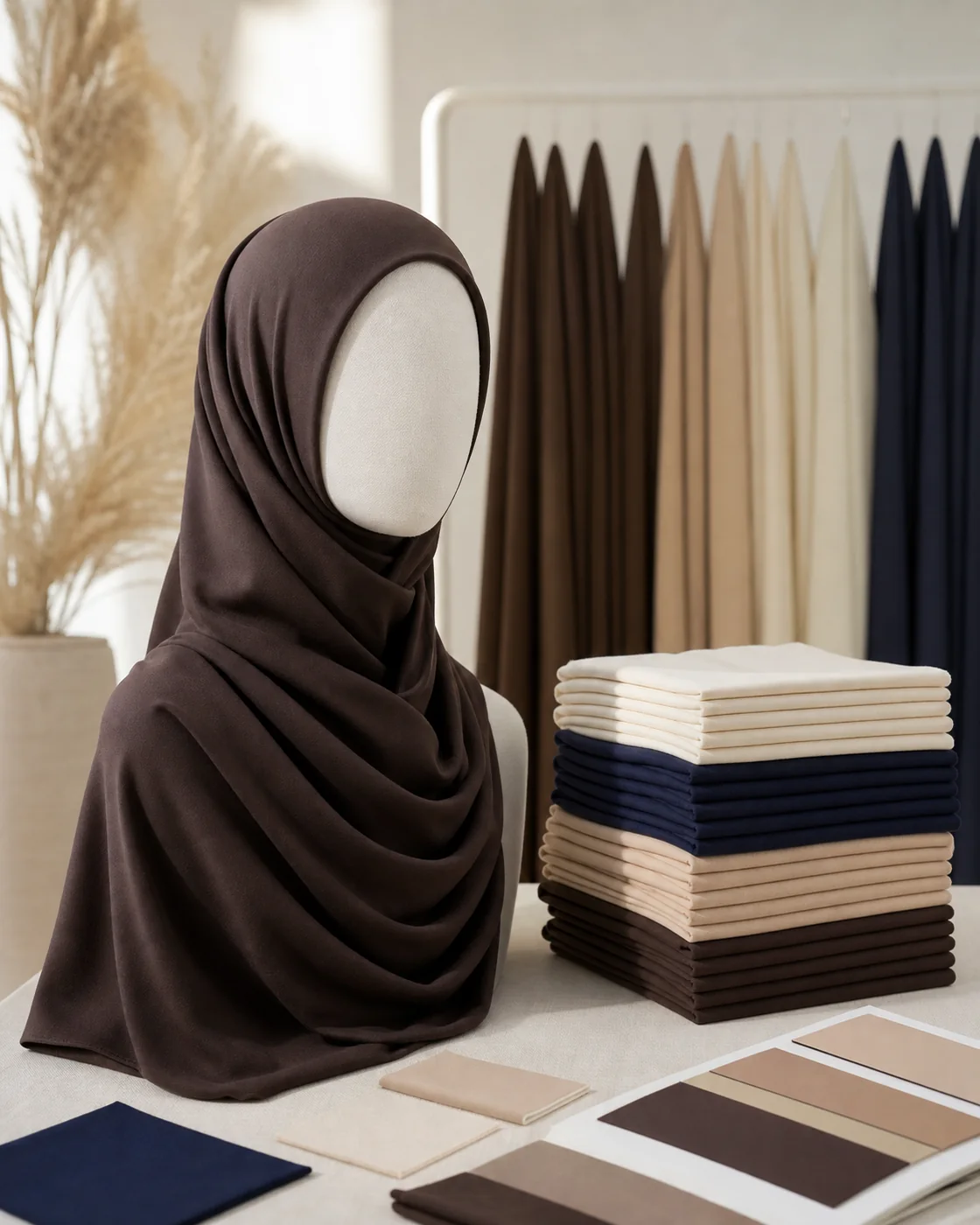
Jersey surfaces can experience friction, fuzzing, abrasion and pilling during wear, care and packing. Fibre type, staple length, yarn, knit structure, finishing and usage all influence the result. Repeated contact at the chin, shoulders, clothing or bag straps can expose differences that a new sample does not show immediately.
During development, inspect the surface before and after controlled handling and appropriate care. Compare representative colors because visible contrast can change how surface wear is perceived. If formal pilling performance is required, agree on a suitable laboratory method, specimen preparation, cycles and acceptance rating. ASTM D4970/D4970M is one recognized Martindale pilling method applicable to many knitted and woven fabrics, but suitability and acceptance criteria must be agreed; this article does not claim NoorSilk testing or a product score.
Shrinkage and Dimensional Stability
Jersey dimensions can change through washing, moisture, heat, relaxation and finishing, but not every jersey shrinks substantially or in the same direction. Dimensional stability should be checked on the actual fabric and finished hijab using the intended care context.
Confirm finished length and width, the measurement method, tolerance, care instructions and any dimensional-change expectation. For an internal buyer comparison, measure a marked sample, follow the agreed care procedure, condition it appropriately and measure again. Do not convert one informal wash into a certified claim.
ISO 5077 describes determination of dimensional change after specified washing and drying procedures, used with appropriate preparation and laundering procedures. It provides a formal framework when such testing is required, but NoorSilk should only be associated with a particular method if it is explicitly agreed and documented for the order.
How Does Edge Finishing Affect a Jersey Hijab?
The edge finish affects appearance, stretch, curling, durability, dimensions and perceived quality. Because a knit edge can stretch or curl differently from a light woven edge, the sewing method, thread tension, cut direction and handling must suit the selected jersey.
Possible directions include a rolled or narrow stitched hem, overlock finish, a clean-cut or raw edge where the approved fabric allows it, and other product-specific treatments. Availability and suitability must be confirmed rather than assumed. Review whether the edge lies flat, waves, tunnels, feels bulky, recovers after extension and remains consistent at corners.
Approve the full-size finished sample. A fabric swatch cannot show how the production edge will change drape or usable dimensions.
How Does Climate Affect Jersey Fabric Selection?
Climate changes the balance a buyer may seek between weight, airflow, moisture comfort, coverage and structure. Buyers targeting warm or humid markets may prioritize lower bulk, breathable construction and comfort over long wearing periods. Cooler-market or seasonal collections may accept a heavier, more substantial jersey where added body or warmth fits the product concept.
These are planning directions, not country-wide consumer rules. Indoor air conditioning, layering, styling, activity level and customer preference can matter as much as outdoor temperature. Test the proposed weight and composition with the target use instead of assigning one fabric to an entire region.
What Should Wholesale Buyers Check in a Jersey Hijab Sample?
A jersey sample should be evaluated as a complete product, not touched once and approved for softness. Use consistent lighting, tension, measurement and care conditions, and compare the result with the written brief.
| Check | How to review it | Record |
|---|---|---|
| Composition | Confirm the complete declared fibre content | Percentages and reference |
| Weight | Compare GSM or approved weight reference where applicable | Method, target and tolerance |
| Stretch direction | Test lengthwise and widthwise orientation | Direction relative to finished product |
| Stretch feel | Extend consistently and compare resistance | Approved sample or defined requirement |
| Recovery | Release after consistent extension and observe residual growth | Timing, method and comparison |
| Opacity | View relaxed, stretched and layered under several lights | Color, tension, layers and lighting |
| Drape and structure | Style the full finished dimensions | Photos plus physical reference |
| Surface | Inspect texture, evenness, fuzzing and pilling tendency | Before/after comparison |
| Edges and stitching | Check flatness, curl, wave, thread and corners | Finish method and approved sample |
| Dimensions | Measure by the agreed method before and after relevant care checks | Length, width and tolerance |
| Color | Compare physical reference under agreed lighting | Name, code and approved swatch |
| Packaging | Fold, pack, reopen and inspect pressure or crease effects | Folding and pack-out reference |
How Can a Buyer Check Stretch and Recovery During Sampling?
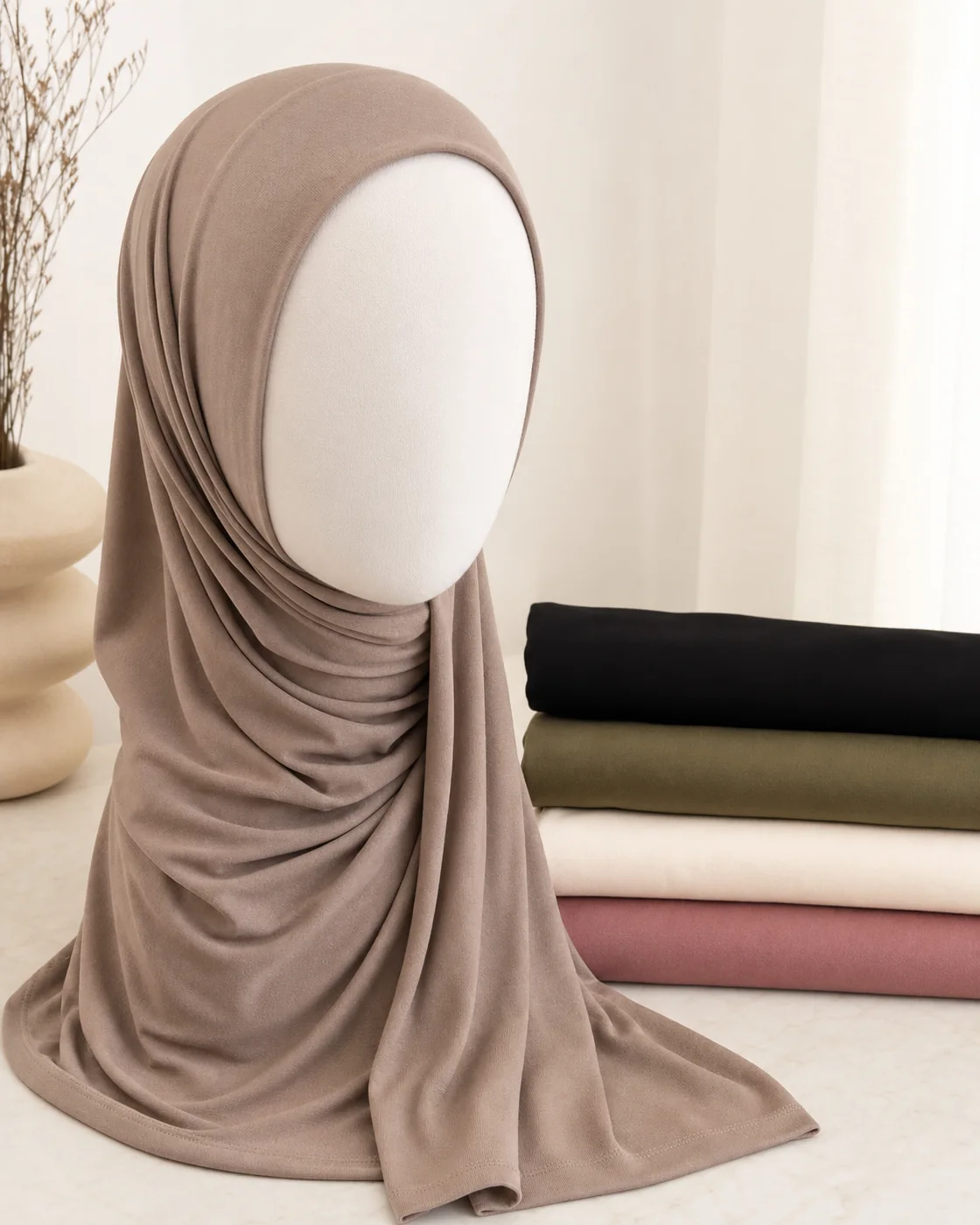
A simple controlled comparison can reveal meaningful differences between samples, although it cannot replace laboratory testing. Use equal specimen direction, dimensions, extension, hold time, release time and environment for every comparison.
- Choose a flat, undamaged section away from the finished edge and identify the knit direction.
- Mark two reference points at a measured starting distance without cutting or damaging the product.
- Extend each comparison sample consistently to the same agreed distance or under the same controlled approach.
- Hold for the same defined time, then release without snapping the fabric.
- After the same recovery interval, measure whether the points return close to the starting distance.
- Inspect surface distortion, waviness, curling, width change and visual opacity.
- Repeat in the other relevant direction and compare multiple areas or samples.
- Record method, timing, observations and sample version.
This screening method is useful for relative buyer decisions only. It does not create an ASTM, ISO or accredited-laboratory result, and the applied force is not controlled unless appropriate equipment and a recognized method are used.
How to Write Jersey Fabric Requirements in a Specification Sheet
A specification sheet should convert subjective requests such as “soft,” “stretchy” or “premium” into a controlled material and finished-product reference. Tie each requirement to the approved sample, revision and evaluation context.
| Specification field | What to record | Why it matters |
|---|---|---|
| Product code | Unique SKU and revision | Separates styles and approval versions |
| Fabric name | Jersey direction plus supplier/reference code where available | Avoids relying on a generic category name |
| Fibre composition | Confirmed fibre percentages | Supports performance review and correct product information |
| Knit construction | Relevant construction or approved physical reference | Influences stretch, surface and stability |
| Weight | Target GSM, method and tolerance if specified | Controls one important material variable |
| Stretch | Direction and requirement with method if numerical | Defines extension behavior |
| Recovery | Expected return or approved comparison method | Controls residual growth and shape retention |
| Finished dimensions | Length, width, measuring method and tolerance | Controls coverage and material use |
| Color | Name, physical reference and approval lighting | Improves repeatability and opacity review |
| Opacity | Relaxed and stretched expectations, layers and lighting | Prevents ambiguous coverage claims |
| Surface finish | Texture, matte/shine direction and approved hand | Influences comfort, wear and presentation |
| Edge finish | Method, thread, appearance and corner reference | Affects durability, curl and drape |
| Care and stability | Instructions and agreed dimensional-change requirement | Aligns product behavior and customer information |
| Labels | Content, size, position and attachment | Controls branding and product information |
| Packaging | Fold, individual pack, SKU label and carton needs | Controls presentation and handling |
| Approval | Sample ID, date, revision and approver | Creates the production reference |
Use the guide to private-label hijab manufacturing to connect the fabric specification with sample approval, production, quality review and packaging.
Jersey Hijab vs Chiffon Hijab: What Changes for the Buyer?
Jersey sourcing emphasizes stretch, recovery, surface wear and dimensional stability; chiffon sourcing usually places more emphasis on transparency, grip, weave surface, snagging and a delicate edge. Both require weight, color, drape, dimensions and finished-sample approval.
| Dimension | Jersey direction | Chiffon direction |
|---|---|---|
| Construction | Knitted | Woven chiffon construction |
| Stretch | Often inherent and central to performance | Usually more limited; evaluate tension and bias behavior |
| Opacity | Must be checked relaxed and stretched | Often evaluated by color, density, light and layers |
| Grip | Knit surface can support secure styling, depending on finish | Smooth or textured surfaces can behave differently |
| Edges | Watch curl, wave and stretch | Watch fraying, rolled hems and delicate handling |
| Sampling priority | Recovery, growth, pilling and stability | Sheerness, snagging, grip and edge quality |
For a deeper chiffon review, see the guide to chiffon fabric types for hijabs. This comparison is intentionally limited so that each article keeps a distinct search purpose.
Jersey Hijab vs Modal Hijab
“Jersey” describes a knit construction, while “modal” identifies a fibre category. They are not exact opposites: modal fibre can be used in different constructions, including knit products, and commercial product names may overlap. Buyers should therefore compare the actual composition and construction rather than assuming every modal hijab is woven or every jersey has the same fibre.
Jersey purchasing often focuses on stretch and recovery; modal sourcing may emphasize softness, fluidity, weight, opacity and drape. In either case, weight, color, finish, dimensions and sample approval remain important. The separate guide to modal hijab weight, opacity and drape develops that fibre-focused decision.
Common Mistakes When Sourcing Jersey Hijabs
Most sourcing mistakes happen when one attractive characteristic is treated as proof of complete product quality.
- Choosing by softness alone: a soft hand does not confirm recovery, opacity or stability.
- Ignoring recovery: high initial stretch can hide unwanted growth after release.
- Comparing only GSM: construction, composition and finish can make similar weights behave differently.
- Checking opacity only when relaxed: the knit can open under styling tension.
- Not confirming composition: a commercial fabric name is not a fibre declaration.
- Ignoring pilling and abrasion: friction can change the surface during real use.
- Ignoring edge behavior: an unstable or wavy edge changes appearance and dimensions.
- Assuming shrinkage: neither “no shrinkage” nor a generic percentage should be guessed.
- Skipping physical samples: photos cannot establish hand, power, recovery or opacity.
- Not documenting the approved fabric: repeat orders lose their physical and written reference.
- Assuming all jersey is alike: fibre, yarn, knit, density, weight and finish all matter.
Jersey Hijab Buyer Checklist
- Confirm the complete fibre composition.
- Confirm the knit type or approved construction where relevant.
- Record the fabric weight or approved weight reference.
- Identify stretch direction relative to finished length and width.
- Evaluate stretch under consistent conditions.
- Evaluate recovery and residual growth after release.
- Check opacity in the relaxed state.
- Check opacity under realistic stretch and lighting.
- Evaluate drape, structure, volume and layering on the full size.
- Check surface texture, evenness, fuzzing and pilling tendency.
- Confirm finished dimensions, method and tolerance.
- Inspect stitching, corners, curling and edge finish.
- Approve each important color against a physical reference.
- Review appropriate care and dimensional stability.
- Approve the finished sample and packaging.
- Record the final specification and revision before bulk production.
From Jersey Fabric Evaluation to a Wholesale Inquiry
Once composition, weight, stretch, recovery, opacity, dimensions, surface and edge finish are defined, the buyer can move from fabric research to product selection and quotation. Send the target market, use case, SKU and color breakdown, quantity, branding, packaging and approved references with the specification.
Review NoorSilk’s jersey hijab manufacturing and wholesale route for commercial development, or browse the jersey hijab product collection to identify relevant product directions. New brands can also use the sourcing checklist on how to start a hijab brand before preparing the final inquiry.
The goal is not to find the stretchiest, heaviest or softest fabric. It is to approve a jersey that delivers the intended balance of comfort, coverage, drape, recovery, surface durability and repeatable production for the collection.
Define jersey performance before bulk production
Ready to compare a jersey sample for your collection?
Share the composition or fabric direction, weight, stretch and recovery expectations, dimensions, colors, edge finish, quantity, branding and packaging.
Request a Jersey Sample or QuoteDiscuss Jersey Requirements on WhatsApp