Buyer Guide
Custom Hijab Labels and Logo Methods Compared
Direct answer
Which label or logo method is best for a custom hijab? The best method depends on the hijab fabric, product construction, desired appearance, comfort requirements, artwork, order quantity, budget and target market. Buyers should compare finished samples rather than selecting a method by name alone. A complete branding system may use a permanent brand or care label on the product, a removable hang tag, SKU identification and branded packaging, but each element has a different job and must be specified separately.
What Do “Custom Hijab Labels” Actually Include?
Custom hijab labels can refer to several different product and packaging components, not one universal label. The first sourcing task is to separate permanent product identification, required consumer information, warehouse identification and removable retail presentation.
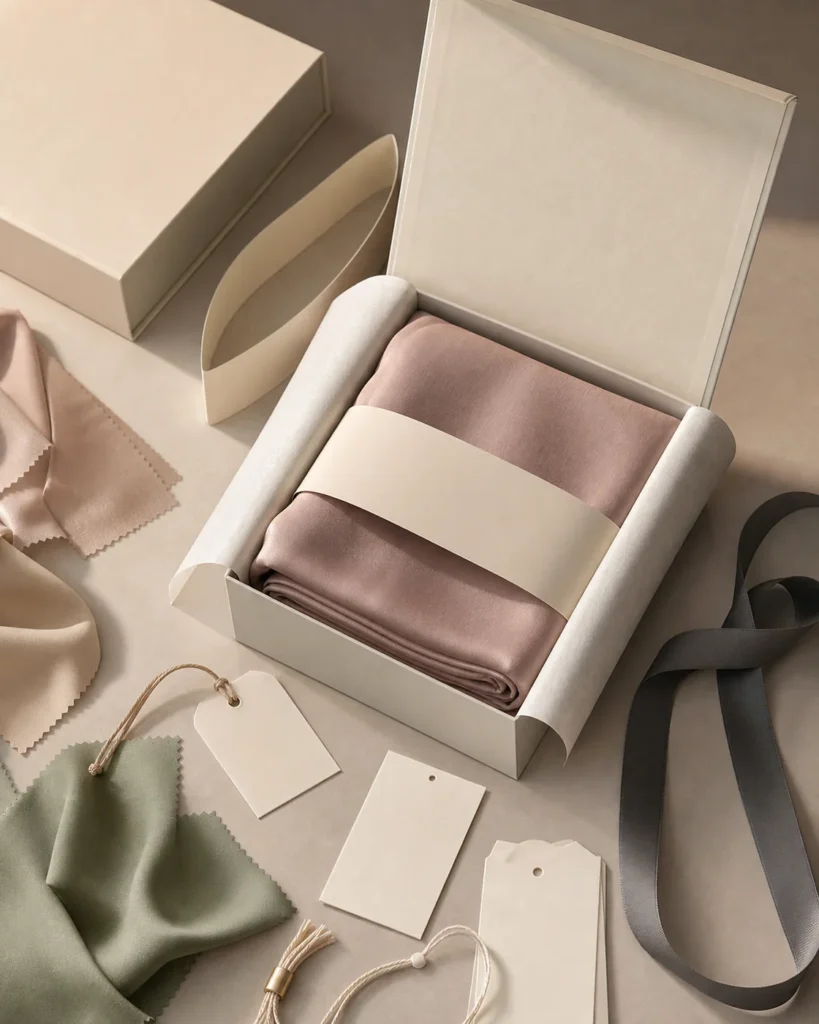
A private-label brief may include a woven or printed brand label, a care or composition label, a size or SKU label, a hang tag, a branded sticker, a printed package or a logo applied directly to the hijab. Some elements can combine more than one function, but combining them should be a deliberate choice rather than an assumption.
Availability depends on the fabric, construction and project. This guide compares possible branding methods from a buyer’s perspective; it does not state that every method is available from NoorSilk or suitable for every order.
Brand Label vs Care Label vs SKU Label vs Hang Tag
These four items serve different purposes. A brand label identifies the brand, a care label communicates product information, a SKU label connects the item to inventory, and a hang tag provides removable retail or marketing information.
| Component | Primary role | Typical information | Buyer decision |
|---|---|---|---|
| Brand label | Permanent or semi-permanent brand identity | Brand name, logo or product line | Material, attachment, size and placement |
| Care/composition label | Product and care information | Fibre content, care, responsible-business or origin information where applicable | Content, language, format and target-market review |
| SKU/size label | Inventory and variant identification | Product code, color, size or barcode | Mapping to purchase order and packaging |
| Hang tag | Removable retail communication | Story, price field, barcode, collection or care summary | Card, print, attachment point and removal |
| Packaging mark | Protection and presentation | Logo, SKU, barcode, warning or handling information | Unit pack, sticker, print and carton relationship |
A buyer should not ask simply for “a custom label.” State which component is needed, where it sits, whether it remains on the product and which information it must carry.
What Is a Woven Label for a Hijab?
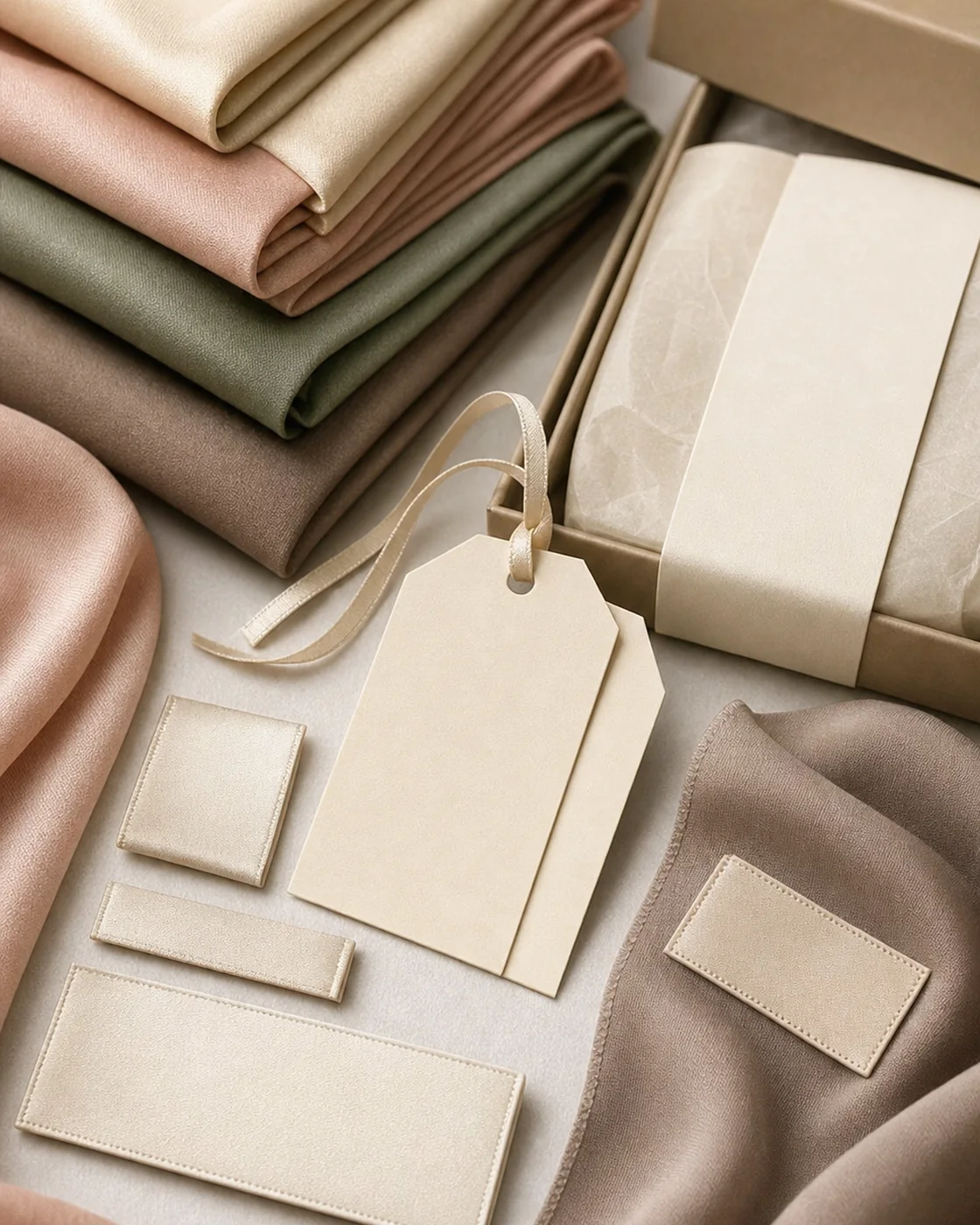
A woven label forms letters and graphics from interlaced yarns rather than printing ink onto a label surface. It can create a structured textile identity, but the finished thickness, edge, backing, fold and attachment all affect how it feels on a hijab.
Woven construction can suit clear logos and repeated brand presentation. Very fine artwork, tiny text or complex color transitions may require simplification, depending on the label construction and scale. A larger or stiffer label may also be more noticeable on a lightweight product.
Buyers should approve the actual woven sample, not only a digital proof. Check logo legibility, yarn colors, edge finish, fold type, seam allowance, orientation, attachment thread and skin-contact comfort.
What Is a Printed Fabric Label?
A printed fabric label applies text and graphics to a prepared label material. It can carry finer text or more information than some woven constructions, which can be useful for care, composition or multilingual content.
Performance depends on the label substrate, print process, ink, finishing and care conditions. A visually sharp digital proof does not confirm the feel, flexibility, edge behaviour or print performance of the finished label.
Approve the printed sample for text accuracy, contrast, legibility, color, surface feel, cut edge, fold, attachment and compatibility with the proposed care instructions. Do not assign an unverified wash-life claim or assume all printed labels behave alike.
When Is a Heat-Transfer Logo Suitable?
A heat-transfer logo may be considered when the buyer wants a directly applied mark without a sewn label, but suitability depends on fabric response, transfer material, heat, pressure, logo size, placement and intended care.
The application can create a clean visual result, yet it may change handfeel, flexibility, drape or stretch in the marked area. Fine fabrics can react to heat or pressure, and elastic fabrics require the applied mark to be assessed during movement. These are sample questions, not reasons to presume that a transfer is either suitable or unsuitable for every hijab.
Inspect adhesion, edge definition, surface change, cracking or lifting risk, color, stretch response and appearance from both sides of the finished sample. Availability and production conditions must be confirmed with the manufacturer for the exact product.
When Can an Embroidered Hijab Logo Be Considered?
Embroidery may be considered when a buyer wants a stitched, dimensional mark and the fabric and product construction can support it. It adds thread and stitch density to the selected area, so weight, stiffness, puckering and reverse-side comfort require review.
Logo detail must be translated into stitches. Very small letters, tight curves or dense filled areas may not reproduce like a screen graphic. Stabilisation, thread, stitch direction, backing and edge placement can also change the result.
Approve embroidery on the intended hijab fabric at the intended location. Check distortion, puckering, thread color, loose or missed stitches, back-side finish, drape and whether the marked area remains comfortable in use. This is a possible method to discuss, not a statement of universal NoorSilk availability.
How Does Direct Printing Differ From an Attached Label?
Direct printing makes the brand mark part of the printed surface or artwork, while an attached label is a separate component fixed to the product. The direct-print option must therefore be coordinated with the complete print file, fabric, color process, scale and placement.
It can avoid the bulk of an attached component, but the logo shares the same production variables as the main print. Position can shift relative to cutting and edges unless the artwork and finished format are planned together. Color and fine detail also depend on the print process and fabric surface.
The guide to preparing artwork for custom printed hijabs explains repeat, scale, borders, color references and file control. Treat direct logo printing as part of that approved artwork, not as an informal instruction added after sampling.
What Role Do Hang Tags and Removable Branding Play?
Hang tags provide removable communication without permanently changing the hijab surface. They can carry brand story, product details, barcode, price field, collection information or a short care message.
A hang tag does not replace any product information that must remain with the item under the rules of the destination market. Buyers should specify card size, stock direction, print, finish, hole or attachment method, string, safety considerations, placement and whether removal could snag or mark the fabric.
Branded stickers can identify unit packaging or close tissue and sleeves, but adhesive, print, barcode quality and placement need approval. Do not use a packaging sticker as an unexamined substitute for product identification.
How Does Branded Packaging Support a Hijab Label System?
Branded packaging connects the product to its retail presentation, SKU and delivery condition. It can include a printed pouch, sleeve, box, insert or sticker, depending on the approved project.
The pack should protect the fabric and keep the correct hijab, label, hang tag and SKU together. A visually attractive package still fails commercially if its barcode, color name, product code or enclosed item is wrong.
Specify the unit-pack structure, material direction, dimensions, artwork revision, product orientation, fold, closure, SKU position, carton assortment and any target-market information. The packaging option and its availability should be confirmed for the actual order.
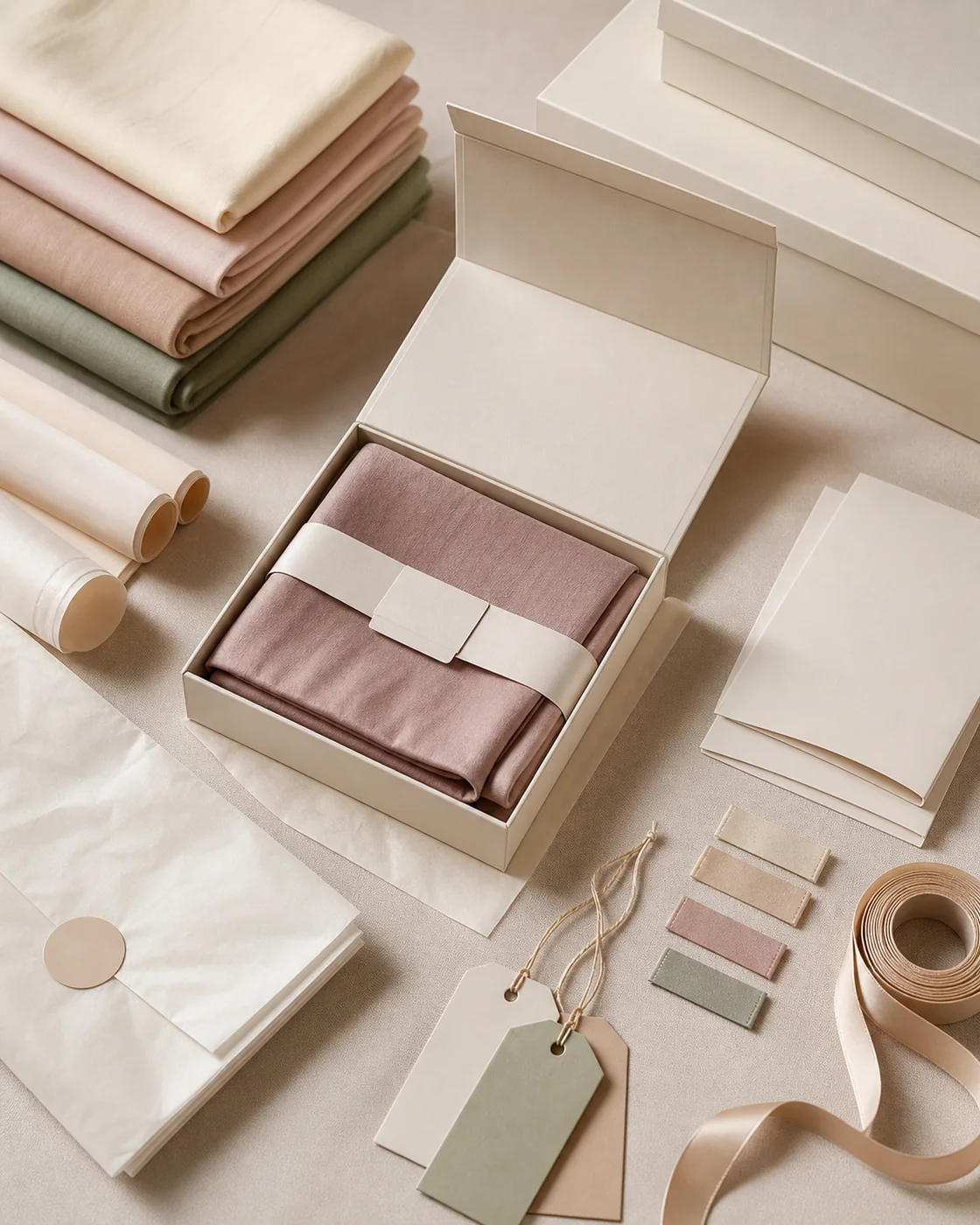
Custom Hijab Logo Methods Compared
No method wins every comparison. The useful decision compares finished appearance, feel, information capacity, fabric behaviour, production setup and reorder control for the same product brief.
| Method | Visual direction | Touch and flexibility | Detail/color considerations | Approval focus |
|---|---|---|---|---|
| Woven label | Textile, structured identity | Depends on yarn, density, fold and backing | Fine detail may need simplification | Weave, colors, edges, fold and attachment |
| Printed fabric label | Clean text and graphics | Depends on substrate and finish | Can carry fine or multilingual text | Legibility, print, feel and care behaviour |
| Heat-transfer logo | Direct surface mark | May affect the applied area | Edges, color and small detail vary by system | Adhesion, fabric response and movement |
| Embroidery | Stitched, dimensional mark | Adds thread, weight and local structure | Artwork must translate into stitches | Puckering, reverse side, drape and comfort |
| Direct print | Integrated with surface artwork | No separate sewn component | Depends on fabric and print process | Scale, placement, color and cut alignment |
| Hang tag | Removable retail communication | Does not remain on product | High information capacity | Print, attachment and correct SKU |
| Sticker/packaging | Branded product presentation | Normally separate from wear surface | Supports barcodes and variant data | Adhesive, print, pack and product mapping |
Cost direction and order feasibility cannot be ranked universally from this table. They depend on specifications, quantity, artwork, colors, setup, sampling and the chosen supplier’s confirmed quotation.
How Does Hijab Fabric Change the Branding Decision?
Fabric changes how a label or logo sits, moves, stretches, reflects light and feels against the wearer. The decision must be tested on the final material rather than transferred from another product.
| Fabric behaviour | Branding risk to review | Sample action |
|---|---|---|
| Lightweight and sheer | Show-through, local weight and edge distortion | View both sides, drape and wear position |
| Soft and fluid | Stiff branding area or interrupted drape | Compare movement with an unbranded reference |
| Stretch knit | Restricted stretch, lifting or puckering | Test stretch and recovery with the mark applied |
| Smooth or lustrous | Needle marks, surface pressure and visual contrast | Inspect under relevant lighting and handling |
| Textured | Reduced print or fine-detail clarity | Approve logo legibility on the actual surface |
| Printed | Logo competes with repeat or border | Approve the complete finished layout |
What Should Buyers Consider for Lightweight Chiffon?
Lightweight chiffon makes the weight, stiffness, show-through and attachment of a branding component especially important. A label that works on a heavier fabric can pull or visually dominate a light scarf.
Check whether stitching or an applied logo changes the edge, creates puckering, shows through or interrupts the intended transparency and drape. Placement near a corner or edge still requires a construction review; it is not automatically safer.
Compare branded and unbranded finished samples in normal drape and under relevant light. The fabric type alone cannot confirm which method will work.
What Should Buyers Consider for Modal and Other Soft Fabrics?
For soft, fluid fabrics, the main question is whether the branding preserves the intended handfeel and movement. A rigid or dense component can create a local area that hangs differently.
Review label softness, fold, seam, transfer-film feel, print penetration or embroidery density as applicable. Check both the visible face and the reverse, then style the sample rather than judging it flat on a table.
The specific modal construction, weight, finish and product dimensions still matter. “Modal” alone does not predict the result.
What Changes When the Hijab Fabric Stretches?
Jersey requires the branding method and attachment to move with the fabric or to occupy a location where restricted stretch is acceptable. Otherwise the logo can distort, the fabric can pucker or the marked area can recover differently.
Test the intended direction and range of movement using a consistent handling sequence. Inspect logo shape, attachment, surface, edge and fabric recovery after handling; do not infer performance from a static image.
The guide to jersey hijab stretch and recovery provides the wider fabric context for this decision.
What Should Be Reviewed on Silk and Satin Surfaces?
Smooth or lustrous surfaces require attention to needle marks, pressure, snagging, puckering, show-through and the contrast between the logo and the fabric sheen.
Silk identifies a fibre category, while satin describes a weave or surface construction; neither word alone defines branding compatibility. Fibre, weave, weight, finish and care direction all affect the result.
Inspect the sample in lighting relevant to sale and wear. A logo that looks subtle from one angle may appear much stronger against a reflective surface from another.
Which Branding Methods Can Affect Comfort?
Any permanent component can affect comfort if it adds a hard edge, stiff area, rough thread, adhesive layer, backing or bulky seam where the hijab touches skin.
Comfort depends on placement and styling as well as material. Check the front and back of the mark, folded edges, attachment threads and corners. Wear or style the finished sample in the intended position and note whether the component rubs, pulls or changes drape.
A removable hang tag avoids permanent contact after purchase, but its temporary attachment must still avoid damaging the product. Do not approve comfort from artwork alone.
How Should Logo Size and Placement Be Specified?
Record logo dimensions and placement from defined product edges or reference points. Descriptions such as “small logo near the corner” are not reproducible production instructions.
The specification should state finished logo or label dimensions, orientation, face, distance from edges, attachment direction and permitted placement tolerance if one has been agreed. Use a marked drawing and a finished sample. Consider how the logo appears when the hijab is flat, folded, packaged and styled.
This article does not set a universal logo size, label size or NoorSilk tolerance. Those values depend on the product, artwork, method and order agreement.
How Should Logo and Label Colors Be Approved?
Use named color codes to communicate the target and a physical sample on the intended material to approve the result. The same color specification can appear different in yarn, ink, transfer material, embroidery thread and packaging.
Review contrast, legibility and interaction with the hijab color under agreed lighting. Record whether the approval applies to the logo, label ground, text, thread, tag, sticker or package, since each uses a different material context.
The article on Pantone color matching for custom hijab production explains why a code is a communication reference rather than a guarantee of identical appearance across materials.
What Artwork Should a Buyer Prepare?
Prepare a controlled logo file plus a placement document and content file. The manufacturer needs to know what the mark is, how large it should be, where it goes and which version is approved.
- Provide a vector logo when the selected process requires or benefits from it.
- Keep editable text or convert fonts appropriately for the agreed workflow.
- Identify every artwork file with a revision.
- State finished dimensions and orientation.
- Show placement on a measured product drawing.
- List color codes and physical approval references.
- Separate logo artwork from care-label copy and barcode data.
- Confirm ownership or permission to use the logo, artwork and typefaces.
- Approve the production proof and physical sample, not only the source file.
Raster resolution, vector formats and production preparation depend on the method. Confirm technical file requirements with the selected manufacturer rather than exporting one file and assuming it suits every process.
What Information Should a Hijab Label Contain?
The correct content depends on the label’s purpose and destination market. Separate stable product information from variable SKU, price, barcode and logistics data.
| Information group | Possible content to confirm | Control point |
|---|---|---|
| Brand identity | Brand name, logo and product line | Trademark, spelling and artwork revision |
| Product identity | Style, size, color and SKU | Match purchase order and pack |
| Composition | Fibre names and proportions where required | Match confirmed product documentation |
| Care | Washing, drying, ironing or other applicable instructions | Base on the actual product and target-market format |
| Business/origin | Responsible-business, importer or origin information where applicable | Verify destination-market duties |
| Retail/logistics | Barcode, price field, batch or carton references | Keep variable data linked to the correct SKU |
| Language | Required consumer languages | Proofread every approved version |
Do not copy label text from another product without checking composition, care, destination and responsible business. A well-made label can still be defective when its information is wrong.
How Should Buyers Approach Label Compliance?
Label, packaging and consumer-information requirements depend on the destination market and the buyer’s or importer’s role. One country’s label should not be treated as a universal template.
Before approving production, identify each country of sale and verify current rules for textile fibre descriptions, care information, language, country or responsible-business information, packaging, product claims and import documentation where applicable. Use the relevant official authority or qualified adviser for that market.
Trademark ownership and artwork usage rights are a separate responsibility. Confirm that the brand can legally use the name, logo, graphics, fonts and licensed elements supplied for production. This general reminder is not market-specific legal advice.
How Do Labels and Logos Affect MOQ and Unit Cost?
Branding can change order feasibility and cost through setup, component quantity, colors, artwork complexity, application time, sampling, packaging and SKU variation. The effect cannot be reduced to one universal surcharge.
A component supplier may have a different production threshold from the hijab order. Multiple logo colors, several label versions, small quantities per SKU or custom packaging can divide volume and add complexity. A simpler option may reduce setup but still needs a finished sample and an accurate quote.
Ask suppliers to quote the same product specification and show branding as a separate line or clearly defined inclusion. The guide to wholesale hijab pricing and unit cost explains why fabric, dimensions, colors, branding, packaging, quality and delivery terms must be compared together.
No fixed NoorSilk MOQ, unit price, setup charge, sample fee or lead time is stated in this article.
What Should Buyers Check on a Label or Logo Sample?
Approve the branding on the intended finished hijab, not as an isolated component. The sample must show how artwork, material, placement, attachment, fabric behaviour and packaging work together.
| Sample checkpoint | What to review | What to record |
|---|---|---|
| Identity | Correct logo, text, SKU and revision | File and product codes |
| Dimensions | Finished mark or label size | Measured values and method |
| Placement | Position, face and orientation | Distances from defined references |
| Color | Logo, ground, thread, ink and contrast | Code plus physical approval |
| Execution | Weave, print, transfer, stitches, edges or attachment | Close photographs and observations |
| Fabric response | Puckering, marks, stretch, drape and show-through | Styled and flat comparisons |
| Comfort | Edges, backing, reverse side and contact point | Handling or wear observation |
| Information | Composition, care, language, barcode and spelling | Approved copy revision |
| Packaging | Fold, tag, sticker, pack, SKU and presentation | Approved pack reference |
Give the approved sample a code, revision, approval date and storage reference. State exactly what it controls and which numerical requirements remain in the written specification.
What Belongs in the Branding Specification Sheet?
The specification sheet should turn every visual or verbal choice into an identifiable requirement. It links the artwork, label component, finished hijab, packaging and SKU.
| Specification field | What to record | Approval reference |
|---|---|---|
| Product | Product code, color, dimensions and revision | Master SKU list |
| Branding component | Brand label, care label, transfer, embroidery, print, tag or packaging | Component code |
| Material/process | Confirmed construction or application direction | Supplier/sample description |
| Artwork | Filename, revision, colors and text | Approved proof |
| Size | Finished width, height and relevant fold or seam allowance | Measured sample |
| Placement | Face, orientation and distances from reference points | Measured drawing |
| Attachment | Stitch, fold, transfer, print or other agreed detail | Finished sample |
| Information | Final care, composition, language and SKU copy | Approved content file |
| Packaging | Pack, fold, sticker, tag, barcode and carton relationship | Approved pack sample |
| Acceptance | Agreed tolerances and control method where defined | QC checklist |
The broader private-label hijab manufacturing process connects this branding specification with fabric, dimensions, colors, samples, production, quality review and shipping preparation.
How Should Custom Hijab Labels and Logos Be Quality-Controlled?
Quality control should compare each inspected item with the approved specification, artwork and sample. It should verify both execution and whether the correct component is attached to the correct product.
- Confirm product, color, SKU and branding-component codes.
- Confirm the current artwork and content revision.
- Measure label or logo dimensions using the agreed method.
- Check position, orientation and face.
- Check color against the approved physical reference.
- Inspect weaving, printing, transfer, stitching or embroidery as applicable.
- Check edges, folds, backing, threads and attachment.
- Inspect fabric for marks, puckering, damage or distortion around the mark.
- Check readability, spelling, composition, care and language.
- Match the product label, hang tag, unit package, barcode and carton SKU.
- Record defects with codes, quantities, photographs and locations.
- Keep the approved reference and final inspection record for reorders.
The wholesale hijab quality-control checklist provides the larger framework for fabric, color, dimensions, stitching, printing, labels, packaging, SKU and pre-shipment review. This article does not assign a NoorSilk inspection rate, tolerance, defect allowance or corrective-action policy.
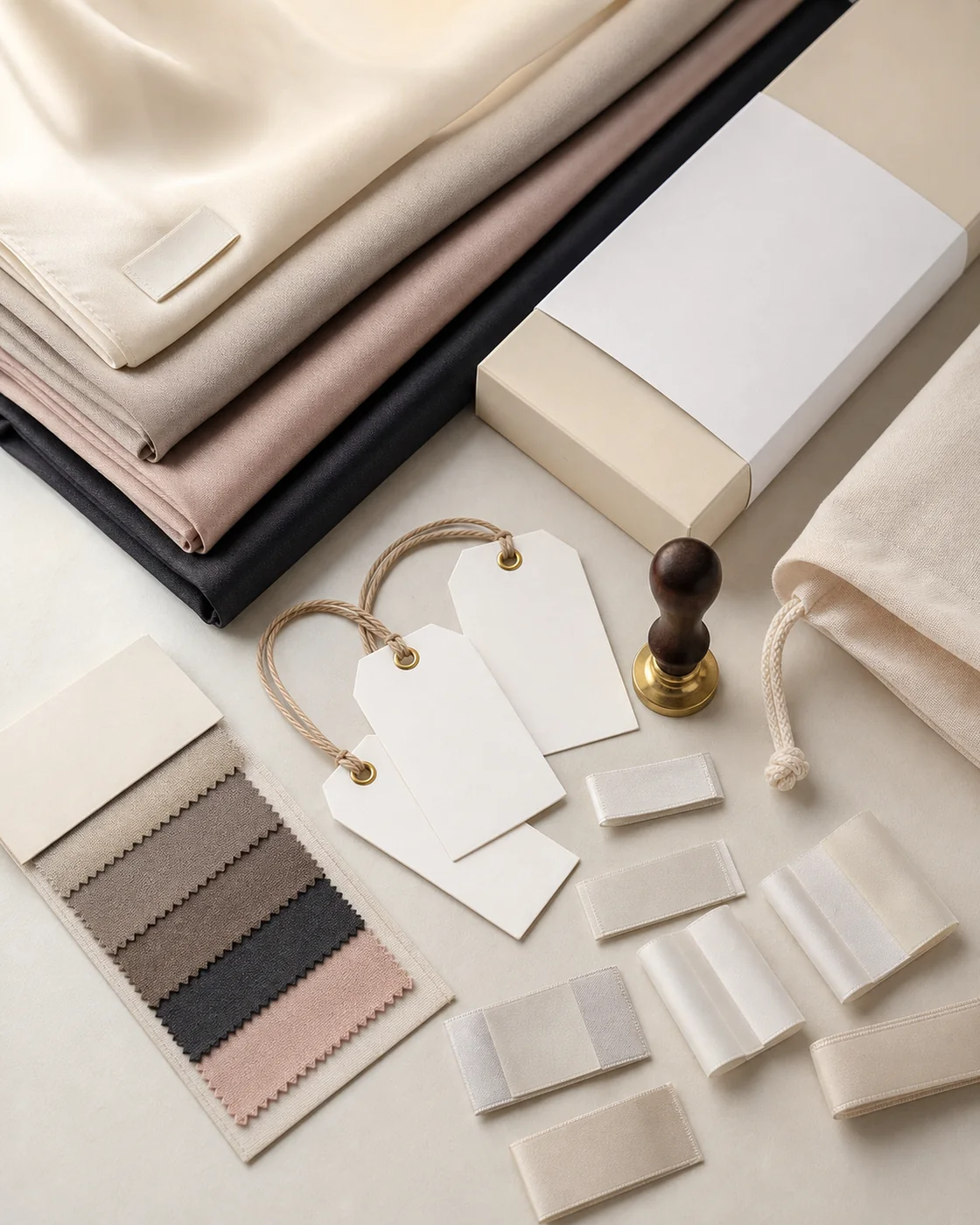
How Should Labels, Packaging and SKU Data Stay Consistent?
Use one approved product-to-packaging matrix that maps each hijab style and color to its product label, care label, hang tag, barcode, unit pack and carton record.
Variable information should be generated or checked from the same SKU master rather than retyped independently for every component. Similar color names and visually close products increase the risk of correct goods entering incorrect packaging.
During sample approval and final review, scan or read the code where relevant and compare the physical product with the purchase order and packing list. Record mixed, missing or duplicated components by SKU and carton.
How Can Buyers Maintain Branding Consistency on Reorders?
Retain the approved product sample, label samples, artwork files, color references, content copy, packaging sample, SKU map and revision history. A reorder should reference this controlled set rather than a screenshot or old email description.
Confirm whether any fabric, label substrate, print process, thread, adhesive, packaging material, supplier or legal content has changed. An intentional change needs a new revision and, where relevant, a new sample.
Previous approval provides a baseline but does not remove batch variation or the need for current review. Keep recurring issues separate from isolated defects so the next inspection can focus attention appropriately.
Common Mistakes When Ordering Custom Hijab Labels
- Requesting “a logo label” without defining its role.
- Selecting a method before confirming the hijab fabric.
- Approving a component separately but not on the finished hijab.
- Using “small” or “near the corner” instead of dimensions and placement.
- Expecting screen colors to match yarn, ink, thread and packaging automatically.
- Ignoring the reverse side, edge, backing or skin-contact point.
- Putting too much fine text into an unsuitable format.
- Copying composition or care content from another product.
- Failing to verify destination-market information and language.
- Mixing logo, label and packaging revisions.
- Changing branding after quotation without reviewing cost and timing.
- Using one barcode or SKU across different variants by mistake.
- Not retaining approved samples and files for reorders.
- Assuming every manufacturer offers every branding method.
A Buyer’s Decision Framework for Label and Logo Methods
Choose the method by moving from product requirements to evidence, not from a catalog name to a purchase order.
- Define the role: permanent brand identity, product information, inventory control or removable presentation.
- Define the fabric: composition, construction, weight, stretch, surface, drape and care direction.
- Define the visual result: discreet, dimensional, integrated, information-rich or packaging-led.
- Define comfort: contact position, reverse side, stiffness, edges and movement.
- Prepare artwork and copy: controlled files, dimensions, placement, colors, languages and SKU data.
- Confirm feasibility: ask the manufacturer which methods suit the specified product and quantity.
- Compare quotations: use the same specifications, inclusions and delivery basis.
- Approve a finished sample: inspect branding on the actual hijab and in its package.
- Freeze the revision: connect the final sample, files and specification to the order.
- Inspect and archive: verify execution and retain records for reorders.
When selecting a production partner, use the broader hijab manufacturer buyer checklist to assess communication, sampling, specifications and order control alongside branding options.
Custom Hijab Branding Buyer Checklist
- Identify every brand, care, SKU, tag and packaging component.
- Define which components remain on the product.
- Confirm the target fabric and finished construction.
- Assess weight, drape, stretch, surface and comfort risks.
- Prepare controlled logo artwork and final label copy.
- Confirm artwork rights and trademark responsibility.
- Specify finished size, face, orientation and placement.
- Define colors with codes and physical approval references.
- Confirm target-market information and languages.
- Map every component to the correct product and SKU.
- Ask which methods are feasible for the project.
- Confirm how branding affects quote, MOQ and schedule.
- Approve proofs and a complete physical sample.
- Record sample code, revision and approval date.
- Include labels and logo points in the QC checklist.
- Inspect product, branding and packaging together.
- Archive files, samples and records for the reorder.
Turn the Branding Choice Into a Production Brief
The right starting point is not “add my logo.” It is a brief connecting the target customer, fabric, finished hijab, brand presentation, required information, artwork, label or logo method, packaging, quantity and market.
Review NoorSilk’s OEM and private-label hijab manufacturing route for a custom project, or the wholesale hijab route when evaluating existing product directions. The guide on starting a hijab brand can help organise the wider launch plan, while the comparison of ready-stock and custom-made hijabs clarifies how much branding and product control each route may require.
Prepare a comparable branding request
Ready to discuss a private-label hijab project?
Share the product and fabric, preferred label or logo method, dimensions, placement, colors, packaging, quantity, target market and reference artwork. Feasibility, MOQ, pricing and timing can then be confirmed for the actual specification.
Request a Private-Label QuoteDiscuss Label and Logo Options on WhatsApp