Buyer Guide
Custom Packaging Options for Private Label Hijabs
Private-label hijab packaging should be selected on more than appearance. Wholesale buyers need to balance product protection, branding, shipping volume, fulfillment, packaging MOQ, unit cost, SKU labeling and retail presentation. A rigid box may strengthen gift positioning and unboxing, while a compact pouch, sleeve or paper-based system may be more practical for everyday ranges or an early-stage launch. The best option depends on product, folded size, sales channel, destination, order structure and the job the packaging must perform.
Direct answer
What packaging options can be used for private-label hijabs?
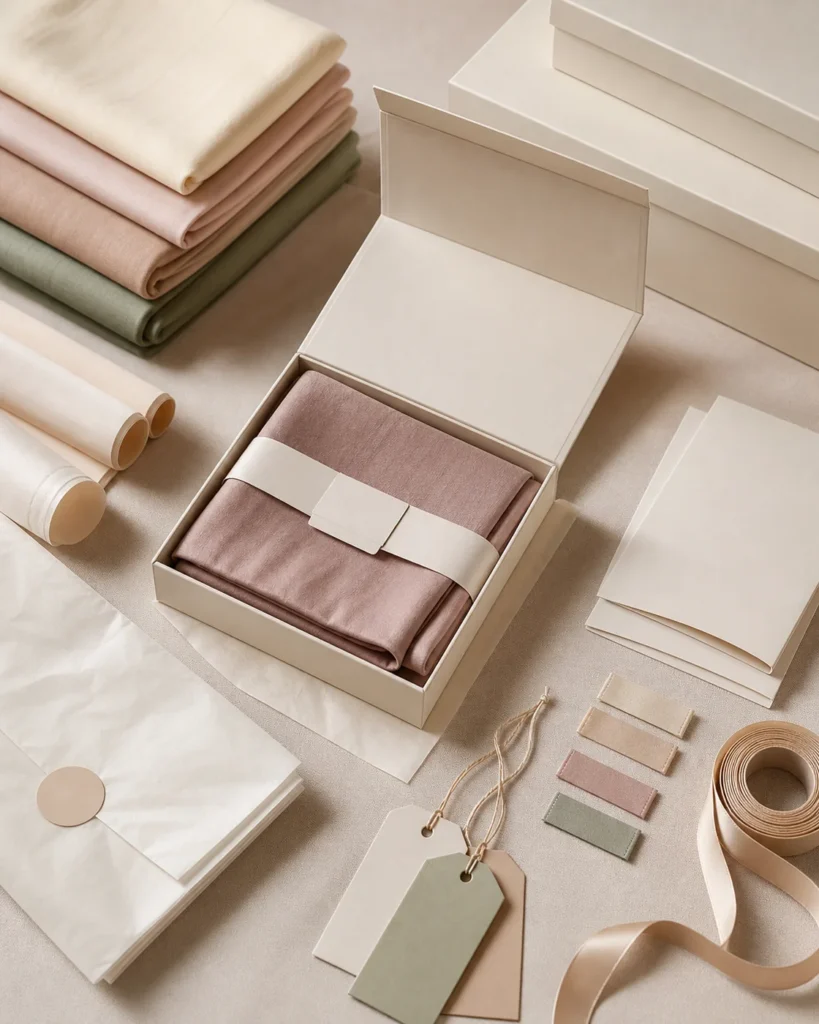
Options can include simple individual bags, reusable or zipper pouches, paper sleeves or belly bands, tissue and cards, folding cartons, rigid or gift boxes, e-commerce mailers and outer shipping cartons. Buyers should compare protection, branding area, product fit, SKU control, storage, packing labor, shipping volume, separate component MOQs and physical samples—not choose by appearance alone.
What Does Private-Label Hijab Packaging Include?
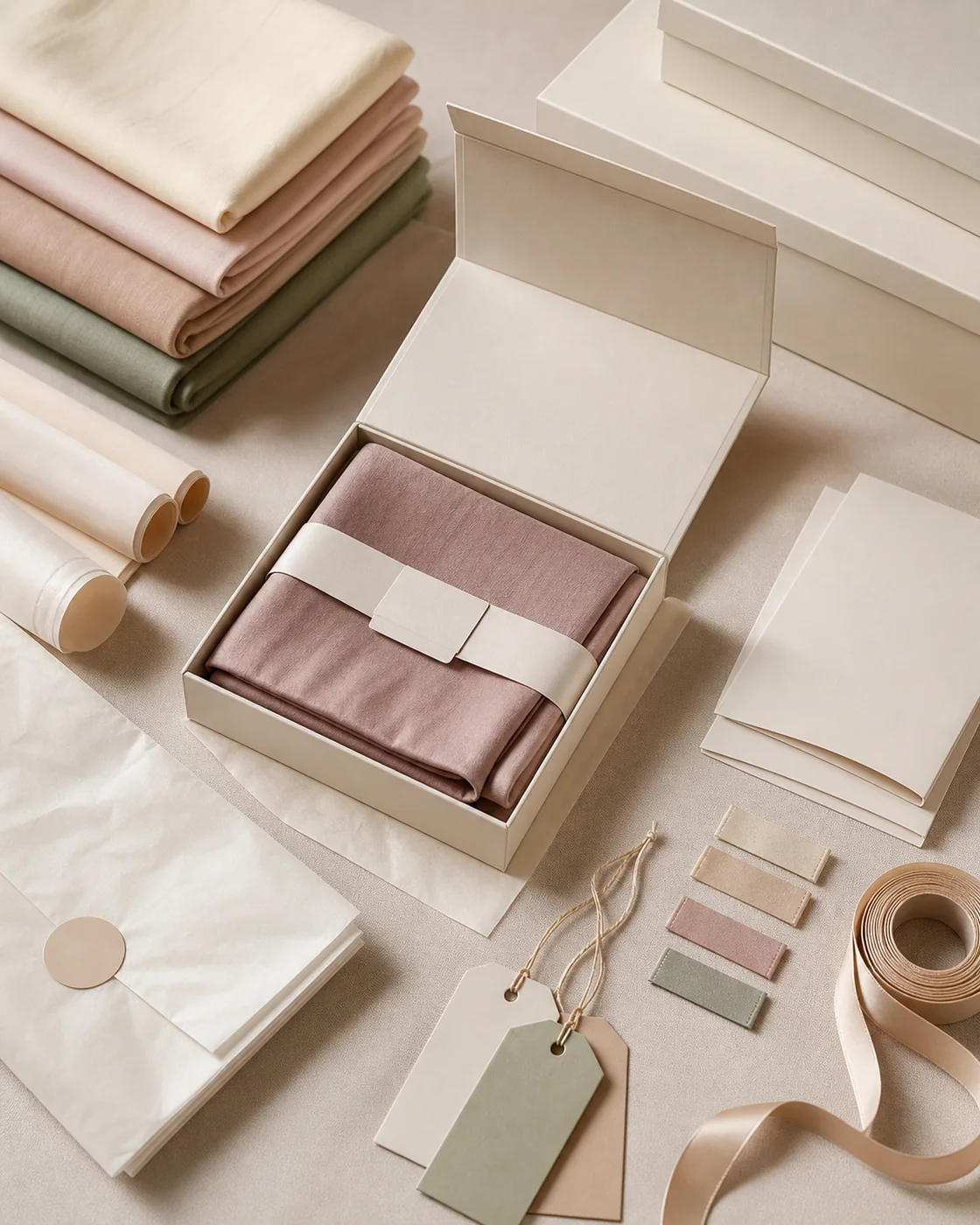
A packaging system can have three layers. Primary packaging directly contains or wraps the hijab. Secondary or retail packaging supports presentation, product information and display. Shipping packaging protects units through storage and transport.
| Layer | Examples | Main task | Buyer decision |
|---|---|---|---|
| Primary | Individual bag, pouch, tissue or direct wrap | Contain and protect the product | Contact material, closure and fit |
| Retail/secondary | Sleeve, band, card, carton or gift box | Present, identify and communicate | Artwork, barcode, display and assembly |
| Shipping | Mailer, inner pack and master carton | Protect and organize during delivery | Density, carton plan, marks and carrier needs |
What Should Hijab Packaging Actually Do?
Packaging should protect the product, identify its SKU, present the brand, support retail or e-commerce operations and fit the shipping method. It is an operational decision as well as a branding decision.
A beautiful pack that causes crushing, barcode errors, wasted carton space or slow fulfillment is not a complete solution. Start with the product journey—from packing and storage to customer opening—then assign each layer a job.
Simple Individual Bags
Clear, frosted, paper-based or other simple unit bags can be lightweight, compact and easy to store. A transparent or labeled surface can help SKU visibility, while a printed or stickered option can add identity.
Review material, product contact, closure, ventilation or moisture considerations, puncture and tear resistance, label adhesion, target-market information and actual protection. This guide does not claim that NoorSilk offers any specific bag type; availability must be confirmed for the order.
Zipper Pouches and Reusable Pouches
Pouches can provide a larger branding area, organized storage and a reusable format, but thickness, closure, dimensions and structure can add unit cost and shipment volume.
“Reusable” describes intended repeated use; it does not automatically prove a lower environmental impact. Evaluate material, likely reuse, durability, production quantity and end-of-life route before making a sustainability claim.
Paper Sleeves, Belly Bands, Tissue and Wrapping
A sleeve or belly band can carry logo, product name, collection, barcode and basic information without the space of a full box. It can suit a minimal system when the underlying product still has adequate protection.
Tissue can separate products and create a gift-like presentation, with a sticker or print where appropriate. Account for packing labor, consistency, ink or dye contact, material cost and whether the wrap survives fulfillment. Do not let decorative tissue replace necessary protection.
Product Cards, Insert Cards and Hang Tags
An insert can carry brand story, care summary, QR code, social details or a thank-you message. It does not replace information that must appear on the product or regulated label in the destination market.
A hang tag is attached to the product and can support identification and retail communication; an insert sits inside the package and supports storytelling or instructions. Specify each separately. The guide to custom hijab labels and logo methods explains the broader branding system.

Folding Cartons, Rigid Boxes and Gift Sets
A folding carton can support retail display and brand visibility. Define board direction, thickness, structure, printing, dimensions, assembly and storage. A rigid box can create stronger structure and gift positioning, but may increase unit cost, packaging MOQ, weight, storage and dimensional volume. It is not automatically the best option.
For multi-hijab sets, plan internal layout, separation, color identification, box dimensions, cards and transport protection. The number of pieces depends on the commercial offer; there is no universal set size.
Mailer Packaging for E-Commerce
An attractive inner pack does not replace shipping protection. The outer mailing bag or box should address moisture, tearing, crushing, closure, carrier labels and barcode visibility in the expected route.
Test the complete pack, not just the product box. A premium carton may still need void control or an outer layer; a compact unit pouch may need a stronger mailer.
Retail Packaging vs E-Commerce Packaging
| Factor | Retail | E-commerce | Buyer consideration |
|---|---|---|---|
| Presentation | Shelf, rack or counter visibility | Unboxing and product condition | Where is the first customer contact? |
| Protection | Handling and display | Carrier sorting, compression and moisture | Test the actual route |
| Barcode | Scanning and price/SKU placement | Fulfillment plus carrier-label separation | Avoid covering operational codes |
| Storage | Display footprint and back-room space | Pick-face density and mailer storage | Measure assembled and flat formats |
| Cost/volume | Retail readiness may justify structure | Shipping efficiency may carry more weight | Compare landed operational effect |
Packaging for Wholesale Distribution
Decide whether boutiques or distributors need retail-ready individual packs, bulk inner packs or products intended for repacking. Define the final customer, unit identification, pieces per inner pack, SKU separation and master-carton arrangement. Avoid adding retail packaging that the distributor will immediately discard unless it serves protection or identification.
How Packaging Affects Shipping Cost
Shipping can depend on actual weight, dimensional weight, carton size, packing density, destination and transport method. Even light product packaging can reduce shipping efficiency if it increases volume.
Compare the number of saleable units per carton and the protected packed volume, not only the packaging unit price. Do not estimate freight without route, carton and carrier information.
Packaging Size and Product Fit
The pack should fit folded hijab dimensions, fabric thickness, number of pieces, inserts and needed protection. Oversized packaging increases volume and movement; an overly tight pack can compress the fabric, create creases or strain closures.
Approve the fold and product orientation together with the package. If inserts or labels are added later, recheck the fit.
How Fabric Type Affects Packaging
Chiffon may need surface and snag protection; silk or satin surfaces may need friction and marking review; jersey can occupy more folded volume; cotton volume changes with construction and weight; fluid modal needs a controlled fold and recovery check.
These are evaluation directions, not guarantees. Review the actual fabric and finished product using the guides to chiffon types, silk versus satin, jersey behavior, cotton and blends and modal drape.
Color Transfer and Packaging Contact
For light products, review contact with dark printed tissue, inks, colored packaging and moisture. This does not mean a material will transfer color; it means direct-contact combinations should be evaluated through appropriate samples or compatibility checks.
Logo, Branding and Packaging Color
Branding may use print, sticker, sleeve, card, foil, embossing or debossing where feasible, but this article does not claim NoorSilk offers every method. Confirm capability for the specification.
A brand color can appear different on paper, plastic, fabric, ink and foil. Pantone or another reference helps communication but cannot guarantee identical visual color across materials. Approve physical results and follow the Pantone color-matching process.
Barcode, SKU and Multi-Color Collections
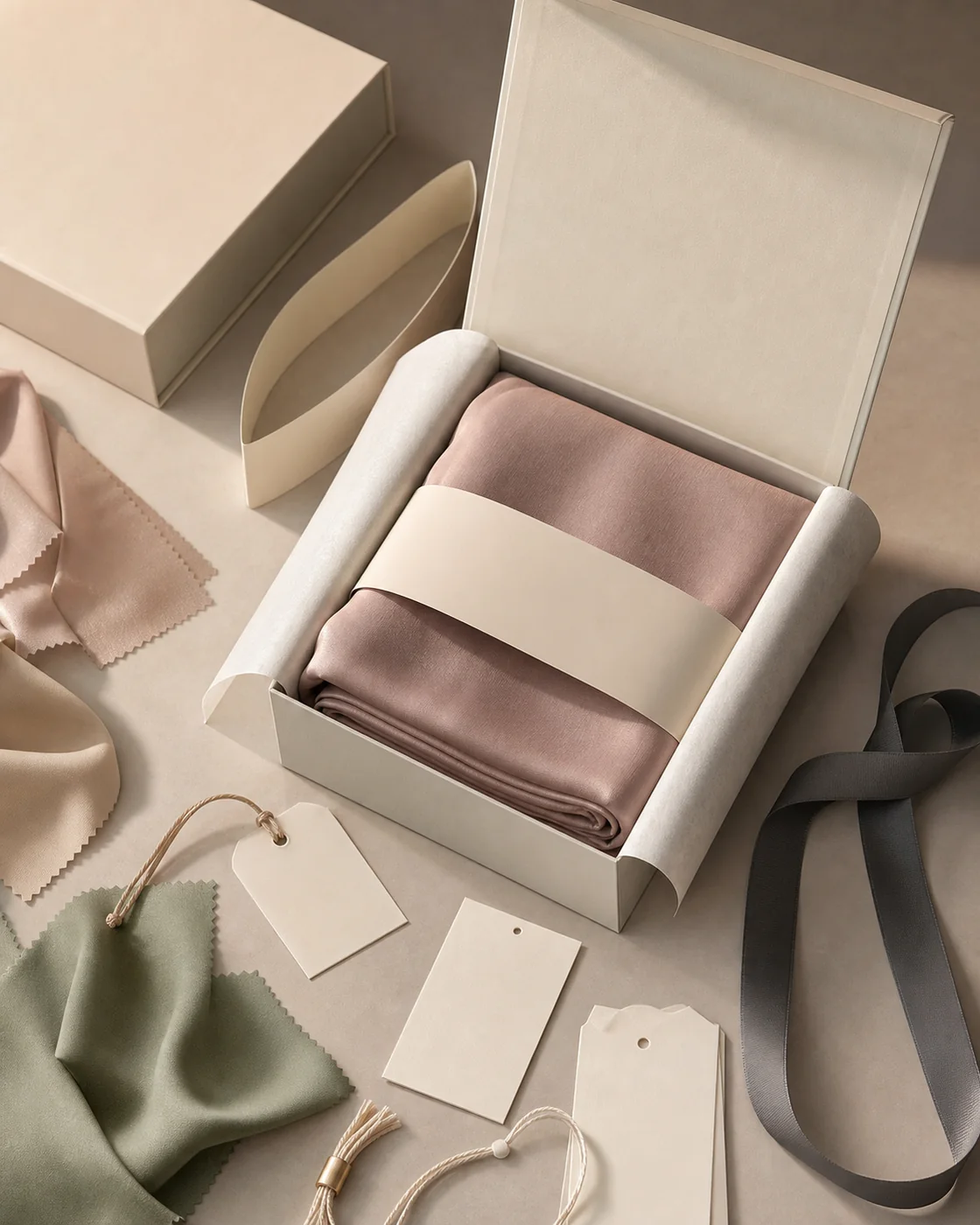
Packaging may need SKU, barcode, product code, color name, collection, quantity and size where relevant. The mapping must agree with inventory, purchase-order and fulfillment records.
When many colors use visually identical packs, differentiate them with a controlled color sticker, SKU label, barcode or product code as appropriate. The wholesale hijab color-assortment guide explains how color growth multiplies SKU complexity.
How Packaging Affects MOQ, Unit Cost and Setup
Product MOQ and packaging MOQ may be different. A box, bag, sticker, card, sleeve or hang tag can come from a separate component supply chain with its own production threshold. Meeting the hijab quantity does not prove that every custom component has the same MOQ.
Unit cost can vary with type, material, dimensions, print colors, finish, inserts, tooling where applicable, quantity, assembly and shipping volume. Setup may involve printing preparation, plate or tooling, dieline, sample or artwork, but not every process charges every item. Request a specification-based quote and use the guide to wholesale hijab pricing and unit cost.
| Cost driver | Why it changes complexity | Buyer check |
|---|---|---|
| Structure/material | Changes production, protection and storage | Confirm exact construction |
| Dimensions | Affects material use and shipping volume | Test product fit |
| Print/finish | Adds files, setup and process steps | Define colors and finish |
| Components | Cards, labels and inserts add sourcing and assembly | List each inclusion |
| Quantity | Each component may have a separate MOQ | Map component quantities to the order |
Should a New Hijab Brand Invest in Premium Packaging?
There is no universal answer. A market test or small launch may benefit from functional packaging with clear branding and low operational complexity. Gift positioning, higher order value or retail presentation may justify a more structured pack.
A risk-controlled path can begin with functional protection, add a sticker or insert, develop a pouch or sleeve, then consider boxes when evidence supports them. Brands do not need to follow this sequence. Compare with planning a small test collection and choosing ready-stock or custom-made hijabs.
Packaging for Premium Collections
Consider material feel, structure, finish, color, gift suitability and protection. Premium does not mean “more packaging.” A coherent, well-fitted and consistently executed system can be stronger than multiple decorative layers with no operational purpose.
Sustainable Packaging Claims: Be Specific
Recyclable, recycled content, reusable, compostable and plastic-free describe different attributes. Recyclable depends on material and available collection systems; recycled content describes input; reusable describes repeated use; compostable requires defined standards and conditions; plastic-free does not automatically prove a lower overall impact.
Use claims only with supplier evidence and a target-market review. Do not label packaging “eco-friendly,” “green” or “sustainable” as an unsupported general claim, and do not imply NoorSilk certifications that have not been confirmed.
How to Prepare Packaging Artwork
Control logo file, copy, barcode, SKU, dimensions, dieline where applicable, bleed, safe area, print colors and version number. Packaging artwork differs from textile print artwork even though both require version control.
A dieline is a layout template showing cut, fold, bleed, safe area and print placement. Some simple packaging may not require a complex dieline; confirm the supplier’s template before finalizing art. The principles in artwork preparation help with file discipline, not packaging construction.
How to Approve a Packaging Sample
Check dimensions, product fit, material, structure, print, logo, text, color, barcode, SKU, closure, folding, protection and customer presentation on a physical sample. A digital mockup cannot confirm material, structure or fit.
Connect the sample to an artwork revision and packaging specification using the hijab sample-approval checklist. During bulk production, verify correct version, print consistency, SKU, damage, folds, cards, labels and carton organization; the wider framework belongs to the wholesale hijab quality-control checklist.
Outer Carton and Shipping-Carton Planning
Record pieces per carton, inner packs, carton dimensions, gross and net weight, carton marks, SKU separation and protective arrangement. These fields prepare the link to a later guide on international wholesale shipping without replacing route-specific packing decisions.
Common Custom Hijab Packaging Mistakes
- Choosing only by appearance.
- Using oversized boxes or packs that are too tight.
- Ignoring dimensional shipping volume.
- Missing SKU identification or mixing packaging versions.
- Artwork errors, excessive copy or an unreadable barcode.
- Approving only a digital mockup.
- Not testing folded-product fit and contact materials.
- Using unverified sustainability claims.
- Investing heavily before validating product demand.
- Not saving the approved specification and sample.
Custom Hijab Packaging Comparison
| Type | Branding | Protection | Shipping efficiency | Typical use | Buyer consideration |
|---|---|---|---|---|---|
| Simple bag | Label, sticker or print | Depends on material/closure | Generally compact | Everyday unit pack | Contact, tear and information needs |
| Zipper pouch | Larger branded surface | Structure varies | Thickness can add volume | Storage/reuse proposition | Durability and claim evidence |
| Paper sleeve/band | Visible compact identity | Needs underlying protection | Compact | Minimal retail presentation | Fit, scuffing and barcode |
| Tissue + card | Story and gift feel | Limited alone | Compact but labor-dependent | Unboxing/presentation | Consistency and contact |
| Folding carton | Full print area | Structure depends on board/design | May ship flat before assembly | Retail/gift | Assembly and storage |
| Rigid box | Strong premium presentation | More structure | Can add weight/volume | Gift/premium range | MOQ, storage and freight |
| Gift-set box | Collection storytelling | Needs internal layout | Depends on set design | Multi-piece offer | Separation and identification |
| E-commerce mailer | Outer or inside print | Designed around shipping route | Optimize to full pack | Direct fulfillment | Moisture, tear, crush and labels |
Relative cost complexity depends on material, quantity, specification and route; the table is not a price ranking.
How to Choose the Right Hijab Packaging
| Priority | Possible direction | Confirm before choosing |
|---|---|---|
| Low shipping volume | Compact bag, wrap or sleeve may fit | Protection and product contact |
| Premium gift presentation | Structured carton or box may fit | Demand, storage and shipment volume |
| New-brand testing | Simpler modular packaging may reduce complexity | Brand clarity and unit protection |
| Retail shelf | Retail-ready branded pack may matter | Display, barcode and retailer needs |
| E-commerce | Protection and shipping efficiency carry more weight | Full packed-route test |
Custom Hijab Packaging Checklist
- Define sales channel, customer use and packaging purpose.
- Confirm folded dimensions, fabric behavior and piece count.
- Select type, material, closure and protection.
- Confirm logo, copy, color, barcode, SKU and inserts.
- Confirm finished package dimensions and product fit.
- Confirm packaging MOQ separately from product MOQ.
- Compare component cost, assembly and shipping volume.
- Review a physical sample and final artwork.
- Lock the packaging version and inspect bulk execution.
- Save sample, files and specifications for reorder.
Packaging Specification Sheet
| Field | Record |
|---|---|
| Identity | Product code, SKU, packaging type and revision |
| Construction | Material, dimensions, closure and quantity per pack |
| Artwork | Logo file, text, print method, colors, dieline and version |
| Operations | Barcode, color label, insert, hang tag and folding method |
| Carton | Pieces per carton, inner packs, dimensions and marks where applicable |
| Approval | Physical sample reference, revision number and approval date |
Turn the packaging choice into a private-label brief
Share the hijab, fabric, folded size, sales channel, brand position, packaging direction, artwork, SKU structure and quantity so feasibility and quotation can be reviewed for the actual project.
Explore private-label hijab manufacturing Discuss packaging requirements